




Returning guest Marisa Buxbaum brought us Powder Burns, the 2006 album by the Twilight Singers, because a chance college discovery became a lifelong connection. We returned to it with different baggage: years of loving the Afghan Whigs, expectations about what came next, and an argument about how much sound a great song needs. Want to bring YOUR favorite lost album to the table? Suggest it for a future episode.

What if the album you struggle with is exactly what somebody else needs?
That question sits underneath our entire conversation about Powder Burns. We hear muscular riffs, desperate singing, beautiful songs, and arrangements that sometimes seem determined to occupy every available inch of the speakers. Whether that last quality pulls you closer or keeps you outside turns out to matter a lot.
But before the mixing argument, there is a CD in a crate on a college campus. Its cover catches somebody’s attention. It goes back to a dorm room, supposedly to soundtrack some cleaning. Within a few songs, the cleaning stops.
That is the kind of discovery we keep making this show to talk about. Not simply finding a good record. Finding a record that seems to recognize you.
The Album You Find Before You Know the History
We spend a lot of time approaching records through other records. We know the earlier band, the famous album, the lineup change. By the time we press play, we have already built a little courtroom in our heads.
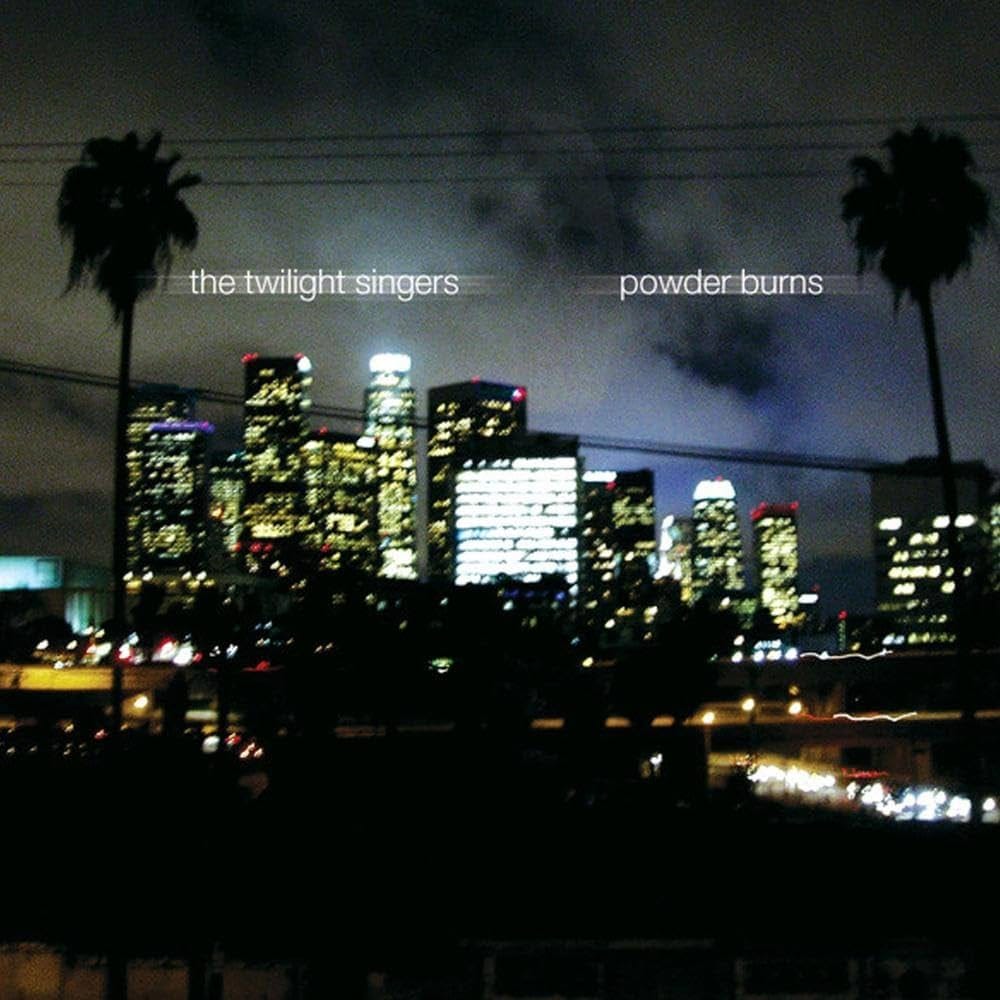
Marisa’s introduction to Powder Burns bypassed all of that. She did not arrive knowing Greg Dulli, carrying an opinion about his previous work, or wondering how this compared with a favorite Whigs album. She bought the CD because its nighttime city imagery felt familiar, then discovered the music behind it. The connection was immediate. The Whigs came afterward.
For those of us who entered through the earlier band, that reverses the usual map. Suddenly the Twilight Singers are not the next chapter in somebody else’s story. They are the center, and everything else branches outward.
We need perspective. We had been excited by the original Twilight Singers collaboration with Shawn Smith and Happy Chichester. When that configuration changed, and the Whigs were gone too, we carried some disappointment into the music that followed. That was baggage, not a flaw embedded in the songs.
Revisiting the album means acknowledging both things: the expectations were real, and they were not necessarily useful. You can spend years asking why a record is not the thing you wanted, while somebody else is hearing exactly the thing they needed.
A Record Made While the World Was Coming Apart
Powder Burns arrived through One Little Indian in 2006, co-produced by Dulli and Mike Napolitano. Its recording stretched across several cities, including New Orleans before and after Hurricane Katrina. Some sessions continued with generator power in the storm’s aftermath. This was not simply a dark record assigned a dramatic backstory later. The circumstances were there while it was being assembled.
That does not make every song a coded history lesson. The more useful connection is between public devastation and private collapse. In our conversation, we kept returning to the way the album lets those experiences illuminate each other: damage, dependency, shame, and the possibility of finding a way forward. The arrangements are often gorgeous without making the emotional situation pretty.
There is a temptation with Dulli to hear the swagger first and stop there. The dangerous character. The cinematic one-liner. The person who seems to know exactly how bad this evening might become.
But swagger can be camouflage. On this record, the bravado does not always hold. Need comes through it. So does exhaustion.
We found ourselves connecting Powder Burns with 1965, but not because they deliver the same experience. Think of one as the party and the other as the hangover. The connection makes the later record feel less like a detour and more like a reckoning with what the earlier good time left behind.
When the Songs Get Bigger Than the Speakers
The opening sequence wastes little time. “Toward the Waves” lasts 49 seconds before “I’m Ready” arrives. That brief threshold matters: the record gives you just enough time to step inside, then starts moving the furniture.
We hear Dulli’s songwriting operating at a remarkably high level here. The muscular guitar parts remain, but piano, strings, keyboards, prominent bass, and layered voices give the songs a broader emotional vocabulary. The voice can sound heartbroken, angry, confused, or desperate without becoming shapeless. Even the phrasing has a rhythmic intelligence that keeps the drama moving.
The credits help explain the crowded rooms. Ani DiFranco sings on “Bonnie Brae,” “Candy Cane Crawl,” and the title track. Joseph Arthur contributes vocals to three songs. John Curley plays bass on “Candy Cane Crawl,” while Greg Wieczorek drums on much of the album. There are real string players alongside Dulli’s synthesizer and Mellotron parts, so not every sustained texture is coming from the same kind of instrument.
What we hear is not simply an earlier band with extra decoration. It is a project that can assemble its cast around a particular song, more like a director choosing the people a scene requires. That freedom is part of the appeal. It also sets up the argument about whether the finished picture leaves enough room to see everybody in it.
Bring your own listening history into the conversation. Join the Dig Me Out community to vote in future album polls, add your ratings, and get into the Discord discussion. Those votes help decide which records become full episodes and companion posts.
Swagger, Collapse, and the Songs That Change With You
“Forty Dollars” is a useful test of how you listen to Dulli. On the surface, we hear attitude and movement, the confidence of somebody who can turn a small phrase into a whole scene. Underneath, our conversation hears something much less comfortable: the language of affection tangled up with the need for a chemical escape. The performance can sound playful while the situation is anything but.
“Candy Cane Crawl” offers a different kind of release. We hear it as a torch song, a place where the scale of the arrangement serves a bruised, exposed center. It is also a reminder that these songs have lives beyond their studio versions. A remembered live performance, Dulli dropping to his knees and leaning into the song, becomes part of how the recording is heard afterward.
Then the record takes turns that keep it from becoming one long mood. The title track’s waltz-like motion inspired a Russian folk-dance comparison in our discussion. “My Time (Has Come)” brings a surprisingly pop-facing energy, with handclaps and a lift that stands apart from the surrounding darkness. That song and “The Conversation” were co-written with Manuel Agnelli of Afterhours.
The closer, “I Wish I Was,” brings us back to tenderness. Dulli has described it as addressing New Orleans as a woman, and that framing gives its consolation a specific destination.
What stayed with us was the possibility that your most important song on an album can change. The track that meets you in one difficult period may not be the one you need years later. The record stays the same. You bring a different life to it.
Great Songwriting Does Not End the Mixing Argument
Here is where admiration stops being agreement.
I still find Powder Burns muddy. That is not shorthand for disliking ambition, strings, keyboards, or big arrangements. The individual ideas often work. My problem is the space between them, or the lack of it. I hear Dulli’s songwriting and personality, but I sometimes struggle to hear the distinct identities of the other players.
That distinction matters. A band performance gives you small, human things to follow: a guitarist’s touch, a drummer’s decisions, the way one instrument answers another. When the layers become a single mass, I lose some of that electricity. The slower songs attract me partly because they create room for intimacy.
We do not all experience the density as an obstacle. It can also feel like the speakers are barely containing the emotion, which is exactly the point. The same accumulation that obscures an instrument for one listener can make the whole song overwhelming in the best way for another.
Even our strongest defense of the album does not require pretending that instrumental overlap never happens. The question is whether the songs carry it. Here, the argument is much more interesting than simply declaring the sound good or bad.
The band’s later history adds another layer of distance. Its final studio album to date, Dynamite Steps, followed in 2011; the 2023 collection Black Out the Windows gathered this body of work into a retrospective box. Marisa contributed an essay to its accompanying book. That makes this conversation more than a return to a favorite CD. It is also a look at what a whole era of music has come to mean.
The Verdict: What Do You Need This Record to Do?
The outside response helps explain why Powder Burns still inspires this level of devotion. In his contemporary Pitchfork review, Stephen M. Deusner focused on the album’s heightened musical and emotional stakes, hearing danger and consequence that felt newly human. AllMusic likewise emphasized the force of the music. Neither response requires treating it as a modest side project.
Our community’s reaction was not completely uniform, either. We heard enthusiasm from listeners who place it alongside the best of Dulli’s catalog, but also a dissenting response from someone who enjoyed moments of the music and could not connect with the vocals. That is worth keeping in the conversation. A voice that makes one person feel understood can keep another person outside the door.
We came away weighing extraordinary songwriting against the experience of hearing it through all those layers. The full episode gets into where that balance finally lands, without requiring everyone to have arrived through the same band or the same decade.
Does the density make this album more emotionally convincing, or less immediate? Which song has changed most for you over the years? And did you find Dulli through the Whigs, the Twilight Singers, or somewhere else entirely?
Listen to the full episode for our final verdict, then drop a comment with the song that still gets you every time. If there is another record we should be arguing about, suggest it for a future episode or community poll. Member participation changes what we make next.
Episode Highlights
04:11: Finding Powder Burns: A campus CD purchase becomes a life-changing first listen.
06:51: Twilight Singers first, Whigs second: How your entry point changes the music.
09:46: The original project: Dulli, Shawn Smith, Happy Chichester, and the early history.
15:55: Recording around Katrina: New Orleans and the album’s wider geography.
26:27: Revisiting old baggage: Expectations, songwriting, and hearing the album again.
38:04: Beauty at rock bottom: The tension between lush music and personal collapse.
43:33: “I’m Ready”: Why the opening sequence hits differently.
44:12: “Powder Burns”: Waltz rhythms and unexpected grandeur.
48:20: The muddy-mix debate: When layers obscure the musicians.
66:03: Final verdicts: Our assessments and the community response.
70:36: 1965 and Powder Burns: The party and the hangover.


