




For plenty of listeners, Blues Traveler remains trapped in a very specific mid-90s frame: John Popper’s harmonica, “Run-Around” in permanent radio rotation, “Hook” cleverly explaining how pop songs work while becoming one itself. Those singles were huge, and they earned their place. But they can also make the earlier records seem like a prologue nobody needs to hear.
That is exactly why Travelers & Thieves is worth reopening.
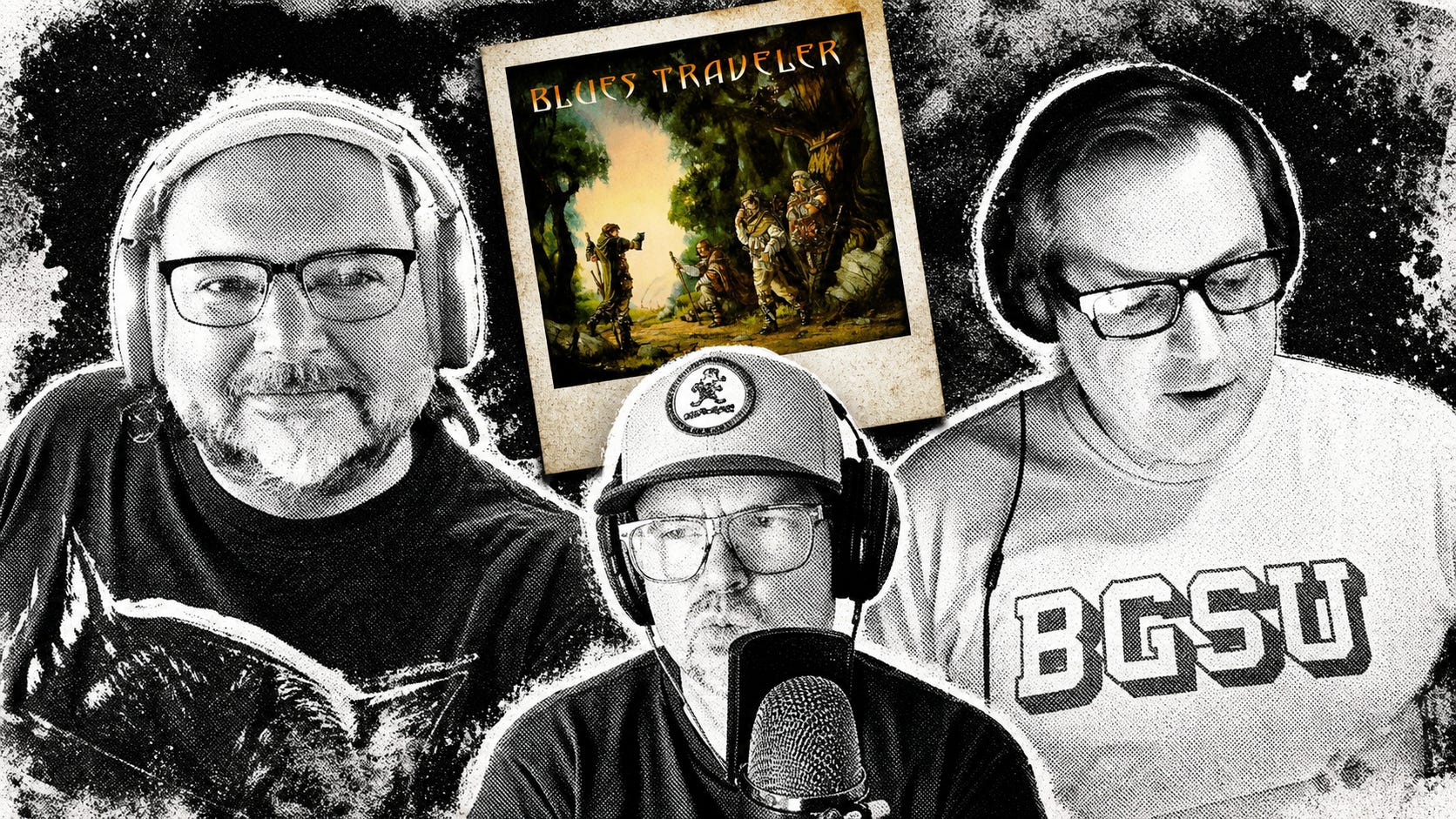
Released September 3, 1991 on A&M Records, it was the band’s second album, produced by Jim Gaines with the band itself. John Popper, guitarist Chan Kinchla, bassist Bobby Sheehan, and drummer Brendan Hill sound less like a future mainstream success story than a working unit testing its internal chemistry.
Board of Directors member Patrick Testa brought this one to us partly because Blues Traveler has long been filed under bands people are tired of, dismiss, or never explore beyond the two ubiquitous singles. That dismissal misses the real tension of this record. Travelers & Thieves is not built like a polished radio machine. It is a band caught between hook-minded rock songs, loose improvisational instincts, bluesy detours, reggae-colored rhythms, funk workouts, and a little progressive-rock ambition.
The record opens with “The Tiding,” a short ambient throat-clearing that feels almost suspiciously grand for a band often reduced to a harmonica vest and a pop chorus. Then “Onslaught” arrives with a bass-forward, shifting approach that immediately complicates the caricature. This is not the Blues Traveler most people think they know.
It is a band in motion, sometimes thrillingly so.
Bobby Sheehan Is the Engine
The obvious star of Blues Traveler is Popper. The voice is unmistakable, the harmonica technique is absurdly fast, and the stage persona is large enough to become the whole story. But the deeper we got into Travelers & Thieves, the clearer it became that Bobby Sheehan is the album’s foundation.
His bass playing is everywhere. It is active without merely showing off, melodic without losing the groove, and often responsible for making a song feel like it is moving in several directions at once. On “Onslaught” and “Ivory Tusk,” the lines have an almost fretless, flowing quality, a little closer to the kind of melodic low-end work that made Pearl Jam’s Jeff Ament such a defining presence on Ten than to the expected roots-rock thump.
That activity is the source of both the album’s power and its friction.
When the band locks, the players create a fabric rather than a traffic jam. Bass lines coil around guitar figures, the drums keep the pulse nimble, and Popper’s rapid vocal phrasing becomes another rhythmic instrument in the arrangement. “Support Your Local Emperor” is one of the clearest examples. The bass does not simply support the song. It establishes the architecture, while Popper answers and reacts inside its movement.
That is the kind of band interplay Patrick loves most. For him, the apparent competition is actually connection, the same way the Allman Brothers Band could make two drummers, multiple guitar voices, and extended improvisation feel like one living organism.
But it is also where the record can make a listener work. There are moments when Popper’s dense, rapid-fire vocal delivery, Sheehan’s busy bass, and the rhythm section’s constant activity create a lot of information at once. If you want a giant chorus to grab you by the collar, Travelers & Thieves can feel elusive. If you want to hear four musicians build a song from interlocking parts, it is rich with detail.
The Slow Songs Tell the Story
The surprise on Travelers & Thieves is how often the quieter material carries the strongest emotional weight.
“Sweet Pain” gives Popper more room than the faster, denser cuts. Instead of turning his voice into a blur of cadence and syllables, the song lets him stretch out, reveal more tone, and lean into a chorus with real lift. The contrast between verse and chorus is sharper here. The arrangement breathes. You can hear the song gathering itself rather than simply moving forward.
That same sense of clarity makes “Support Your Local Emperor” stand out. Its relative restraint does not make it less ambitious. It makes the musical decisions easier to hear. The bass, vocal, and rhythmic ideas stop fighting for attention and begin to feel like parts of a single shape.
Then there is “Mountain Cry,” the record’s long closing piece and perhaps its most revealing collision of Blues Traveler’s goals. Gregg Allman appears on Hammond B3 organ and vocals, bringing a direct connection to the Southern-rock and jam-band lineage hovering around the record. Chris Barron of the Spin Doctors also appears elsewhere on the album, on “All in the Groove,” another reminder that these bands were not separate commercial categories yet. They were friends, peers, and products of overlapping scenes.
“Mountain Cry” is not flawless. The performance is more interesting than tidy, and the guest vocal does not always land with the force its pedigree promises. But the song matters because it shows the band reaching for something bigger than a clever groove or a potential single. It is bluesy, extended, and emotionally exposed.
That is the version of Blues Traveler we kept coming back to: the band that slows down long enough to let the songs become more than a display of skill.
A Jam Band Before the Label Fit
Blues Traveler was not yet the giant they would become when Travelers & Thieves arrived. Their breakout was still years away. “Run-Around,” from 1994’s four, eventually hit No. 8 on the Billboard Hot 100, an unusually massive crossover result for a band associated with improvisation and the jam scene.
That later success changes how we hear this earlier album. It makes Travelers & Thieves feel like a record from a band that had not yet learned which parts of itself would sell.
The conventional story says Blues Traveler became successful when they found cleaner pop structures. There is truth in that. “Run-Around” and “Hook” are more direct, more concise, and easier to enter than the material here. Their choruses are clearer. Their shapes are less likely to wander. Even listeners who do not identify as jam-band fans can hear why those songs connected.
But Travelers & Thieves makes a different case for the band. It shows that the group’s range was broader than the radio version suggested. The songs can sound like alternative rock one moment, New Orleans-inflected roots music the next, then funk, reggae, blues, and something close to jazz fusion. That reach is not always equally convincing. When the record pushes into funk or reggae, it can feel more like a stylistic experiment than an inhabited identity. When it leans into more open-ended fusion textures, some of us wanted a little more grit and less polish.
Still, the willingness to try all of it is what keeps the record interesting.
This was also the era in which Blues Traveler helped launch the H.O.R.D.E. Festival, a touring environment built for artists who did not fit neatly into the dominant alternative-rock, metal, or pop lanes. Its name stood for Horizons of Rock Developing Everywhere, and its lineups eventually included artists as varied as Phish, The Black Crowes, Lenny Kravitz, Ben Folds Five, Wilco, and Soul Coughing.
The point was bigger than any one band. H.O.R.D.E. created a place where improvisation, roots music, college-rock instincts, and left-of-center songwriting could coexist. Travelers & Thievessounds like it belongs to that opening moment, before the categories hardened.
Great Players, Uneven Drama
The record’s central limitation is also the price of its personality.
There is an enormous amount of musicianship on Travelers & Thieves. Popper can make the harmonica sound like a lead guitar, particularly in the speed and articulation of his runs. Kinchla is an inventive guitarist. Sheehan is constantly finding new paths through a measure. Hill stays alert to every turn.
Yet great playing does not automatically create drama.
For us, the faster songs can sometimes occupy a narrow dynamic space. Everyone is engaged, everyone is playing, everyone is offering something, but the record does not always create the sharp contrasts that make an album feel emotionally inevitable. We wanted more light and dark, more room between the notes, more moments when the band either got truly ugly or truly beautiful.
“I Have My Moments” demonstrates the tradeoff. It has one of the album’s most memorable hooks, but its vocal density can bury the very thing you want to carry away. “What’s for Breakfast” works better as a funk-oriented track because the band commits to the pocket and keeps returning to the center of the groove. “Bagheera,” meanwhile, is an enjoyable song that may be the easiest candidate for trimming if you are building the leaner version of this album.
The album is most compelling when it makes a choice. “Sweet Pain” chooses emotional space. “Support Your Local Emperor” chooses a strong internal structure. “Mountain Cry” chooses scale. “Onslaught” chooses movement.
Those choices are more interesting than a band simply trying to prove it can play.
The Verdict Is in the Tension
Travelers & Thieves is not the hidden masterpiece that makes every later Blues Traveler record irrelevant. It is better than that kind of claim, because it is a complicated record from a complicated band.
It catches a young group before the hits, when its musical vocabulary was wide open and its identity had not settled into the version radio would eventually reward. There are riffs and grooves here that deserve more credit. There are songs that feel like sketches for a more decisive future. There are moments where the density becomes exciting, and others where it becomes hard to enter.
That is the fun of the conversation.
Was Blues Traveler more compelling before it became a hitmaking band? Does Bobby Sheehan deserve to be remembered as one of the defining bass players of that era’s roots-rock explosion? Is “Sweet Pain” the emotional center of the album? And when you hear Popper’s rapid vocal phrasing, do you hear clutter or an instrument playing a different role in the band?
We have our full assessment in the episode, but this one is worth arguing about. Listen for the complete verdict, then drop a comment with the Travelers & Thieves track you would keep, cut, or make the case for.
Episode Highlights
00:14: Patrick Testa returns, and brings a deliberately challenging Blues Traveler pick
04:13: Why Travelers & Thieves, not the debut or 1994’s four
13:39: The album’s lineup, Jim Gaines production, and guest appearances from Gregg Allman and Chris Barron
16:35: H.O.R.D.E. Festival, and where Blues Traveler fit in the 90s touring ecosystem
23:20: Bobby Sheehan’s bass work becomes the center of the discussion
30:10: Why “Sweet Pain” and the slower songs reveal a different side of John Popper
36:59: The trouble with limited dynamics, busy arrangements, and buried hooks
44:07: “Mountain Cry,” Gregg Allman, Southern-rock grit, and the record’s biggest swing
50:29: Patrick’s H.O.R.D.E. Festival memories, including a remarkable side-stage jam
1:06:50: Final ratings, favorite tracks, and the case for an EP-length version of the album


