



Darren Leeman, long-time Dig Me Out community member, selected Who’s Tommy Cooper for this episode, a record he remembered from his teenage years only by a chorus that haunted him for eight months before he tracked down the CD online. Want to nominate your own lost album? Suggest it here.
A 1996 active rock radio hit with zero Spotify listeners thirty years later. Reacharound were British expats working Silverlake rehearsal spaces and playing shows with the Sex Pistols reunion, Cheap Trick, and Reverend Horton Heat, all on the strength of one single. “Big Chair” was the most-added track on modern rock radio for one week in August 1996. Then the band dissolved, the album vanished, and the story ended before most people knew it began.
Patron Darren Leeman brings this one to the table: a record he remembered only by a melody stuck in his head, which sent him on an eight-month search before he found the CD online. The result is a 43-minute genre sprint through British punk, rockabilly, power pop, and 60s mod, the kind of album that sounds like The Living End meets The Kinks with a Reverend Horton Heat detour midway through. If you respond to Super Drag or The Who at full volume, this record has something for you.
The album is not on streaming. You will need to find the CD. The discussion of why it vanished, what the album title means (it involves a British comedian who died on live television in 1984), and whether the back half holds up to the front half is all in the episode.
The Joke Americans Never Got
Here is one of the great “only-makes-sense-if-you’re-British” inside jokes ever pressed onto a major label record. Tommy Cooper was a six-foot-four Welsh prop comedian and magician who wore a red fez, performed tricks that appeared to fail (the failure was the joke), and died of a heart attack live on national television in 1984 at the age of 63. The studio audience at Her Majesty’s Theatre kept laughing as he slumped to the stage, because they assumed the collapse was part of his act. He was beloved across Britain. He was unknown in America.
When the members of Reacharound arrived in Los Angeles from the UK in the early 1990s and mentioned Tommy Cooper to Americans, they got the same blank stare every time. “Who’s Tommy Cooper?” That question, repeated back to them at enough bars and rehearsal spaces in Silverlake, became the title of their only album. The inside art of the CD depicts a stage with a curtain and a pair of shoes poking out below it, a visual eulogy that only sharpens the joke. In the pre-internet era of 1996, this title was a total void to American listeners. Walk into a record store, see a CD called Who’s Tommy Cooper, and you had nothing to go on. In the streaming era, you could Google it in five seconds and land on something genuinely poignant. The band picked the wrong decade for the bit.
The album name was the second-least commercially savvy decision they made. The first was the band name itself: a studio joke made during a rehearsal session that the drummer shouted at a Warner executive during a showcase. The rep loved it. It stuck. Frontman Matt Caisley later went on record saying he genuinely regretted it, noting that the name made the band hard to find. Their previous names, Medicine Show and The Great Unwashed, suggest a band with a cheerful gift for sabotaging their own marketability.
The Song That Should Have Launched a Career
The origin of “Big Chair” is almost too perfect. Around 1994, the band was on the verge of splitting as Medicine Show, rehearsing in a Silverlake space they could barely afford. Dusty Wakeman, best known at the time as Dwight Yoakam‘s producer, heard them through a wall. He told them not to break up. He offered to record five songs for free. The first song they tracked was a three-chord argument Caisley had written about a fight with his girlfriend. It was called “Big Chair.”
The song found its way onto college radio and then into rock programmers’ hands. In August 1996, it peaked at #22 on the Radio & Records Active Rock chart. For one week, it was the most-added track on modern rock radio, with pickups at WXRK New York, WBCN Boston, and Q101 Chicago. Cash Boxcalled the album “a stunning, fierce mix of nasty, instantly memorable rock and roll that goes from metal to rockabilly to Sex Pistols-y old time punk in one graceful, effortless swoop.”
That is a real critical response, from a real trade publication, about a record that currently has zero monthly Spotify listeners.
What makes “Big Chair” hold up is that it sounds nothing like a record that would have zero Spotify listeners. It opens with Caisley’s harmonica cutting through the mix like a switchblade, drops into a locked guitar-and-bass groove that would make The Living End jealous, and lands on a chorus so blunt and memorable that listeners were still humming it eight months after they had last heard it. That is not a hypothetical: one fan tracked down the CD online three decades later specifically because the chorus surfaced unbidden in his memory, with no band name attached. He had to work backward from a YouTube search for “Big Chair song” to find out who wrote it.
What the Record Actually Sounds Like
Who’s Tommy Cooper opens with “Big & Mean,” a bouncy, swaggering track that immediately establishes the band’s thesis: British punk energy filtered through rockabilly precision and power pop songwriting, delivered with more authority than anyone at a Trauma Records showcase in 1996 had any right to expect. The Kinks are audible. The Who are audible. The Clash surface on the harder edges. The drums, played by Adam Maples, who had previously worked with Legal Weapon and the Sea Hags before landing in Reacharound, swing exactly when the song needs swinging and lock down exactly when it needs locking.
The A-side is nearly flawless by any power-pop metric. “Big Chair” is the hit. “Nearest Bridge” turns surprisingly dark subject matter into something almost sunny, a tonal trick that should not work but does. “Hole in My Soul” is a punk freight train with the harmonica riding on top. “Then You Go” pulls the tempo down to a slow delta blues burn without losing any of the grit. “Seen It Before” is where the record tips its hand about what year it was actually built for.
“Seen It Before” is a 60s-soaked power-pop track with a Who-like stomp and an Elvis Costello melodic sensibility: the kind of song that sounds like it wandered in from 2001 by mistake. When the garage rock resurgence arrived and made Jet famous, Reacharound had already recorded the template. They were Jet before Jet. The Mooney Suzuki, who made that same 60s throwback energy fashionable in the early 2000s, essentially picked up where “Seen It Before” left off, five years after Reacharound had already put it down.
“Gene Autry,” a short whistling-driven psychobilly detour that sounds exactly like Reverend Horton Heat on a ranch, works as a midpoint palate cleanser. The back half drifts toward Southern rock on “Fools & Horses” (Black Crowes riffs planted firmly in a 1975 British hard rock context) and atmospheric delta blues on the overlong “Hand in My Pocket,” which would benefit from being half as long. Production consistency also starts to slip: “Shaking Like a Leaf” sounds live-ish, “Caught Up With Myself” sounds stripped down, and the overall sonics shift in ways that dilute the tight identity the first seven tracks built so convincingly. The B-side energy drop is real, even if the individual songs are not without merit.
What holds the whole record together despite the back-half wobble is Caisley’s voice: a rasp with just enough pitch control to land a hook, rhythmically precise in a way that ties the vocal identity across every genre pivot. The band sounds like the same band on every track, whether they are doing punk, rockabilly, or slow blues. That is harder to achieve than it sounds.
The Guitarist Who Went Somewhere Else
The most legible trace Reacharound left on music history runs through their guitarist, Ted Hutt. After the band dissolved, Hutt eventually found his way into Flogging Molly as a player, then pivoted to production, where he became one of the more respected rock producers of the 2000s and 2010s: Flogging Molly’s Drunken Lullabies, Dropkick Murphys‘ Going Out In Style, The Gaslight Anthem‘s The ‘59 Sound, multiple records by Old Crow Medicine Show. His production discography contains a Grammy winner and several Billboard top-10 debuts. His band has zero Wikipedia page and zero Spotify listeners.
The band’s collapse has a clean narrative: Interscope pushed them toward a Radiohead or U2 sound for a second album. They wrote 30 songs in a rehearsal room, seven days a week. Hutt fell in love with The Verve and tried to pull the band toward the Britpop orchestral direction. Caisley, who had built the band on “punky British invasion type of songs,” found himself recording material that, as he later said, “wasn’t me.” The label told him he didn’t mean it. He agreed. He quit the band.
No manager, no second single, label manipulation on tour expenses, a creative split at the exact wrong moment. The band lasted two years. The 30 unreleased songs have never surfaced.
Why It Vanished (And Why It Matters That You Find It)
The touring history of this band is, in retrospect, hilarious given their subsequent obscurity. They opened for the Sex Pistols reunion at Red Rocks. They went on the road with Cheap Trick. They toured with Reverend Horton Heat, who were good to them, though the Reverend’s crowd found Reacharound too poppy for their taste. They played with Korn, Fun Loving Criminals, Luscious Jackson, and the Butthole Surfers. They were everywhere in 1996, and then they were nowhere.
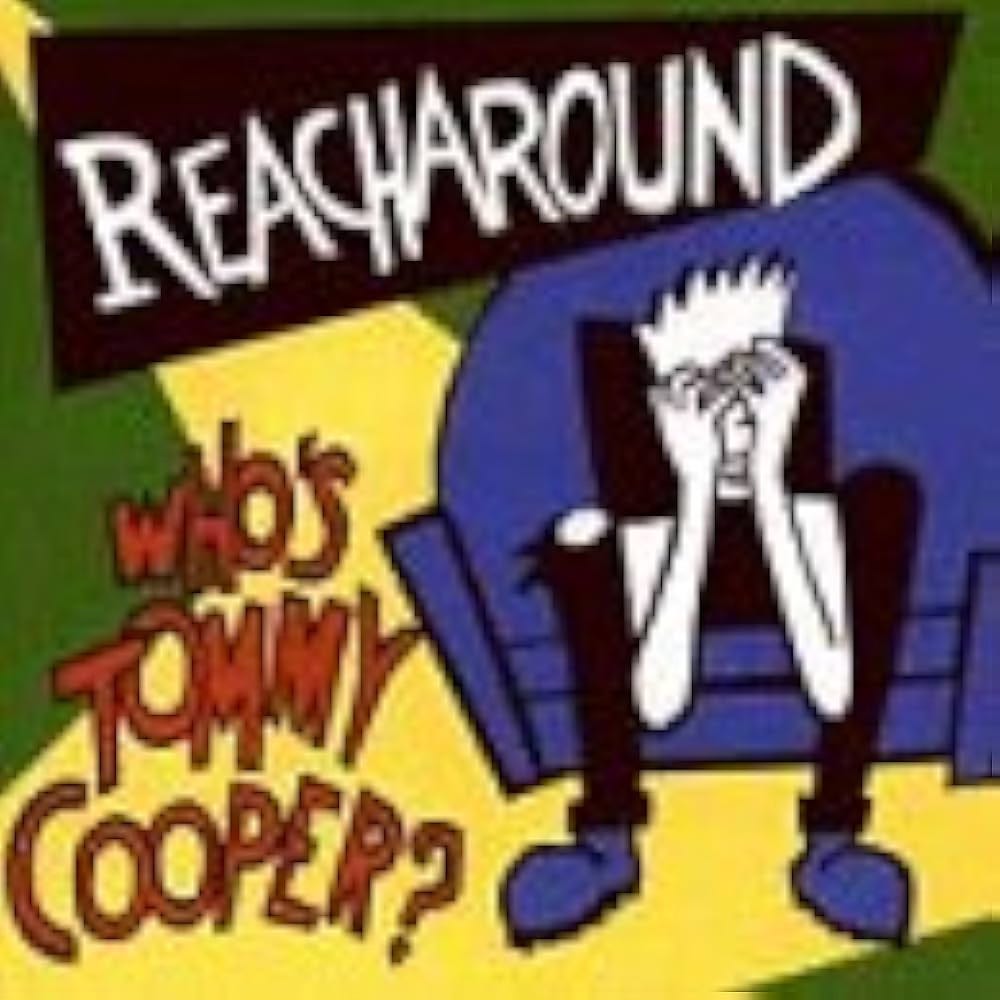
The album cover did not help. The font choices and color palette read as ska, not punk rockabilly, and in 1996 those were two very different market positions. There was no manager to point out that the album name was a British inside joke, the band name would create search problems before search engines existed, and the artwork looked like it came with a two-step and a horn section.
Caisley, after the band ended, worked at a restaurant for a time and felt embarrassed when patrons recognized him. He had, by his own account, felt like a failure. The music does not support that self-assessment.
The question Who’s Tommy Cooper? turns out to have a longer answer than the band intended: a British comedian who died on live television, yes, but also a record that reached #1 most-added on active rock radio and then disappeared so completely that its most comprehensive recent coverage is a podcast episode from 2026. The irony is not lost on anyone paying attention.
You can find Who’s Tommy Cooper on Discogs for a few dollars. You can stream the full album on YouTube. Whether the hosts and fans who revisited it agree it holds up as a Worthy Album, a Better EP, or something else. What do you think: is this a lost classic, a promising near-miss, or exactly the kind of album that should have broken through in 2001 instead of 1996? Leave a comment. Find the CD. And look up Tommy Cooper while you’re at it.
Episode Highlights
Intro: Album overview and Darren Leeman’s patron pick: a record he ordered online after the chorus of ‘Big Chair’ popped into his head eight months earlier
1:53: Who was Tommy Cooper?: the life of British prop comedian Tommy Cooper, who died of a heart attack live on television in 1984 while the audience laughed thinking it was part of his act
8:32: Band history: Reacharound’s origin story: notes from a 2016 Hustle podcast interview with frontman Matt Kaisley, from near-breakup to college radio hit, the band name joke that stuck, and producer Dusty Wakeman recording their first songs for free
10:58: Touring, label troubles, and breakup: Reacharound toured with Sex Pistols, Cheap Trick, and Reverend Horton Heat but had no manager, only one single, and were pushed by Interscope toward a Radiohead sound that fractured the band
18:29: Patron comments: community members praise the album, compare it to Reverend Horton Heat and the Fireballs, and note the ska-looking album cover is misleading
20:16: Album overview: what works: Hosts describe the album’s core sound of English punk meets rockabilly with power pop songwriting, compared it to The Living End, The Kinks, The Who, and The Clash
22:22: Big Chair: The band’s college radio hit plays, a three-chord song Matt Kaisley wrote about an argument with his girlfriend
26:37: Seen It Before: Track 6 plays and the hosts immediately call out its 60s Who/Kinks energy and note it sounds like something the Mooney Suzuki would release five years later
31:14: Darren’s track-by-track breakdown: walk through all 12 tracks with notes: genre tags, influences spotted, and highlights like Imperial’s Elvis Costello vibe and Hand in My Pocket’s atmospheric slow burn
33:36: Gene Autry: A brief rockabilly/psychobilly track with whistling plays; Darren immediately calls out Reverend Horton Heat, and the hosts love it as a fun mid-album detour
35:02: B-side deep cuts: Fools & Horses and Hand in My Pocket: Discussion of the album’s Southern rock outlier Fools & Horses (Black Crowes comparisons) and the hypnotic, atmospheric Hand in My Pocket, plus debate over whether the back half loses momentum
40:03: What doesn’t work: the production inconsistency and energy drop on the B-side; Hand in My Pocket is too long
44:40: Drummer Adam Maples’ wild discography: the drummer previously played with Legal Weapon and the Sea Hags in the 80s and later recorded with Mark Lanegan, making for unexpected connections to heavier rock history
46:24: The verdict: All three hosts rate it Worthy Album; 75% of the Patreon community agrees, a rare unanimous verdict for an album so obscure it barely surfaces in search results
53:51: What if and what happened next: the album was ahead of its time and might have broken through in 2001’s garage rock moment; discussion of Matt Kaisley’s post-band life and a tangent about a completely different Milwaukee band called The Reacharounds
Join the Board of Directors at dmounion.com to pick your favorite lost album and join us on the podcast.
Have a lost or forgotten album that deserves the spotlight? Suggest it here.
If this hit for you, try these next
The Living End by The Living End (1998): The most direct sonic comparison the hosts make in this episode. Australian three-piece doing the same British punk-meets-rockabilly blueprint, with the same locked walking bass lines and tight two-minute-punch energy. If the A-side of Who’s Tommy Cooper landed for you, this record is the logical next listen.
The Wildhearts: P.H.U.Q. (1995): UK hard rock that pulls from the same metal, power pop, and punk intersection as Reacharound, with big sugary hooks over heavy riffs. The Wildhearts get a mention in the community comments for this episode, and the connection holds up across both records.
Superdrag: Head Trip in Every Key (1998): The retro-60s power pop angle that surfaces on “Seen It Before” and “Imperial” finds its closest equivalent in Superdrag’s approach: Kinks and Who filtered through 90s American college radio with just enough grit to keep it honest.


