



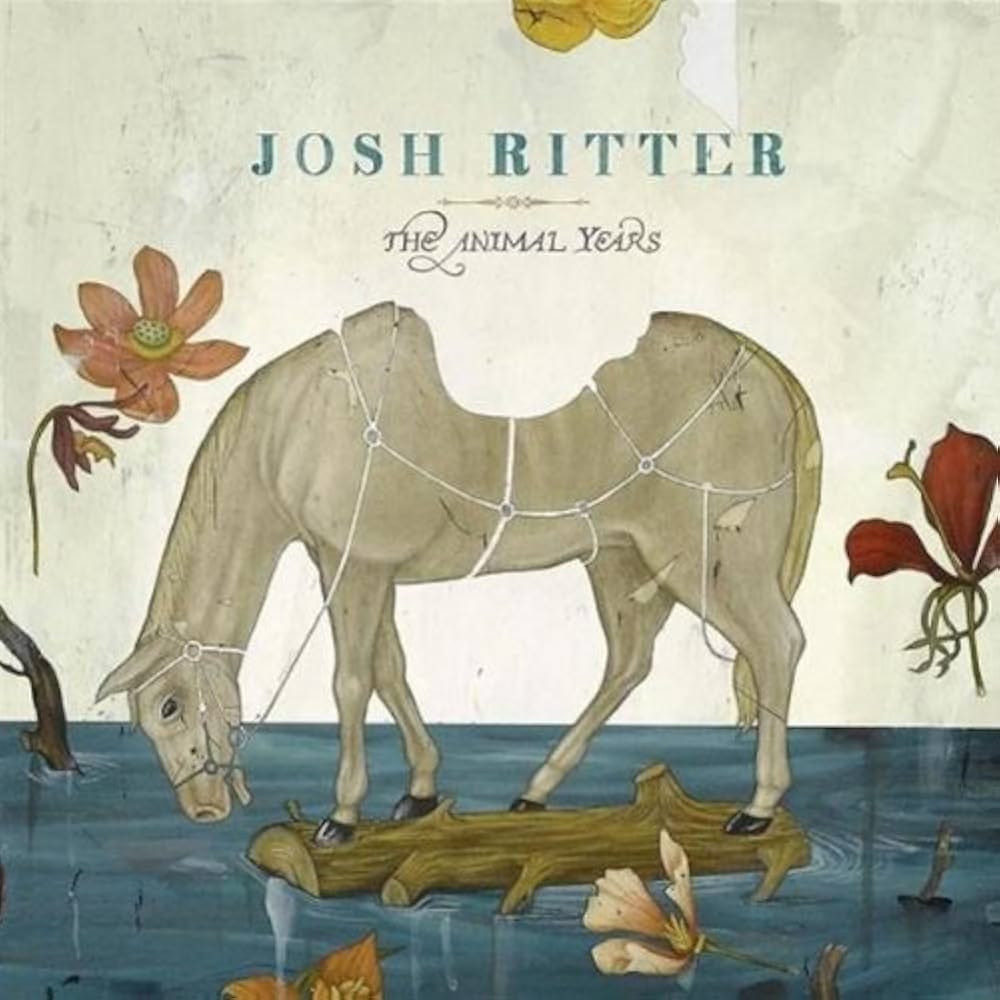
The Animal Years by Josh Ritter was brought to the show by patron Scott Halgrim, a self-described completionist who has been nominating records and absolutely listening to every episode ever since. Scott picked this one for its 20th anniversary, passing on the usual 30th-anniversary fare because this album demanded the spotlight. Want to bring YOUR favorite lost album to the table? Suggest it for a future episode.
From Moscow, Idaho to the Irish Charts
Josh Ritter is not a household name in the American rock conversation. He should be. He grew up in Moscow, Idaho, a small college town in the state’s panhandle: a tiny purple dot in a sea of crimson red. Both of his parents are neuroscientists. When he got to Oberlin College in Ohio, he promptly abandoned the family science track and created his own major: American History Through Narrative Folk Music.
That is either the most pretentious thing you’ve ever heard or the most perfectly calibrated act of self-determination in the history of undergraduate education. Given that it led directly to opening for Bob Dylan, the evidence tips toward the latter.
After Oberlin, Ritter spent time studying at the School of Scottish Studies, moved back to Rhode Island for open-mic nights, and eventually crossed paths with Glen Hansard of The Frames. That connection became a lifeline. Hansard brought Ritter into the Irish music world, and the results were immediate. His third album, Hello Starling, debuted at number two on the Irish charts before Ritter fully understood how big he’d become there. Ireland claimed him before America did.
By the time The Animal Years arrived on V2 Records in March 2006, Ritter had something rare: a passionate audience, critical credibility, and a story that felt like it was still building.
The Sound: A Room, a Piano, and Something Underneath
Credit Brian Deck for knowing what this record needed to be. Deck, who had already produced Iron and Wine and Modest Mouse and had Fruit Bats in his catalog, built The Animal Years around intimacy. Not sparseness. Intimacy.
The difference matters. There is a warmth here that feels like a small club on a Tuesday night, close enough to see the player’s hands but never so close it feels claustrophobic. Sam Kassirer’s piano sits at the center of almost every track, melodic rather than percussive, guiding without dominating. Zack Hickman‘s bass lines have the round, resonant quality of an upright instrument. David Hingerty’s drums are heavy on toms, giving the low-mid range a pulse that keeps the record from floating away into pure atmosphere. And then there’s the Hammond organ, which mostly plays it straight until it doesn’t.
The keyboard presence recalls Bruce Springsteen‘s Nebraska-era approach: not the main event, but the emotional weather underneath. There are echoes of The Jayhawks and Gary Louris in the way the arrangements breathe. Ritter’s voice, chest-resonant and slightly husky, threads through comparisons to Bob Dylan‘s phrasing and John Hiatt’s lived-in warmth. All of those references point at the same thing: this is a record that wears its influences without being consumed by them.
There is also something else in here, if you’re wearing headphones. Listen closely to “Monster Ballads” and you’ll find a synthesizer loop, almost subliminal, buried under the acoustic instrumentation. You miss it on speakers. On headphones it changes the song. That Deck and Ritter hid it rather than featuring it tells you something about their approach to this record.
The Songs: War Dressed as Love
Ritter has said he set out to write about America, and it all kept coming out sounding like a love song. That tension is the engine of The Animal Years.
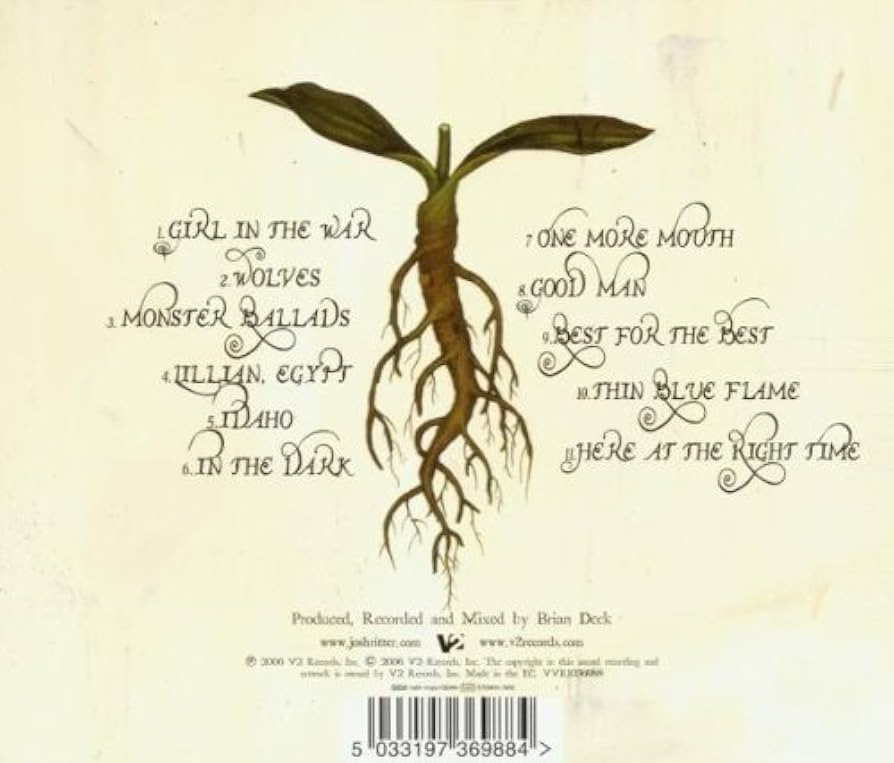
“Girl in the War” opens the album with biblical imagery and wartime dread wrapped in one of the most deceptively singable melodies on the record. “Paul said to Petey, you gotta rock yourself a little harder” is a line that sounds like a folk standard on first listen and reads like an anti-war prayer on the third. Pair it with “Thin Blue Flame” and the album’s anti-war bookends come into focus.
“Thin Blue Flame” is the main event. At nine minutes and thirty-eight seconds, it earns every second. “The days are nights and the nights are long / Beating hearts blossom into walking bombs” is the kind of writing that doesn’t happen by accident. It sits in the lineage of Bob Dylan‘s “Masters of War” and shares something of Bright Eyes‘ orchestral drama on I’m Wide Awake, It’s Morning. The song builds through tom fills and stacked organ chords until it reaches something genuinely dissonant and genuinely cathartic. It’s the one moment where everything goes off-script. A couple more moments like that would have pushed The Animal Years to another level.
“Idaho” does something quieter and equally precise. The lyric about masts turning to cedar trees and wind to gravel roads builds a sense of place so specific it almost aches. It may be the album’s purest sense-of-place moment. “Good Man” delivers Springsteen-esque character writing, grounded in chord changes that feel old and true, with the organ drop a third of the way through standing as one of the most satisfying ten seconds on the entire record.
And “Monster Ballads,” it turns out, is not about monster ballads. It’s about Mark Twain, Huckleberry Finn, and the decline of the Mississippi River steamboat at the hands of the railroad. Ritter even toured in a white suit in Twain’s honor. The album contains more buried literary architecture than its warm, accessible surface suggests.
What Doesn’t Work
The honest critique of The Animal Years is also its most consistent one: it plays it safe.
On first listen, it can feel like vanilla. Nothing reaches out and grabs you. The second half front-loads the ballads, which compounds the album’s natural tendency toward slow burn. “In the Dark” is the one track that’s hard to defend: not bad, just fine. You wish Deck had pushed further in places, treated the drums differently, brought in some affected electric guitar, done something to disturb the record’s considerable comfort. The album earns its Sunday-morning-with-coffee reputation almost too easily.
For some, the record’s warmth might read as distance. The literary depth isn’t announced. You have to come looking for it. And if you don’t? The back half can feel like it’s asking you to meet it more than halfway.
The Verdict
Here’s where things get interesting. The Animal Years scored an 80 on Metacritic and an A- from the A.V. Club in 2006. Twenty years later, the r/JoshRitter subreddit consistently votes it Ritter’s masterpiece by a wide margin, with “Thin Blue Flame” winning a track-by-track poll of the album. Sputnikmusic users have rated it 4.5 out of 5. Albumism ran a 15th anniversary retrospective in 2021 calling it a benchmark.
And yet: a wider mainstream rock audience in 2006 was not listening. The Iraq War surge was coming. Ritter was writing about it before most people were ready. Does that explain the gap between the record’s reception and its reach? Is this an album that landed in the wrong year, or the right one?
The critical consensus and the casual listener experience pull in opposite directions, and that tension doesn’t resolve cleanly. Is The Animal Years a masterpiece that rewards patience, or an album that asks for more than a casual listener is prepared to give? Which song makes the strongest first-impression case for a newcomer? Is “Thin Blue Flame” the kind of nine-minute centerpiece that defines a catalog, or a bold experiment that works better in context than in isolation?
Hit play on this week’s episode to hear where we land. Then drop your take in the comments.
Episode Highlights
Intro: Welcome back to patron Scott Halgrim, who nominated the album
2:01: Josh Ritter’s origin story: From Moscow, Idaho to Oberlin College’s self-invented folk major, to Ireland via Glen Hansard and the Frames
7:23: Career overview and discography: Stephen King’s Entertainment Weekly rave, the Royal City Band, two novels, and a catalog that runs through 2024
9:42: Patron poll reactions: Ian McIver delivers his verdict (’album best forgotten’), Gavin goes in blind and lands on EP
11:04: Production and lineup breakdown: Brian Deck (Modest Mouse, Iron and Wine), Sam Kassirer on keys, and the V2 Records context
12:17: What works, Jason: Piano-forward arrangements, Hammond organ tension, intimate room sound, Jayhawks and Springsteen Nebraska comparisons
17:05: Girl in the War: Opening track clip, Paul, Petey, the dove from above; religious and wartime allegory on display
17:57: What works, Tim: Hidden synth textures in Monster Ballads, war subtext in 2006 Iraq context, Wolves and Good Man as character studies
18:58: Monster Ballads: Ones and zeros bleed, the digital imagery verse that rewards headphone listening
22:34: What works, Scott: Girl in the War and Thin Blue Flame as anti-war bookends; the organ drop in Good Man; Idaho’s cedar-tree lyric as pure sense of place
25:29: Thin Blue Flame: The album’s most explicitly anti-war moment: days are nights, beating hearts blossom into walking bombs
27:09: Idaho and the texture of voice: Chest-y resonance, upright bass warmth, tom-heavy rhythm, why this record sounds closer to John Hiatt than a stripped Americana album
30:40: What doesn’t work: All three hosts: plays it too safe, back half front-loads the ballads, In the Dark is the one track nobody fights for
32:42: Good Man: These chords are old but we shake hands, Springsteenesque character writing in action
37:12: Thin Blue Flame production spotlight: The one moment the record goes off-script: dissonant organ climax, building toms, Bright Eyes comparison
39:46: The verdict: Where the hosts land on the album, and why the patron poll pulled in a very different direction
44:25: Outro: Scott sign-off with a nod to So Runs the World Away
Have a lost or forgotten album that deserves the spotlight? Suggest it here.


