



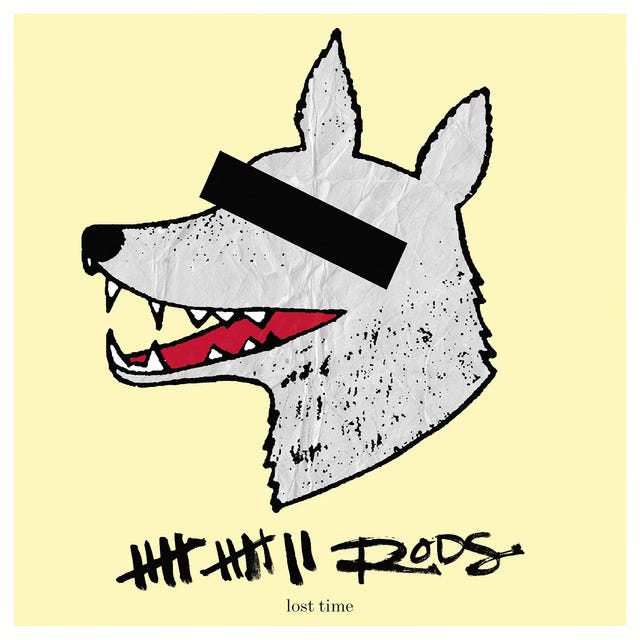
Jeremy Amend has the kind of origin story every record-store kid secretly wants: he walks into a now-vanished Oxford, Ohio shop, grabs a five-dollar self-released EP from a local band he’s only heard whispered about on 97X, takes it home, hits play—and his brain basically gets rewired. That band was 12 Rods, and his long-game obsession with them is how we landed on their 2002 album Lost Time for this episode’s deep dive. Want to put your own long-time favorite (or private obsession) on the table next? You can suggest an album or join our Board of Directors and step up to the mic with your own pick.
The band that didn’t fit anywhere
If you were a Midwest alt-rock kid in the late 90s, 12 Rods were the band that always seemed to be happening just offstage. They started in Oxford, Ohio, with brothers Ryan and Ev Olcott, then bailed for Minnesota—partly, as Jeremy jokes, because Cincinnati already had one “broken out” band in The Afghan Whigs and maybe they needed a different lane. The name came from a children’s Bible storybook, which led some people to assume a Christian band… only to be “sorely upset” when they actually heard the music.
By the time Lost Time arrived, 12 Rods had already ridden a weird little rollercoaster: self-released EP, a debut that earned a 10.0 from Pitchfork, a follow-up album Split Personalities, then the Todd Rundgren–produced Separation Anxieties on V2 Records that tried to nudge them into something poppier and more marketable. The label push didn’t really land, fans were divided, and you can feel Lost Time as both a reaction to that and a reclamation—Ryan taking the wheel back, producing it himself, and leaning into the version of the band that never slotted neatly into emo, pop-punk, or nu-metal, no matter what the poor A&R guy needed to write on the one-sheet.
Smart pop songs, wired for chaos
Spin Lost Time from the top and it’s obvious somebody in this band knows their way around theory and arrangement. Jay hears a little Brian Wilson in the melodic choices—a sense that the vocal lines are hitting less obvious, more sophisticated notes—plus that Ben Folds-ish space where piano pop and clever harmony rub up against each other. But just when you think you’re getting a “smart pop” record, track three blows the doors open and reveals the real game: hooky, carefully constructed songs colliding with aggressive guitars, synths, and rhythm-section choices that feel closer to Shiner, Failure, or Minus the Bear than anything in modern rock radio rotation circa 2002.
Across the album, those two impulses—sugary, almost 60s-pop vocal instincts and jagged, ambitious art-rock—keep pushing against each other in a way that actually works more often than it should. Summertime Vertigo becomes a calling card for how the band uses tension and release, not just in the standard “build to chorus” way but as a constant elastic cycle, with time shifts, pauses, and sudden guitar and cymbal explosions that never quite settle into predictable patterns. Tim hears flashes of Dismemberment Plan’s weirder side, Minus the Bear’s tight, chiming guitar math, and even the technicolor power-pop prog of Jellyfish; when the hooks hit—24 Hours Ago, Accidents Waiting to Happen—they’re “hook city,” big enough to stand beside early-2000s indie and emo but too odd to be filed next to Jimmy Eat World without raising an eyebrow.
It’s also a record that quietly smuggles in jazz harmony and fusion moves: odd chords, augmented voicings, and unexpected harmonic detours that an untrained listener just experiences as “why does this feel so different?” while the theory nerd quietly loses their mind. Tim points out that some tracks flirt with 70s prog (even tossing Genesis into the conversation) but stay more concise and song-focused, like a band trying to see how far they can bend the form without snapping the chorus in half.
The drummer who sounds “wrong” in all the right ways
One of the biggest shifts on Lost Time is behind the kit. Early 12 Rods records leaned heavily on original drummer Chris McGuire’s brute, almost tribal energy; Jeremy remembers that as one of the first things that floored him on the EP and debut. On Lost Time, Dave King steps in, and the whole rhythmic picture tilts. King brings a jazz background and a sense of “wrongness” that feels intentional: the very first real song opens with a stuttering, jazzy fill that sounds like a mistake until you’ve lived with it a few spins and realize, no, that’s the point.
The drums across the album shift constantly—sometimes compressed and distorted to the edge of feeling programmed, sometimes suddenly flipping into very obviously live, organic playing mid-song. Jay admits that kind of inconsistency would normally bug him, but here it becomes part of the fun: one second you’re wondering if you’re hearing a sample, the next it’s undeniably a human drummer throwing off snare fills you rarely hear on rock records. Jeremy suspects there’s more drum programming in spots, plus deliberate overdrive on certain tracks, which adds to the sense of a band willing to mess with their own sonic foundation if it gives a song a new angle.
There’s also a meta-layer: Ryan started out as a drum student, and at one point someone literally asked him to put a band together because there “weren’t enough bands” in Oxford. That drummer’s brain never fully leaves the music. Even when he’s the singer-guitarist-producer, you can feel the songs being built around rhythmic games—hesitations, odd accents, and those little moments where your head keeps bobbing but your brain has to catch up.
Pop instincts, strange lyrics, and the Ozzy thing
For all the time-signature trickery and tonal curveballs, Lost Time lives or dies on Ryan’s voice and melodic through-line. Tim zeroes in on how his vocal sits in this curious middle register—not a soaring high tenor, not a low baritone, more a slightly elevated center that he rides consistently across the record. That consistency is part of what keeps the album from collapsing under its own variety; no matter how wild the arrangements get, you always know who’s singing and what emotional thread you’re following.
Production-wise, Ryan keeps his vocal layered and present but resists the urge to reinvent his persona from song to song; Tim even imagines a version of this record that fails if Ryan had tried to “do voices,” whisper songs, or Nick Cave theatrics. Jeremy shares his wife’s observation that there’s a faint Ozzy Osbourne quality to the delivery—more in the enunciation and phrasing than in any metal theatrics—which he jokes about as “off-brand Ozzy vocals.” Once you hear it, it’s hard to un-hear, but it also explains why the melodies cut through even when the band is being dense or chaotic.
Lyrically, Ryan leans into weird on purpose. On earlier records, he’d write lines that sounded like they came from a kid or junior high notebook, occasionally breaking grammar in a way that feels more like a stylistic choice than ignorance. That sensibility carries over: choruses like Summertime Vertigo’s, which mainly repeats the title, feel like they could have gone further but also reinforce that push-pull between simplicity and complexity. Jeremy nitpicks that one in particular—wishing for an extra line to deepen an already strong melodic and dynamic idea—but still loves the song.
There are also those little listener-mishear moments that stick. For years, Jeremy misheard a line in Terrible Hands as including a homophobic slur instead of “punching bag,” and winced every time, even while knowing Ryan’s actual beliefs didn’t line up with that reading. Only when he finally saw the lyrics did he realize his brain had been filling in the worst possible option, and now he has to consciously remind himself, “Nope, he’s not saying that” every time the chorus hits. It’s a reminder of how much our baggage rides shotgun with us into records—and how fragile that trust between artist and listener can feel.
A record that’s brilliant, and a little “off”
For Jay and Tim, the main knock on Lost Time isn’t the songwriting or performances; it’s the sequencing. The album opens with a short, conceptual instrumental and then drops into a slinky R&B-ish groove that feels like an odd handshake for a band this restless. Once you know what the record contains—24 Hours Ago’s steamroller hook, the new wave shimmer of The Time Is Right to Be Wrong, the nervy jolt of Telephone Holiday—you start to resent that it takes until track three to really feel like the album has started.
Jay’s biggest gripe is that some of the most immediately accessible songs are buried deep in the tracklist, while an experimental piece like Lost and Found is sandwiched between two punchy, new wave–leaning cuts. He doesn’t want anything cut; at 38 minutes, Lost Time is already compact. He just hears a different possible story the track order could tell—one that walks the listener from pop sensibilities into the more challenging territory and then back out again, instead of scattering the extremes across the runtime. Tim even jokes that playing the album backwards actually flows better: you get sharp, high-energy material earlier, then wind down with the weirder intro and closing piece.
Jeremy’s nitpicks are smaller but telling: he finds the single-note keyboard figure in Accidents Waiting to Happen deliberately annoying, like Ev is hammering one key for the entire verse just to poke the listener. He loves the song but imagines a new listener asking, “Can someone please shoot the guy on keyboard?” after 30 seconds of that. He also thinks The Time Is Right to Be Wrong could lose 30–60 seconds of chorus repetition without losing any impact.
But these are the kinds of complaints you only get from people who’ve lived with an album long enough to argue about which 45 seconds to trim. When the poll dust settled, both hosts landed on “Worthy Album,” and Jeremy—despite accidentally fat-fingering “Decent Single” on the Substack poll—sided with them. Some listeners did vote for “Better EP” or “Decent Single,” which Jeremy fully expected; this is a divisive record by design, the kind of album you can imagine annoying your partner on long drives if you blast it too often.
Lost Time as a lost future
Maybe the most bittersweet part of the 12 Rods story is how much potential you can hear in Lost Time and how little the universe cared. Here’s a band with multiple rave reviews (including that infamous 10.0), a Todd Rundgren cosign, a V2 push, and enough musical chops to straddle pop, prog, and indie math-rock—and yet outside of a reissue on Justin Vernon’s Chigliak imprint and a couple of live sets at First Avenue, they never crossed into anything close to mainstream consciousness.
The later history only deepens the “what if”: Ryan attempting tours, then scrapping one due to what he called “insubordination,” pivoting to a solo tour that’s more logistically realistic for a band at this level. The band’s site is still active, complete with merch and a dedication to a keyboardist who recently passed away, underscoring that this isn’t some closed archive—it’s a living, messy, human story that never quite found its economic or cultural lane.
Listening to Lost Time now, you can easily imagine alternate timelines. Maybe they fully double down on the “album as experience” path Jeremy compares to Failure, pushing the adventurous side even harder. Maybe a different producer—Tim floats Ric Ocasek, with his knack for keyboard-driven bands and sharp pop structure—connects with them instead of a distracted Rundgren who, according to Ryan, mostly hit record, worked on crossword puzzles, and told anyone who’d listen that the band basically didn’t need him. Maybe the digital era treats their archive better, instead of leaving some material stuck in low-bitrate purgatory and forcing Ev to scramble with 128 kbps sources and questionable archival decisions just to get the songs online.
What we actually get is this: a 38-minute document of a band that could never choose between being clever and being confrontational, between writing perfect power-pop choruses and throwing rhythmic grenades into the verses, between chasing a broader audience and staying loyal to the strange little universe in Ryan’s head. Lost Time isn’t a tidy career-capper or a cult classic with a clear narrative; it’s the sound of a group that knew exactly who they were musically and never found a world ready to meet them halfway.
Songs in this Episode
Intro - Terrible Hands
17:12 - Fake Magic 8-Ball
21:19 - Summertime Vertigo
26:05 - Boy in the Woods
30:16 - Twenty Four Hours Ago
41:31 - The Time Is Right (To Be Wrong)
Outro - Accidents Waiting to Happen


