




This album was brought to the show by long-time Dig Me Out community member Jeff Gentes, who hand-picked Firewater for a deep dive discussion. Want to bring YOUR favorite album to the table? Join our Board of Directors on Patreon to hand-pick one or two albums from any decade and come on the podcast to break them down yourself. Or suggest an album for our community to vote on in a future poll. If we don’t dig out these albums, who will?
Here’s a question that should bother you: How does a band record with Steve Albini for the better part of a decade, tour with Pavement and Guided By Voices, get signed to Matador Records, and still end up a footnote?
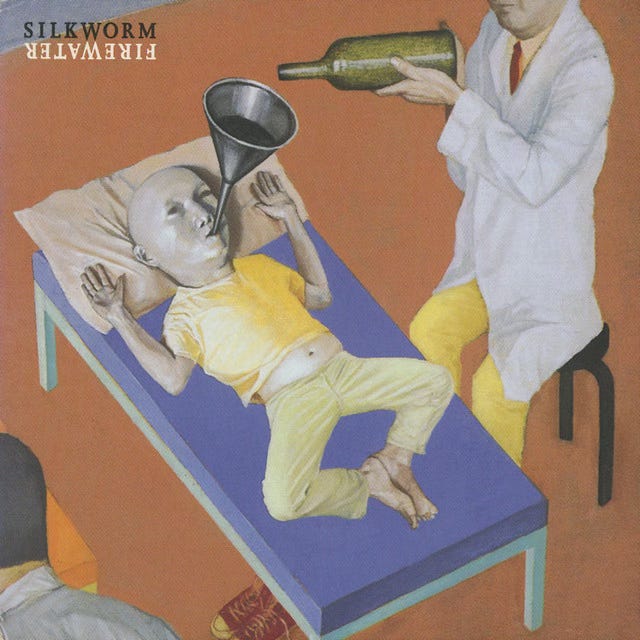
That’s the Silkworm story. And Firewater, their blazing, bleary-eyed fourth album, is the record that makes you wonder what went wrong. Or maybe what went right, depending on how you feel about fame versus integrity.
From Montana to Nowhere (on Purpose)
Silkworm didn’t come out of some scene-blessed city with built-in press coverage. They came out of Missoula, Montana. Think about that for a second. Not Seattle. Not Chicago. Not even Minneapolis. Missoula. A college town surrounded by mountains and indifference.
Tim Midyett (bass/vocals), Andy Cohen (guitar/vocals), and Joel RL Phelps (guitar/vocals) all attended Hellgate High School in Missoula, the same school, as it happens, that produced Steve Albini. They started as a band called Ein Heit in 1985 before rechristening themselves Silkworm in November 1987. By early 1990, they’d made the move to Seattle, right before Nirvana blew the city’s music scene wide open.
But here’s the thing: Seattle didn’t exactly roll out the welcome mat. As Midyett later recalled, the band played “an endless number of sparsely attended shows” over their first four years in town. They weren’t part of the grunge narrative. They weren’t Sub Pop darlings. They were just three guys from Montana playing to a dozen people on a Tuesday night.
Then Albini called. Literally. During a Silkworm radio interview on WNUR at Northwestern University, Albini phoned in to contact the band. Old high school connections die hard, apparently. That call led to a recording relationship that would span nearly a dozen albums and define Silkworm’s sound for the rest of their existence.
The Departure That Made the Album
By 1994, Silkworm had released three albums and an EP with Albini. But something was shifting. Joel RL Phelps, co-founder, singer, guitarist, and one-third of the songwriting brain trust, left the band mid-tour. His departure was seismic for the small but devoted fanbase. Phelps was an essential voice. How do you lose that and keep going?
You become a trio. And you make Firewater.
Released on February 27, 1996, on Matador Records, Firewater was the remaining three-piece of Midyett, Cohen, and drummer Michael Dahlquist essentially proving they didn’t need a fourth member, or anyone’s permission, to make something extraordinary. Albini engineered the record, as he would for nearly every Silkworm release. Sixteen tracks. One hour. An unpleasant bender well worth the hangover.
Honest Rock at the Bottom of a Bottle
Let’s talk about what this record is. The title isn’t subtle. Firewater. The opening lines of the album: “No more simple tunes / No more easy poon / It takes so many millions to get laid.” From note one, this is an album about drinking, and everything that spirals out of drinking. Fear. Betrayal. Forgiveness. The bonds of friendship fraying under the weight of one more round.
But calling it a “drinking album” sells it short. Magnet magazine nailed it when they named Firewater a Lost Classic: “Saying the album was solely about dipsomania and its associated despair sells it short... Fear, betrayal, forgiveness and the bonds of friendship received equal play in these tough, spare numbers.”
What makes it work is the push and pull between control and chaos, which, if you think about it, is exactly what alcohol does to a person. The album starts focused, deliberate, almost rigid. Then it loosens. The arrangements unravel. The guitar solos go off the rails. It’s a structural metaphor hiding in plain sight.
The Bass That Hits Like Shellac (But Sings Like Something Else)
Here’s what grabs you first: the bass. Midyett’s tone is immediately recognizable if you’ve spent any time in Albini’s universe. It’s thick, gritty, and sits right at the front of the mix. You hear it and you think Shellac. You think Jesus Lizard.
But then something different happens. Midyett’s bass lines are melodic. They don’t just hold down the root. They run, they climb, they carry the song. On tracks like “Nerves” and “Drunk,” the bass is essentially the lead instrument, laying down a foundation that lets Cohen’s guitar and the vocal melody dance around it. It’s busy without being chaotic. It’s the skeleton and the bloodstream at once.
And those vocals. Both Midyett and Cohen split singing duties across the album. Midyett handles tracks like “Drunk,” “Wet Firecracker,” and “Cannibal Cannibal,” while Cohen takes the mic on “Nerves,” “Slow Hands,” and “Tarnished Angel.” The delivery is borderline spoken-word at times: honest, unpolished, somewhere between Stephen Malkmus’ slacker drawl and Mac McCaughan’s insistent yelp from Superchunk. There’s vulnerability in it. A willingness to be odd. As Albini himself said in a Reddit AMA: “Beautifully weird songs, singing that was genuine and unafraid to be odd, amazing guitar playing, heroic drumming, great, great band.”
When Albini said that about you, you know it was true. The man didn’t bullshit. Rest in peace.
Andy Cohen: The Secret Guitar Hero
Now let’s talk about the guitars, because this is where Firewater starts to reveal its hidden depth.
Andy Cohen didn’t develop his style by accident. In a 1997 interview, he described “untold hours of practice”, obsessive, daily sessions dating back to high school, driven by an emotional impact he wanted to convey but didn’t yet have the proficiency to realize.
That discipline shows up all over Firewater. “Slow Hands” is the showcase, a patient, tension-filled track that builds toward guitar runs recalling J Mascis at his most transcendent. There’s a precision to the playing, but also an intentional sloppiness: that thing where the overdrive bends the notes in unexpected directions, where the player lets the effects guide the sound into territory that only a handful of guitarists ever really nail. Mascis does it. Neil Young does it. Cohen does it.
“Drag the River” delivers another searing solo. “Severance Pay” opens with an in-your-face guitar blast. And then there are the moments of controlled chaos: Cohen switching between clean technical runs and Octafuzz wails that scream over the top of the mix. He’s the hero of this record, the one element that keeps pulling you back for another listen even when the album’s length starts to test your patience.
Dahlquist’s Controlled Fury
Michael Dahlquist’s drumming deserves its own paragraph because it’s doing something that most Albini-associated recordings don’t. It’s restrained. If you listen to a lot of records that came through Electrical Audio, the drums tend to bash, partly because that’s the nature of the bands Albini works with. But Dahlquist plays with control and nuance. On the mellower tracks, he purposely holds back, letting the dynamics breathe. On the heavier moments, he leans in with authority. There’s even a jazzy quality to some of his patterns: the way he treats the cymbals, the way his fills sit in the pocket without overwhelming the arrangement.
It’s the kind of drumming you don’t notice at first. Then you listen again. And again. And you realize it’s the glue holding everything together.
The Case Against an Hour
Here’s where it gets complicated. Sixteen songs. Sixty minutes. For a three-piece band with no piano, no organ, no backing vocals, no additional textures beyond bass, guitar, drums, and two voices, that’s a lot to ask.
The first half of Firewater is undeniable. “Nerves” is a perfect album opener: urgent, hooky, immediately memorable. “Drunk” strips things down to bass, drums, and a low, almost Ian Curtis-like vocal that channels post-punk darkness. “Wet Firecracker” is a two-minute blast of energy. “Slow Hands” unfolds like a slow-burning epic. “Tarnished Angel” is one of the record’s finest moments, a song that just about everyone who encounters this album falls in love with.
But by the back half, the sharpness starts to wane. “Miracle Mile” pushes the vocal into a thin, forced register without enough instrumental muscle to prop it up. “Killing My Ass” wanders. “Cannibal Cannibal” rambles where it should punch. The ideas become looser, the melodies more fleeting. The catharsis gets lost in another meandering track.
Their previous album, Libertine, was 46 minutes. The one after this, Developer, clocked in at a lean 36 minutes. Firewater was their first Matador release, and maybe the temptation to fill the space was too strong. But this band’s superpower was efficiency. Bass-driven hooks. Direct vocal delivery. Dynamic guitar work. Give me 10 or 11 of these songs and you’ve got a stone-cold classic. At 16, the water starts to dilute the fire.
Two Albums Hiding in One
Here’s an interesting way to think about it: there might be two records buried inside Firewater. One is the dark, focused, bass-driven post-punk record that opens the album and produces its best tracks. The other is something subtler, an alt-country undercurrent that surfaces on songs like “Tarnished Angel,” “The Lure of Beauty,” and even “Miracle Mile.”
“The Lure of Beauty” is a weird one. It’s got a broken, off-kilter rhythm that sounds, of all things, like an indie rock band trying to channel the Rolling Stones. Think Voodoo Lounge-era Keith Richards stumbling through a riff while Jagger gropes for the melody. It’s disjointed on purpose, and the fact that Silkworm nearly pulls it off is admirable.
That twang, that Midwestern underbelly: it connects Silkworm to bands like Uncle Tupelo and Paw. There’s a “Great Plains rock” thing happening here that never really got its own scene name the way Seattle grunge or Midwestern emo did. Silkworm were from Montana. Cursive came from Nebraska. Paw were from Kansas. Something in the geography, the open space, the isolation, produced bands that understood both heaviness and heartbreak without needing a coastal scene to validate them.
The Tragedy That Ended Everything
On July 14, 2005, Michael Dahlquist was killed at a Skokie, Illinois intersection. A 23-year-old woman named Jeanette Sliwinski, distraught after an argument with her mother, deliberately accelerated her car to nearly 90 miles per hour and rammed it into the back of a Honda Civic stopped at a red light. Dahlquist and two friends, John Glick of The Returnables and Doug Meis of Exo and the Dials, were killed instantly. They had been on their lunch break from work.
Tim Midyett announced immediately that Silkworm could not continue without Michael. The band was done. Eighteen years of music, gone in an act of senseless violence.
Cohen and Midyett eventually formed Bottomless Pit, a new band with Chris Manfrin of Seam and Brian Orchard of .22. A posthumous Silkworm EP, Chokes!, was released in 2006. And in 2013, filmmaker Seth Pomeroy released the documentary Couldn’t You Wait? The Story of Silkworm, a title taken from a song on Libertine, that traced the band’s entire arc from Montana basements to Chicago stages to the unthinkable end.
The Reunion Nobody Expected
Then, in 2024, Steve Albini died suddenly from a heart attack. And something remarkable happened: Joel RL Phelps, Andy Cohen, and Tim Midyett reunited as Silkworm for a tribute show, with Jeff Panall of Mint Mile sitting behind Michael Dahlquist’s own drum kit. They played three songs. It was the first time the surviving original members had performed together in over 20 years.
One thing led to another. By September 2025, Silkworm was playing full live dates again, with more shows planned into 2026. And in February 2026, Matador Records celebrated the 30th anniversary of Firewater, a reminder that the record’s reputation has only grown in the three decades since it was released.
What Firewater Really Is
Strip away the tragic backstory. Forget the cult status and the what-ifs. What is Firewater as a piece of music?
It’s honest rock. Not performatively raw. Not strategically unpolished. Just a band playing in a room with a guy who knows how to record them, making songs about the mess of being alive and occasionally drunk. The bass leads. The guitar solos shred and wail and surprise you. The drums know when to hit and, more importantly, when not to hit. The vocals don’t try to be anything they’re not.
It’s too long. That’s real. Trim four or five songs and you’re holding one of the great indie rock albums of the ‘90s. As it stands, you’re holding a flawed, ambitious, occasionally transcendent record that rewards patience and repeat listens, especially in that staggering first half.
Firewater spills a lot. But what doesn’t evaporate lingers in ways that cleaner, tidier albums never could. Thirty years later, it still burns going down.
Songs in this Episode
Intro - Nerves
19:28 - Quicksand
21:28 - Drag the River
29:06 - Cannibal Cannibal
31:07 - The Lure of Beauty
Outro - Don't Make Plans This Friday


