




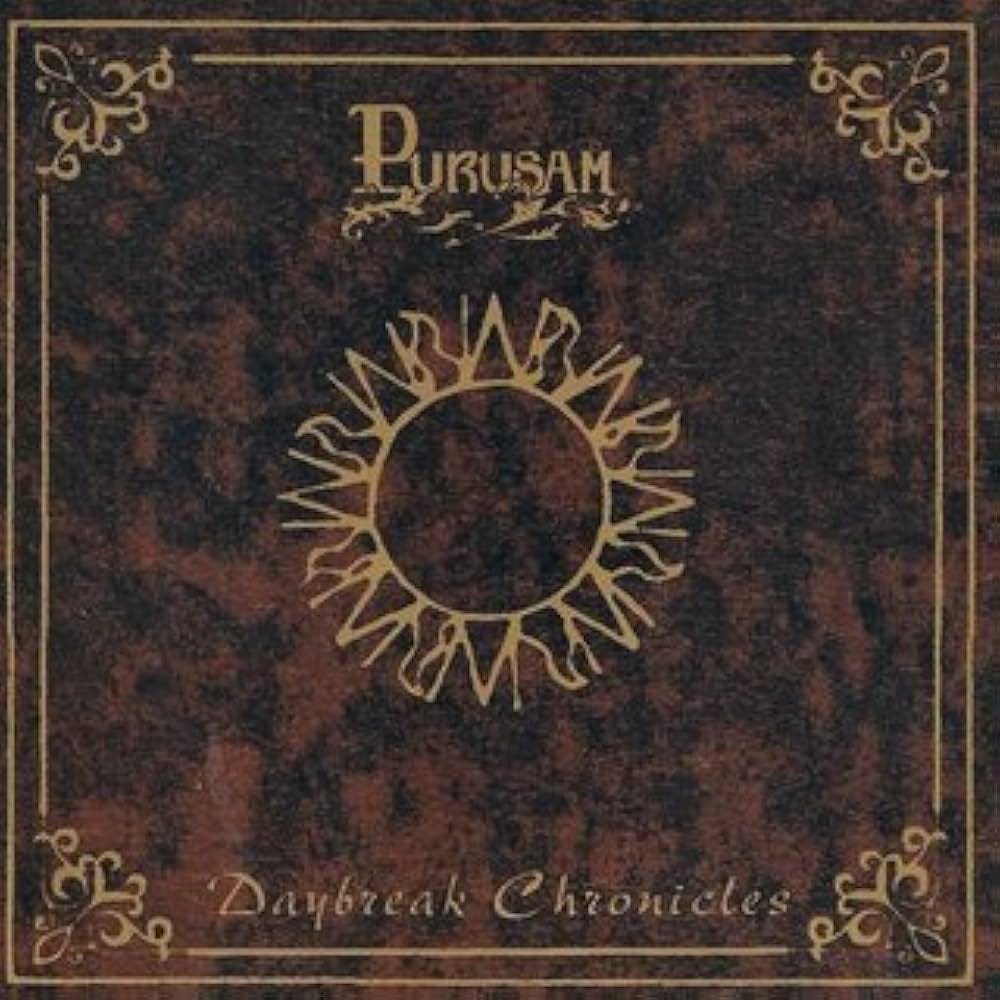
Keith Tasker, Dig Me Out Board of Directors member and first-time guest on the show, brought Daybreak Chronicles to the table. Want to bring your own lost album to Dig Me Out? Join the Board of Directors or suggest an album here.
Somewhere in a crate, on a server with 156 monthly listeners, this record has been waiting.
Purusam were a straight-edge hardcore band from Skellefteå, Sweden, later based in Umeå. In 1997, they recorded their second full-length album, Daybreak Chronicles, on Desperate Fight Records, a label co-owned by Dennis Lyxzén of Refused. Then they broke up. Then nothing. The album never came out in the United States. It never toured here. It died quietly in Sweden and Spain, the only two territories where copies ever existed.
In 2022, a Swedish label called Svensk Hardcore Kultur pressed 501 numbered vinyl copies to keep it from disappearing entirely. That is where most people are finding it now, twenty-five years later. The remaster brought the guitars back to life. The songs were already there.
The Buried Blueprint
Here is the part that makes this album genuinely strange to sit with. The guitarist on Daybreak Chronicles, Jon Brännström, left Purusam and joined Refused. One year after this record was released, he co-wrote The Shape of Punk to Come, now considered one of the most important hardcore albums ever made. You can hear the connection clearly: the way the burst sections land, the rhythm of the vocal against the guitars, the instinct to build something architecturally complex out of raw hardcore energy. The DNA is shared. The credit is not.
The Shape of Punk to Come died on release too, for the record. It was not until a music supervisor placed “New Noise” in Friday Night Lights years later that the world caught up. Refused got a second life. Purusam got 501 vinyl copies and a Spotify page with monthly listeners you could count on two hands.
The drummer on Daybreak Chronicles, Fredrik Holmstedt, later recorded Veni Vidi Viciouswith The Hives, one of the most beloved garage rock albums of the early 2000s. Two completely unrelated genre histories, separated by geography and style and a decade of distance, run through the same obscure 1997 Swedish hardcore record. Most people have never heard of Purusam. Almost everyone has heard of what came next for the people who made it.
What Actually Happens When You Listen
The production is dry and hot in a way that will either grab you immediately or send you looking for a volume knob. The mix clips audibly on the opening double kick. The first thirty seconds feel like your head is pressed against a cranked Marshall amp, which is almost certainly the point. Once you adjust, the record rewards the patience.
The guitars are the thing. Two of them, constantly trading roles: one carrying a galloping Iron Maiden-style riff while the other runs something technical and offset, then switching on a dime to a desyncopated 90s feel you weren’t expecting. Sweep runs and pinched harmonics and harmonized solos appear not as showboating but as sudden energy events, like pressure releasing. It sounds like a group of teenagers playing at the absolute edge of what they can do, and doing it in a room together, not pieced together in a studio. That immediacy is the point. It is not glossy. It is real.
Three tracks feature violin and cello. The instrumental interludes between the heavy sections lean toward what a later generation would call post-rock, or what one listener compared favorably to Failure. The album’s lyrics reference Final Fantasy and Mana, two JRPG franchises, inside a straight-edge hardcore concept record about light and darkness and the passage of time. That combination should not work. It does.
The tracklist divides into three sections: “The Way of the Hero,” “The Great Conqueror,” and “The Final Fantasy.” It is a concept album in the most earnest sense, not a marketing gesture. The screamed male vocal is an acquired taste, which the band name (from the Sanskrit “purusha,” meaning universal spirit) probably did not help, given how easily it got lumped into the Krishnacore subgenre they had nothing to do with.
The Female Vocal, and Why It Mattered
Anna-Lena Svanborg sang clean on this record. In 1997 hardcore, that was nearly unheard of. Not operatic, not soaring: her presence is ethereal and restrained, a counterweight to the screaming male vocal rather than a competition with it. The contrast creates something more interesting than either element alone. She is in a different headspace. That is what makes it work.
This approach, the juxtaposition of harsh and clean vocals, particularly male screaming against female singing, has become standard practice in the metal adjacent genres of the last fifteen years. In 1997, this record was doing it in a self-produced straight-edge hardcore album by teenagers in Sweden. The genre called it “fantasy hardcore” at the time, which sounds like an insult but is actually a fairly accurate description of what they were building.
Have a listen to “Atma,” the seventh track. It opens with the feeling of a Bruce Dickinson Valkyrie charge, drops to a halftime verse, and features a cannon sound effect at the forty-one second mark that is used exactly once and never again. The band plays that card and folds it. That restraint, that instinct to introduce something wild and then let it go rather than repeat it into the ground, is what separates a genuinely interesting record from a genre exercise.
Why It Disappeared
The reasons are almost too obvious once you line them up. The band name read as Krishnacore in a scene that was not Krishnacore. The album art was poor on the original and worse on the Victory Records version. Desperate Fight Records, Dennis Lyxzén’s label, had essentially no distribution outside Scandinavia. Victory eventually put out a Desperate Fight bundle of reissues and sent them to radio stations in five-pack boxes with no promo, no chart pushes, nothing. Keith Tasker, who was a radio DJ hosting a metal show at the time, remembers getting the box and not knowing what to do with it. That was the entire US promotional campaign for this record.
The album never came to the States. It probably played Germany, Sweden, Switzerland. It may not have made it to England. According to Discogs, Sweden and Spain are the only countries where physical copies were officially released. Converge was doing comparable technical hardcore-metal fusion in the US and building a reputation. Purusam was doing it in Umeå and building nothing outside the scene.
Refused had a similar problem. The Shape of Punk to Come also died on release. They broke up on tour, playing house shows. It took a TV music supervisor and a sports drama to resurrect them years later. Purusam had no such catalyst. Nobody picked up “The Way of the Hero” for a film. Nobody sync-licensed “Starlit.” The record just waited.
The Verdict, and What You Should Do
This is proto-metalcore before the genre existed. It is one year before the record that supposedly invented the template, made by people who were living inside the same creative moment, on the same label, in the same city. Jay, who came in knowing nothing about Purusam and without any particular affection for hardcore as a genre, walked out calling it “The Shape of Metal to Come.” Tim, also hearing it blind, found himself returning to the two-guitar passages with headphones on, floored by the interplay.
The community vote when this episode split three ways: exactly one-third each for Worthy Album, Better EP, and Decent Single. That split is honest. The screamed vocal is not for everyone. The production is raw even by the standards of the era. The concept album structure does not always cohere across all twelve tracks. These are real limitations.
And yet: is this a better record than its complete historical invisibility suggests? Does the Brännström connection reframe what happened in 1998 in ways the genre histories have never acknowledged? What would you call a record that sounds like the future but arrived with no mailing address? And how many other albums like this are still out there, waiting for someone to bring them to a podcast?
Listen to the episode. Then tell us what you think.
Episode Highlights
Intro: Opening Theme / The Way of the Hero: Jay and Tim welcome first-time patron guest Keith Tasker, joining from the Great Lakes region.
1:07: Introducing Purusam: Keith lays out the case for a proto-metalcore concept album from Umeå, Sweden, released in 1997 on Dennis Lyxzén’s Desperate Fight Records.
4:02: Fantasy Hardcore: What Makes This Record Different: Harsh and clean vocals, female clean vocals in hardcore (rare in 1997), Iron Maiden gallop rhythms, pipe organ, strings, flutes, and dueling guitar solos in a self-produced straight-edge record by teenagers.
6:07: The Refused Connection: Former Purusam guitarist Jon Brännström later joined Refused and co-wrote material on The Shape of Punk to Come, making Daybreak Chroniclesa sonic blueprint for the blueprint.
9:27: Band Lineup: Drummer Fredrik Holmstedt would later record Veni Vidi Vicious with The Hives, the only member to surface elsewhere in music history.
12:32: The 90s Hardcore Lineage: Keith traces straight-edge hardcore’s family tree and explains why Purusam’s Iron Maiden-rooted approach was shocking in that context.
15:47: Leave and Forget: Track 2 played as entry into the full album discussion.
22:38: Atma: Track 7 opens like a Bruce Dickinson Valkyrie charge, drops to halftime, and features a cannon sound effect at 41 seconds used exactly once, never repeated.
33:27: Drumming Spotlight: Fredrik Holmstedt’s double kick never numbs because bass and rhythm guitar accent those moments as events, not wallpaper.
35:23: Starlit: Track 10 played as transition into the critiques section.
38:04: What Doesn’t Work: The hot-amp mix clips audibly on the opening double kick; the screaming vocal has no traditional melodic movement, which Tim compares to following a native Italian speaker on Duolingo.
50:41: Why Didn’t It Make It: The name, the art, the tiny label, no US distribution, no US touring. Contrasted with Refused, whose Shape of Punk to Come also died on release until a TV sync revived it years later.
Outro: Hourglass: Track 12 closes the episode. Keith teases his next patron pick, a 1990 England-only release from a band that still headlines UK festivals but is unknown in the States.
If this hit for you, try these next
The Shape of Punk to Come by Refused: The album Purusam’s guitarist helped build one year after Daybreak Chronicles -- the definitive DMO episode on the record that changed hardcore.
Converge: History of the Band: The US counterpart to what Purusam was doing in Sweden -- technical, heavy, and built on the same hardcore-metal fusion that nobody else was attempting in the mid-90s.


