



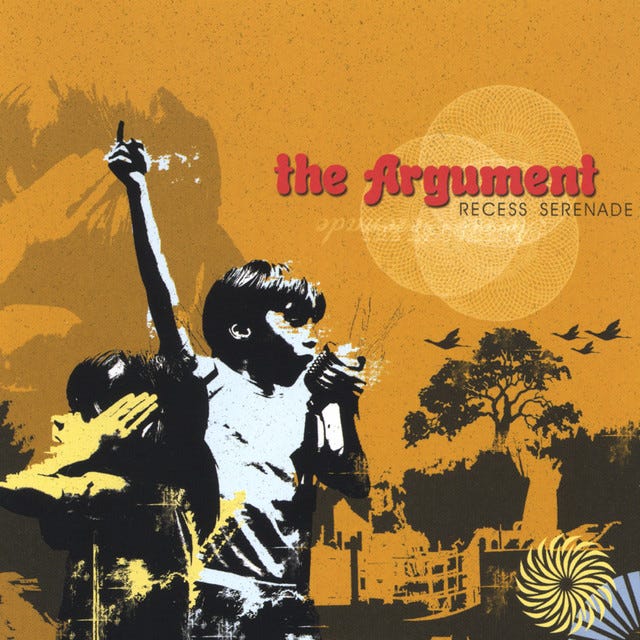
Recess Serenade (2004) by The Argument was brought to Dig Me Out by returning patron Whitney Beehler, one of the most dedicated power pop advocates in the community. Whitney's previous picks include Caviar, Death Ray, Human Radio, Wunderband, The Tories, and Papa Vegas; four of them are self-titled records, which has become his signature. He came to the episode with a physical CD and a concert ticket from November 2004 that he still has. If you have a record that belongs in the conversation, suggest it here.
A Quick Note on Names
Searching for The Argument online leads you almost immediately to the wrong place. Fugazi‘s beloved 2001 album is also titled The Argument, and it dominates search results for the band name. The Morgantown band is a separate entity entirely: a four-piece power pop group from West Virginia, active in the early 2000s, led by singer and keyboardist Scott Simmons. No connection to Fugazi, Ian MacKaye, or post-hardcore.
On streaming platforms, the confusion compounds. The band’s album does not always surface under a search for the artist name, sometimes requiring a direct search of the album title Recess Serenade to find it. Apple Music has the cleanest presentation; Spotify availability is unconfirmed. The name problem is part of why this band disappeared so completely. It is also, unfortunately, part of why you have probably never heard of them.
What It Sounds Like: Jellyfish Goes to the Gym
The band name also evokes confrontation but the sound of The Argument is about harmony, not friction. The most immediate and accurate sonic reference for Recess Serenade is Jellyfish: specifically the Bellybutton side of Jellyfish, not the baroque orchestral excess of Spilt Milk. The Argument takes that same foundation: thick harmonies, piano-driven melodic instincts, pop structures built for radio, and then plugs it into a heavier, chunkier guitar and bass setup. The bass tone on this record carries real weight. The guitars are gritty without being distorted into oblivion. That combination keeps the album from ever turning syrupy.
Scott Simmons appears to write on piano, and it shows in the best way. Writing on a keyboard instrument pushes melody into different voicings than guitar-first songwriting. Chords land in unexpected places. Vocal lines climb higher. The Cars’ keyboard DNA runs through the album’s sonic architecture, and Ben Folds Five‘s piano instincts inform the mid-tempo moments, particularly on “Act My Age”: melodically specific, rhythmically bouncy, emotionally direct without being maudlin.
“Everyone’s Sellin’ Something” (track 5) is the album’s sharpest moment. It is a social commentary song with real teeth, not another relationship song dressed in pop clothing. The lyrics take aim at media saturation and commercial culture with the kind of directness the genre rarely gets credit for. For a power pop record, that is a pointed piece of writing. “Movin’ In,” “Incognito,” and “Act My Age” all sit in that upbeat, chunky-guitar sweet spot where the band sounds most like itself. The 36-minute runtime is not a limitation; it is a feature. The album never overstays its welcome.
The Mitch Easter Connection
Here is the detail that makes the obscurity even harder to explain. Mitch Easter mixed this record alongside Ted Comerford. Easter is the producer and engineer who made R.E.M. sound like R.E.M. at the start of their career: Murmur, Reckoning. His credits are not wallpaper; they are a lineage. A self-released band from Morgantown, West Virginia got Mitch Easter on the board for their album.
That credential alone should have opened doors. Combined with the LA Reid meeting and the American Music Awards recognition, the question stops being “why didn’t this band make it” and starts being “what specifically went wrong.” The answer is not available anywhere, because there is no record of this band almost anywhere. The band’s own website has no “About” page. No interviews have surfaced. The story simply ends in 2004 with an album that got zero reviews because nobody reviewed it.
Six People at the 400 Bar
On November 15, 2004, Whitney went to the 400 Bar to see The Argument play. He still has the ticket stub. There were six people in attendance, including him and his friend Jeff. The same venue had been packed for Walt Mink. The Argument played a full show anyway.
That story captures something the statistics cannot. The 531 Last.fm listeners is an abstraction. Six people in a Minneapolis bar while the bartender left is specific. A good band, an empty room, and no explanation for the gap between what the music deserved and what the audience showed up to receive.
Whitney knew at the 400 Bar in 2004 that this band was worth more than the room they were playing. He was right.
Where It Falls Short
Recess Serenade is not a perfect record. The album’s momentum dips in its second half, and a few tracks blur together in a way the stronger cuts avoid. “Soaked,” the mid-tempo ballad, is a well-constructed pop song with the melody and production to have been a 2004 radio hit, and it sounds exactly like a 2004 radio hit, which is the problem. It sits slightly outside The Argument’s own identity, polished into a kind of generic competence. It could be Lifehouse. It could be The Fray.
“Song One,” the opener, also lacks the oomph that the album’s best moments deliver. The vocal sits more exposed than the dense guitar-and-piano interplay deserves on the quieter tracks. These are not album-breaking flaws; they are album-thinning ones. The record’s eight strongest songs would be a near-perfect EP. But even at its softest moments, nothing makes you reach for skip. Ten songs in 36 minutes, no dead weight serious enough to stop you.
After the Deal That Never Happened
The Argument’s story did not end in 2004. In 2005, they released a five-track EP on Rostrum Records, notable because every other Rostrum act at the time was a hip-hop artist (Wiz Khalifa, Mac Miller). The EP led off with a cover of The Cars’ “Hello Again,” which also appeared on a Not Lame Recordings tribute compilation. By then, the window for major label momentum had already closed.
Scott Simmons moved to Los Angeles and built a session career. His credits include work with Mike Love (12 Sides of Summer) and Puddles Pity Party (Songs That Got Me Through the Plague), alongside Dirty Vegas and various independent artists. Under The Argument name, three singles surfaced on Qobuz in 2023 and 2024. The band website went active again around reunion shows in 2025 and 2026. The story is not over; it is just very quiet.
The gap between what Recess Serenade deserved and what it received is exactly the kind of story Dig Me Out exists to tell. LA Reid heard this album. Mitch Easter mixed it. The American Music Awards noticed it. And still: 531 listeners.
The Verdict
Whitney brought this album with confidence, and the conversation validated that confidence with some qualifications. Whether our ratings line up with the community, and exactly how far they pushed toward the album’s highs versus its softer spots, is a conversation worth hearing in full.
Drop your take in the comments. And if you have a lost record that deserves the same treatment, suggest it here.
Episode Highlights
Intro (0:00): Whitney Beehler returns. Jay recaps her prior picks: Caviar, Death Ray, Human Radio, Wunderband, The Tories, Papa Vegas, Baltimora. Four self-titled records. That’s her niche.
2:08: Album reveal. Whitney holds up the CD on camera. Band is from Morgantown, WV. Jay and Tim have been there. They played to an empty bar.
3:56: Whitney’s live show story. The 400 Bar in Minneapolis, November 15, 2004. Six people in attendance, including her and her friend Jeff. He still has the ticket stub. The band played a full set.
7:10: Album cover mystery. Both Jay and Tim have vague familiarity with the cover they cannot place. Maybe a Virgin Megastore bin. Self-released but got real distribution somehow.
9:07: Mitch Easter connection. Easter and Ted Comerford mixed this record. The same Mitch Easter who made R.E.M.’s Murmur and Reckoning.
13:40: What works (the sound). Piano-driven but chunky. Bouncy Fender Rhodes-style keys against heavy bass and gritty guitars. Jellyfish but harder: Belly Button side, not Spilt Milk.
17:39: What works (the songwriting). Summer Camp and Sweet Water comparisons. Cars power pop DNA. Voice fits the style: sweet-with-edge, not throaty. 36 minutes, flies by.
20:55: What works (Whitney’s take). The harder guitar pop framing. Everyone’s Sellin’ Something as social commentary that goes beyond the typical relationship song.
23:55: Everyone’s Sellin’ Something (clip). Lyrics target media saturation and commercial culture. More pointed than the genre usually gets credit for.
26:45: Soaked (clip). Mid-tempo, atmospheric, more polished than the rest. The album’s softest moment.
28:15: What doesn’t work. Second half loses some momentum. Some tracks blur together. Nothing breaks the album, but a few songs thin it out.
31:59: My Dumb Luck (clip). Upbeat closer. Good energy to end on.
34:30: The near-miss story. Named Top Ten Unsigned Bands in the Country (American Music Awards 2003). LA Reid at Arista flew them to New York. Atlantic and Hollywood Records also interested. The deal never happened.
38:15: Verdicts. Poll results: Worthy Album 50%, Better EP 25%, Decent Single 25%. All three participants weigh in.
Outro: Whitney shoutout. Reunion show context. Scott Simmons session career update.
Have a lost or forgotten album that deserves the spotlight? Suggest it here.
If This Hit for You, Try These Next
The Tories on Dig Me Out: Another Whitney Beehler pick. Power pop done right, and another band that should have been bigger.
Ben Folds Five on Dig Me Out: The piano-driven pop rock blueprint The Argument is working from.
Sweet Water on Dig Me Out: Another power pop deep cut with the same chunky-but-melodic DNA.


