




Every week, Dig Me Out listeners help decide what gets pulled back into the light. This episode came from a long-time Board of Directors member Adam Rogahn, which is exactly how some of the most interesting records find their way back onto the turntable: not because they topped a greatest-albums list, but because somebody refuses to let them disappear. Got a forgotten favorite, a misunderstood one-off, or a record with one killer single and a whole lot of unresolved questions around it? Submit an album at and help shape what gets covered next.
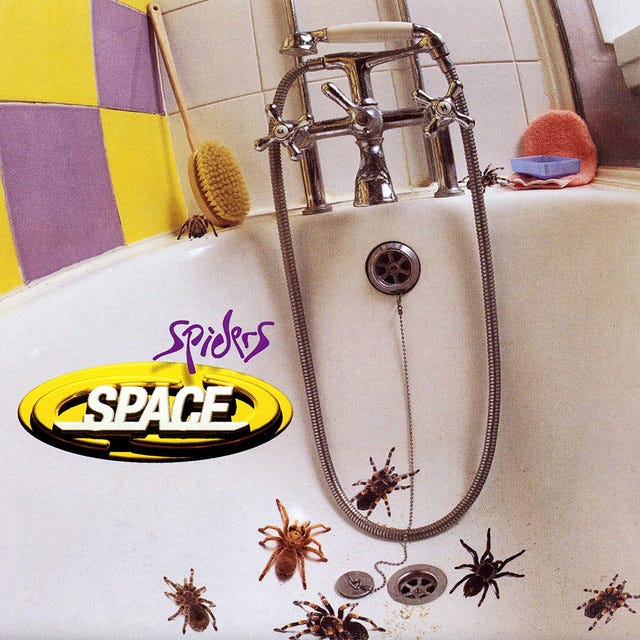
There are albums that fit neatly into their era, and then there are albums that seem to have shown up wearing the decade’s clothes while quietly plotting against the dress code. Spiders, the 1996 debut from Liverpool band Space, belongs to the second category. It arrived during Britpop’s peak commercial years, when the market was flooded with bands trying to bottle some combination of Beatles shimmer, Kinks wit, Oasis swagger, and Blur cleverness. Space looked at that lane, shrugged, and swerved into something stranger.
That strangeness is the whole story.
If the only thing most listeners remember is “Female of the Species,” that’s understandable. It’s the kind of single that burns so brightly it can distort the memory of everything around it. Sultry, theatrical, vaguely sinister, and just knowing enough to be funny without collapsing into novelty, it remains one of the great oddball hits of the era. It sounds like a lost lounge-pop theme from an imaginary 1960s spy flick that somehow escaped into the alt-rock ecosystem of the mid-90s and started making itself comfortable in movies, TV, and anybody’s brain who heard it after midnight.
But Spiders is not merely the album that contains “Female of the Species.” It is a much messier proposition than that: a record full of half-brilliant pivots, theatrical overreach, eerie atmosphere, great singles, questionable sequencing, and enough personality to stay interesting long after its flaws have made themselves obvious.
Britpop by way of the haunted funhouse
What makes Spiders compelling is that it refuses to settle down long enough to become generic. Where so many bands of the period were polishing their influences into something market-ready, Space assembled a collage. You can hear late-60s mod, pulpy lounge-pop, Madchester looseness, trip-hop mood, cheap sci-fi soundtrack kitsch, and a little bit of classic-rock drama all rubbing against one another. It feels less like an album with a single sonic thesis than like flipping channels at 1 a.m. and landing on a string of reruns: spy shows, horror flicks, off-brand variety specials, some weird imported crime drama with bad dubbing, then a music video that looks like it cost £17 and somehow still nailed the vibe.
That atmosphere is the record’s best trick. Organs wheeze and shimmer. Synths creep in from the corners. Xylophone and mallet percussion pop up where normal bands would settle for tambourine. Strings show up not to elevate the songs into grandeur, but to give them a sly, cinematic wink. Even the guitars often feel less like the center of the band than one more prop in the production design.
It gives the album a mood few of its peers could touch. Space were not trying to beat Oasis at being Oasis. They were building a world instead.
One undeniable hit
Still, there’s no getting around the fact that “Female of the Species” towers over the rest of Spiders.
That isn’t because the other songs are bad. It’s because that track is one of those rare moments when concept, songwriting, arrangement, and performance all click at once. The groove is sly. The hook is immediate. The orchestration is playful without being cluttered. The vocal is theatrical, but disciplined. Most importantly, it feels complete. Not dressed up. Not overcompensating. Complete.
That’s what separates it from a lot of what surrounds it. On the album’s best songs, the production deepens the material. On its weaker songs, the production sometimes feels like it’s trying to distract from songs that are merely decent. “Female of the Species” never has that problem. Its lounge-pop strut, sinister charm, and perfectly calibrated weirdness are the song. Strip the arrangement away and you lose the whole point.
That’s also why it outlived the band’s broader reputation, especially outside the UK. It didn’t need context. It didn’t need scene literacy. It didn’t need a listener to buy into all of Space’s eccentricities. It was just instantly, unmistakably itself.
And that kind of single can be a curse. Once a band lands a song that specific, every other track risks sounding like either a failed attempt to repeat the trick or proof that the trick can’t be repeated.
The case for Spiders
The strongest argument in favor of Spiders is that when it hits, it’s a lot of fun. Not polished fun. Not prestige fun. Real fun. The kind that comes from a band willing to try a weird instrumental choice, a left-turn arrangement, a vocal flourish that shouldn’t work but maybe does.
“Neighbourhood” has the crackle of a strong opener and quickly establishes that Space are more interested in mood and movement than guitar-band orthodoxy. “Money” leans into a sleazy, cinematic cool that suits the band’s instinct for stylized storytelling. “Me and You vs. the World” carries a 60s-pop glow that suggests Space could have made a cleaner, more focused retro-pop record if they’d wanted to. “Dark Clouds” and a few others flash the band’s knack for texture—how to make a song feel like a set piece even when the tune underneath it is only partway there.
And that’s really the charm of the whole enterprise: you can hear the curiosity. The album doesn’t sound like a band trapped by a formula. It sounds like a band chasing whatever detail or influence excited them in the moment, whether that meant baggy grooves, keyboard color, spaghetti-western twang, pulpy narrative lyrics, or dancefloor percussion. In a decade full of alt-rock records that flattened personality into market-tested sameness, that counts for a lot.
The case against it
But there’s another side to all that freedom.
For all its invention, Spiders can also feel like an album that mistakes motion for momentum. It jumps styles, moods, and vocal approaches so often that the experience starts to blur. What feels playful in the first half can feel scattered in the second. A record this committed to collage needs either knockout songs or ruthless pacing to hold everything together. Spiders has flashes of the first and not enough of the second.
The back half is where the strain starts to show. Some tracks begin to sound less like bold acts of reinvention and more like affectionate but lesser versions of other bands’ ideas—second-tier baggy grooves, second-tier dance-rock, second-tier Britpop songwriting hidden under layers of character and production. The more the album sprawls, the more it exposes how much of its identity depends on atmosphere doing the heavy lifting.
The vocals don’t always help. Space love character, but character is a dangerous drug. Sometimes the exaggerated accents, theatrical cadences, and shape-shifting deliveries make the songs feel cinematic. Other times they make them feel muggy and overacted, like the musical equivalent of a supporting character in a Guy Ritchie knockoff trying way too hard to steal the scene.
Then there’s the rhythm section problem. Some of the drum programming and loop-based choices lock the album so firmly into mid-90s production habits that the songs flatten out instead of erupting. You keep waiting for a few of these tracks to hit harder, swing more, or open up dynamically, and too often they just hover in place. The result is an album that can feel long not simply because of its runtime, but because so many songs occupy the same murky middle distance.
This is where Spiders becomes such a great record to argue about.
Because the honest answer might be that it is not a great album so much as a very good five- or six-song EP trapped inside a full-length running on nerve, style, and a willingness to risk embarrassment. Trim the fat, sharpen the sequencing, keep the strongest singles and the most vivid deep cuts, and you’ve got something closer to a cult classic than a curio.
That isn’t a backhanded compliment. Plenty of bands never make one great single. Plenty of bands never build a world vivid enough that listeners still want to rummage around in it decades later. Space did both. They just may not have had the songwriting consistency or editorial restraint to stretch that world across more than 50 minutes.
And yet even that excess is part of the appeal. Spiders is not the sound of a band playing it safe. It’s the sound of a band trying too much, pushing too far, trusting their oddest instincts, and occasionally tripping over their own ambition. There’s something admirable in that, especially now, when so much music arrives pre-smoothed and algorithmically legible.
The one-song trap
A lot of albums in the 90s fell victim to the one-song trap: one brilliant single, one unforgettable video, one radio moment, and then a full-length that couldn’t possibly live up to the expectation created by that hit. Spiders belongs in that lineage, but with an important twist. Most of those records are remembered only for the disparity. Here, the gap between the hit and the rest of the album is real, but so is the atmosphere, the ambition, and the strange little collection of pleasures sitting around it.
That makes Spiders more than a footnote. It’s a reminder that some records matter not because they’re airtight, but because they’re gloriously unstable. Because they capture a band in the act of trying to invent a language of their own, even if they only speak it fluently a few times.
“Female of the Species” may be the song that gets Space into the room. Spiders is what keeps them there just long enough to make the conversation worth having.
Episode Highlights
00:00 – Patron setup and intro – How a long-time Union member brought Spiders into the rotation and why it stood out in a sea of 90s Britpop and alt‑rock
05:10 – Band history – The early days of Space, lineup changes, and how a supposedly Britpop band ended up chasing film, trip‑hop, and lounge instead of Beatles worship
09:00 – Singles and UK vs. US reception – The strange rollout of five singles, why “Female of the Species” broke through, and how the rest of Spiders stayed a cult item outside the UK
13:30 – Building the “spy‑fi lounge” sound – Organs, synths, xylophone, strings, and how the band leaned into retro TV, B‑movies, and cocktail‑lounge vibes instead of standard guitar rock
18:45 – Cinematic songwriting and dark humor – How Tommy Scott writes like he’s scoring imaginary films, the Tarantino influence, and the tension between playful arrangements and morbid lyrics
24:20 – When the collage works (and when it doesn’t) – The highs of the album’s atmosphere versus the moments where stock drum loops, overcooked vocals, and weaker songwriting start to drag
31:10 – The back-half problem and 90s production – Why the second side feels more like genre cosplay, how dated beats flatten dynamics, and what a tighter runtime might have fixed
36:40 – One killer single vs. whole-album verdict – The “worthy album / better EP / decent single” debate and why most roads lead back to a leaner version of Spiders
41:30 – Community verdict and where Space fits now – Patreon poll results, listener comments, and how Spiders sits today as an eccentric 90s time capsule rather than a lost classic


