




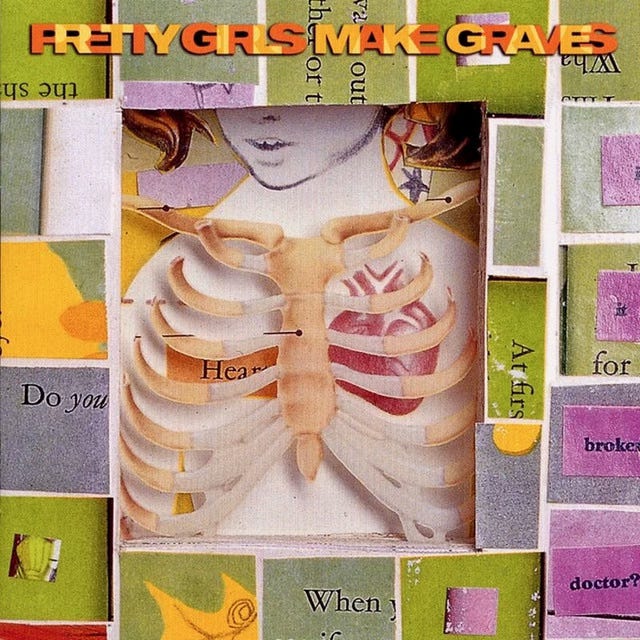
I had a six-disc CD changer in my car in 2002. You remember those, right? This album got stuck in there for months. Not because the changer was broken—because I couldn’t bring myself to take it out.
Good Health by Pretty Girls Make Graves was that record. Twenty-seven minutes that felt like they contained everything I’d ever loved about rock music, compressed into nine tracks that refused to waste a single second.
You probably forgot this band existed. Most people did. But man, they shouldn’t have.
“Speakers Push the Air” and the Power of the Physical
The album opens with one of the best first tracks of the entire decade. Bold statement? Maybe. But “Speakers Push the Air” does something most opening tracks don’t—it tells you exactly what’s about to happen while it’s happening.
Andrea Zollo sings about life’s complications disappearing when the music starts playing. About finding a record that opens your eyes. And while she’s delivering that message, Jay Clark’s guitar is literally doing it—these siren-like runs up the fretboard that feel less like technical exercises and more like pure excitement made audible.
But here’s the line that gets me every time: “I couldn’t put it away.”
Not “I couldn’t stop streaming it.” Put it away. That’s the CD era talking. The physical relationship with music. When you loved an album so much that even the act of ejecting it from your player felt wrong. When the only reason you’d finally swap it out was because your hand was tired from handling the case.
That guitar tone? Like controlled chaos—angular and melodic at the same time, which shouldn’t work but absolutely does.
Here’s something wild: bassist Derek Fudesco co-founded the Murder City Devils. Yeah, that Murder City Devils. He and Andrea Zollo had been playing together in bands with names like The Hookers, The Death Wish Kids, and Area 51 before landing on Pretty Girls Make Graves. The name itself comes from a Smiths song, which came from a Jack Kerouac book.
So why doesn’t this sound like Murder City Devils? Because they added Andrea’s commanding vocals, Clark’s intricate guitar work that bounces between post-punk angularity and straight-up hooks, and Nick DeWitt on drums doing things that made you remember why you fell in love with rock drumming in the first place.
This was post-At The Drive-In era rock when everything felt possible again. You know that feeling? When a genre cracks wide open and suddenly bands are grabbing every tool in the toolbox? That’s this.
When Did Drummers Get This Good?
Something happened in the early 2000s with drummers. Suddenly you’d go see a band at a small venue and the drummer would be doing things that in the 80s or 90s you’d only hear from prog bands or arena acts. Technical ability, yes—but also feel.
Nick DeWitt is the perfect example. Listen to “If You Hate Your Friends, You’re Not Alone”—he’s shifting from angular complexity to straightforward momentum, sometimes in the same measure, and it never feels like showing off. He knows exactly when to hit simple quarter notes to emphasize a groove, when to drop into halftime for drama, when to unleash a fill that makes you go “wait, what?”
The whole band does this, actually. Alternating between complexity and simplicity so your brain can process what’s happening while your body just responds to the energy. Guitar part gets wild? Rhythm section keeps it simple. Vocals get conversational? Guitars go nuts. It’s like they understood that maximalism doesn’t mean “everything all the time”—it means knowing when to deploy what.
Producer Phil Ek—who’d go on to work with Built to Spill, Modest Mouse, Band of Horses, Fleet Foxes—captured something crucial here. This sounds raw but not under-produced. Roomy but not distant. You can crank it in your car and it sounds massive, but it never feels polished to death.
That matters because Pretty Girls Make Graves’ later albums got slicker. Not bad, just different. Good Health sounds like a band that might physically combust at any second. Like they recorded it live and then said “yeah, that’ll do.” Whether they actually did that or meticulously multitracked everything, I have no idea—but it feels like a performance.
Everything in 27 Minutes
You want 80s arena rock energy? “Speakers Push the Air” delivers. Post-punk experimentation? Check “Bring It On Golden Pond.” Gang of Four-style rhythm playing? It’s in there. Fugazi-like dueling guitars? Absolutely. At the Drive-In angularity? Of course. But also pop hooks you can actually sing.
Nine tracks. Twenty-seven minutes. No filler.
Brooklyn Vegan ranked it among 2002’s best emo and post-hardcore albums. Stereogum’s 20th anniversary piece called it “28 delirious minutes that are enough to leave you breathless and stirred.” Our community gave it 83% “the album” rating.
The Six-Year Wonder
Pretty Girls Make Graves existed from 2001 to 2007. That’s it. Six years, three albums, some seven-inch splits, done.
Nick DeWitt left in January 2007 and the band called it. Jay Clark went on to form Jaguar Love with a member of the Blood Brothers, then got replaced by a drum machine, which is honestly hilarious. Andrea Zollo played in a couple more bands, then left music entirely to become a hairstylist. She’s on Facebook being gracious to fans who still remember.
They’ve done reunion shows—When We Were Young Festival, Bumbershoot, Best Friends Forever Fest. Weekend in Vegas, play the old songs, remind people what 2002 felt like. But no new music is coming.
I know what you’re thinking: “This is just nostalgia talking.”
Maybe. But I went back and listened to Good Health for the first time in probably fifteen years, and you know what? It still rips. The technical stuff still impresses. The hooks still land. The energy still feels urgent.
This is a band that loved everything about rock music—the anthems, the noise, the precision, the chaos—and refused to pick one. For 27 minutes, they had it all. They alternated between complexity and simplicity so seamlessly that you could process the technical stuff while your body just moved.
That’s rare. That’s special. That’s worth remembering.
So here’s your homework: Go listen to “Speakers Push the Air.” Then tell me why this band wasn’t massive. Because I still don’t understand it.
Highlights
0:00 - Intro - Ghost In The Radio
0:42 - Album Introduction
2:22 - Band History & Formation
4:58 - What Works: The Maximalist Approach
12:05 - Musical Analysis: Guitar Work & Vocals
13:05 - Speakers Push the Air
18:34 - Production & Sound
24:28 - What Doesn't Work (Spoiler: Not Much)
25:08 - The Get Away
31:12 - If You Hate Your Friends, You're Not Alone
33:35 - Overall Rating & Community Response
40:02 - Outro - More Sweet Soul
If you loved this, check out these related episodes:
In On The Kill Taker by Fugazi
The post-hardcore blueprint that made bands like this possible
In/Casino/Out by At The Drive-In
The angular explosion that defined the era


