



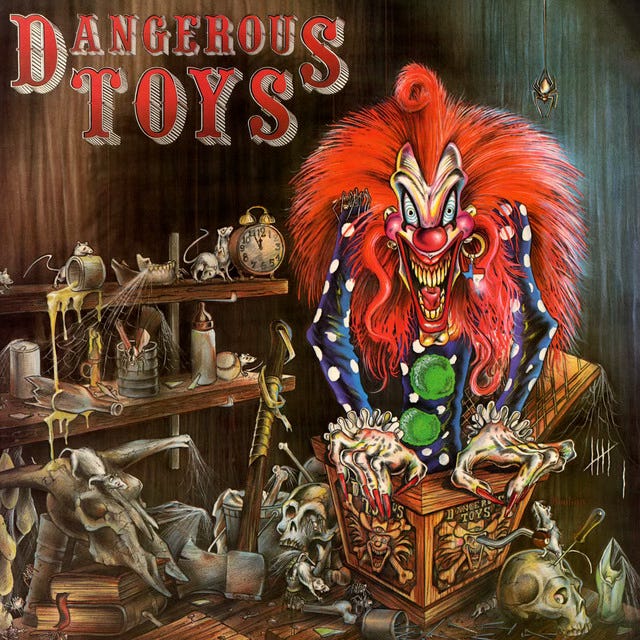
Dangerous Toys (self-titled, 1989) was brought to the show by Dig Me Out community member Keith Miller, who nominated it for the December 2025 Patreon poll, and the community agreed, sending it to the top with 37% of the vote over LA Guns, Ozzy’s Diary of a Madman, and Lillian Axe. Keith clearly knew what he was doing. Want to bring YOUR favorite lost or overlooked album to the table? Suggest it for a future episode or community poll.
Gold-Certified. Headbangers Ball-Approved.
Dangerous Toys did everything right. The rock history books still left them out.
Half a million copies sold. Billboard 200, peak position #65, 36 weeks on the chart. Heavy rotation on Headbangers Ball for two singles. An evil killer-clown mascot named Bill Z Bubb on every T-shirt at every arena show from ‘89 to ‘91. And yet, ask someone to rattle off the great debut albums of the late-80s hard rock moment and you’ll hear Appetite, Skid Row, Warrant, maybe even Bang Tango if they’re feeling generous. Dangerous Toys? Barely a footnote. If you know, it feels like a secret handshake. If you don’t, this is your invitation in.
That’s the story this album tells in 2026: not the tragedy of obscurity, but the stranger, more irritating story of an album that earned its run and still got erased. Because grunge didn’t just kill hair metal. It buried some genuinely great records. This is one of them.
From Onyxx to Austin’s Finest
Before they were Dangerous Toys, they were Onyxx, two X’s, one terrible name, and all the ambition of a band that knew they were built for something bigger than the Austin club circuit. They formed in 1987, got spotted by a Columbia Records rep at South by Southwest, and signed before most of their Sunset Strip contemporaries had figured out the right shade of spandex.
That origin matters. Austin in the late ‘80s was not Los Angeles. It wasn’t built on the same industry machinery, the same Sunset Strip hustle, the same management-and-mogul food chain that turned Poison into a phenomenon. Dangerous Toys came from a place where ZZ Top was a local institution and Southern boogie was in the water. That Texas DNA would end up being both their greatest asset and the thing that kept them from fitting neatly into any radio format.
At the center of it was Jason McMaster, a singer with a secret. Before Dangerous Toys, McMaster fronted Watchtower, one of Austin’s most technically ambitious metal outfits. Progressive rhythms, Judas Priest-adjacent precision, the kind of musicianship that gets you credibility in every circle that matters. Then he traded all of that for a killer clown mascot and some of the sleaziest riffs of 1989. It paid off. For a minute.
The result of that pivot: a band that had more going on under the hair than anyone gave them credit for. McMaster thinks of himself as a heavy metal musician first. Dangerous Toys just happened to arrive at the party in the right costume.
Max Norman Turns Up the Punch
Here’s a detail that reframes everything: Dangerous Toys was produced by Max Norman at Sound City Studios in Van Nuys. Let that sink in. The man behind Ozzy’s Diary of a Madman and Blizzard of Ozz. The man who would go on to produce Megadeth‘s Countdown to Extinction and Youthanasia. He also produced Lynch Mob, Grim Reaper, Death Angel, and Armored Saint, a résumé that reads less like a hair metal producer and more like a hard rock mercenary who could sharpen any band’s edges.
And that’s exactly what this record sounds like. Don’t come here expecting the warm, Aerosmith-inflected low end of Appetite for Destruction. This is punchier. More compressed. The guitar tones have a crispness that sits closer to thrash territory than to Slash‘s velvet-smooth Les Paul. When McMaster’s voice lands on top of it, part Axl Rose snarl, part power-metal projection, the whole thing crackles with a productive tension you don’t always get from the genre.
That production choice is the fingerprint of McMaster’s real identity. He wasn’t making a glam record. He was making a heavy metal record in a glam package. As McMaster told Chris DeMakes A Podcast in 2025:
“I’m a metal guy. I’ve always been a metal guy.”
Norman understood that, found the middle ground, and delivered an album that’s tighter and harder than its reputation suggests. The Van Halen guitar tone invoked during “Scared” isn’t an accident. It’s a peak-era melodic metal choice from a band that knew exactly what it was reaching for.
The Songs: Side A Is a Sledgehammer
Start with “Teas’n, Pleas’n.” The album’s opener does something that most late-80s hard rock openers don’t bother with: it earns its sleaze. That bluesy boogie riff is the obvious entry point, the hook that gets you nodding along. But then the mid-section hits a time signature shift, McMaster goes into full character mode, and the chord choices underneath get genuinely interesting. This is not a paint-by-numbers Sunset Strip retread. The band is showing you something.
Then comes “Scared,” and it’s unanimous. If you talk to anyone who knows this record, anyone in a Dig Me Out comment thread, any r/hairmetal regular, any guy who wore the Bill Z Bubb shirt to a 1990 show, “Scared” is the song. The Alice Cooper cameo is the kind of detail that should have been a story. The melody is direct and devastating. The guitar work reaches for the 1984/5150 era Van Halen tone and mostly gets there. Chip Midnight has had this on every hair metal playlist he’s ever made, which at this point spans about 35 years. That kind of staying power isn’t an accident.
“Queen of the Nile” shows up and throws you off in the best way. It’s got a power-pop structure that sounds more like Killer Dwarfs than Austin, Texas, and that element of surprise is part of what makes Side A work so well. The first six or seven songs give you multiple versions of this band. Each one is committed, each one has a distinct personality, and McMaster holds all of it together with the sheer force of his delivery.
Side B Runs Out of Gas
Let’s be straight about it. The back half of this record does not match the front half. That’s not a knock; plenty of great albums have this problem. But it’s real, and anyone who loves this record knows it.
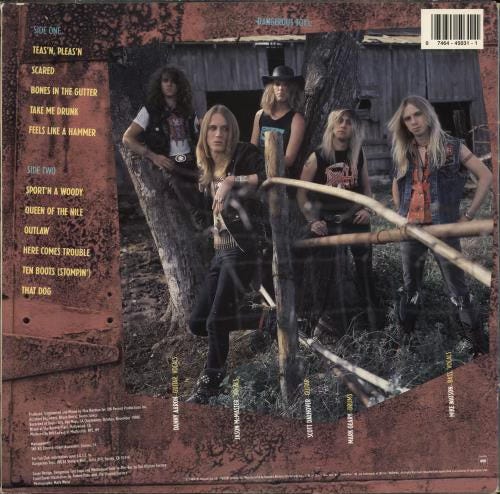
“Ten Boots (Stompin’)” lands as a less interesting version of “Teas’n, Pleas’n.” Same template, lower stakes. “That Dog” feels generic in a way none of the Side A tracks do. “Sport’n a Woody” is lyrically juvenile in a way the rest of the album has the good sense to at least dress up. It’s not offensive, just thin, and it’s over fast enough not to be a dealbreaker. Classic cassette-flip problem: Side A earns the purchase, Side B makes you hit rewind.
The deeper critique, the one that stings, is the comparison test. Appetite for Destruction isn’t just better-produced in the warm-and-fat sense. It has a deeper bench of singles. Every track on that record could have been a single. Dangerous Toys peaks earlier and coasts later, and that gap is where the difference between “Gold record that people still talk about” and “Gold record that became a secret handshake” lives. The talent is here. The consistency isn’t quite.
That said, and this matters, there is not a song on this album that makes you want to skip it forever. Every track delivers conviction. For a genre where filler was practically a feature, that’s a meaningful distinction.
The Grunge Erasure Problem
By 1991, Dangerous Toys were on the Operation Rock and Roll package tour alongside Motörhead, Judas Priest, Alice Cooper, and Metal Church. Right as Alice in Chains and Nirvana were exploding. The tour may not have even completed its run. Whatever momentum they’d built, two Gold-adjacent albums, two Headbangers Ball singles, a recognizable mascot, evaporated practically overnight.
They’d spent their entire touring cycle in the theater-level range: The Cult, Bonham, LA Guns, Faster Pussycat, Trixter. Solid package tours, 5,000-to-8,000-seat rooms. Never arena status. Never the one crossover moment that makes a band untouchable when the tide turns. When grunge arrived, bands at that level had nothing to grab onto. The bands who survived the switch, Aerosmith, Alice Cooper, Ozzy, had legacy status as a lifeline. Dangerous Toys had been a band for four years.
The Austin origin story cuts both ways here. Being outside the Sunset Strip machine gave them their sound. It also left them without the industry infrastructure that kept other acts alive through the transition. There was no big-name manager fighting for their legacy. There was no hometown mythologizing machine. There was just the music, which was genuinely good, and the timing, which was genuinely cruel.
Skid Row and Warrant survived because their radio hooks were more polished, their major-label machinery was stronger, and, let’s say it plainly, the cultural appetite for precisely their version of hard rock held slightly longer. Dangerous Toys were a different proposition: a little rougher, a little stranger, a little more McMaster than market research. That’s exactly what makes the record interesting in 2026. It’s also exactly what made it vulnerable in 1992.
So Where Does This Leave Dangerous Toys?
Here’s where it gets interesting. The fans never left.
Sputnikmusic users rate the album 4.5 out of 5. The r/hairmetal threads are full of people who are genuinely baffled it doesn’t come up more often. Rock and Roll Globe ran a 35th anniversary retrospective in 2024. McMaster himself gave a long, engaged interview about the record in 2025. And in December, the Dig Me Out community voted it to the top of the poll over Ozzy, LA Guns, and Lillian Axe, not because it needed to be discovered, but because it needed to be discussed.
So the question isn’t really whether this album is good. It’s whether “good” was ever the problem. Was it the timing? The mascot? The Austin address instead of a Sunset Strip one? Was Side A strong enough to carry Side B, or did the drop-off cost them the kind of replay loyalty that separates a Gold record people remember from a Gold record people forgot?
All three hosts have their take, and they don’t all agree on where this album lands. You’ll have to hit play to hear the full verdict.
We want yours too. Drop it in the comments: Where does the Dangerous Toys debut sit for you? Top-tier sleaze metal, or a record that peaks too early and coasts? And what’s your favorite track: is it “Scared,” or is there a deeper cut that deserves more love?
Episode Highlights
Intro: Album overview and the December 2025 poll reveal
17:49: Teas’n, Pleas’n, the bluesy opener with a mid-song time signature surprise
20:10: Scared, the unanimous fan favorite and the Alice Cooper cameo story
21:03: Queen of the Nile, the power-pop curveball nobody expected from Austin
26:26: Scared (revisited), playlist staple debate and 35 years of replay value
27:25: Outlaw, Dokken comparisons and the George Lynch guitar tone
27:29: Here Comes Trouble, the hard rocker where McMaster’s voice really lands
28:07: Feels Like a Hammer, the Zeppelin-esque acoustic intro and the power ballad question
29:12: Take Me Drunk, the humor and the misheard lyric that made everyone laugh
30:27: Sport’n a Woody, lyrically juvenile but mercifully short
35:58: Production deep dive, Max Norman’s thrash-adjacent approach and why this isn’t Appetite
40:34: Ten Boots (Stompin’), the Side B drop-off begins
42:27: That Dog, the consensus weak link
46:10: The verdict, where all three hosts land on the album
Outro: Nominator shoutout to Keith Miller
Join the dmounion.com to pick your favorite lost record and join us on the show.
Have a lost or forgotten album that deserves the spotlight? Suggest it here.


