

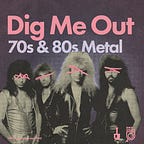


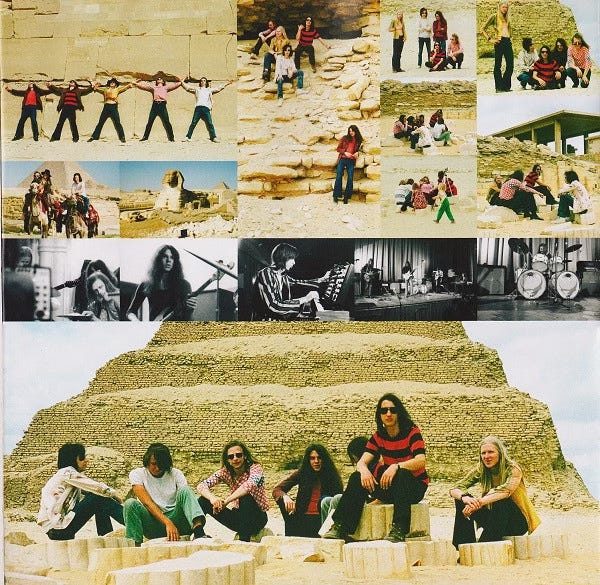
Ever stumble on an album cover in a dusty record bin and think, “I have to know what this sounds like”? That goldish sleeve with four longhaired dudes perched in what looks like a pyramid or mountain, somewhere between ancient ruins and a desert mirage? You’d buy it, wouldn’t you? You’d have no idea if it was recorded in 2026 or 1971, but you’d take it home, drop the needle, and prepare for whatever weird trip awaited.
That’s exactly the vibe Malesch delivers—except none of us on Dig Me Out had ever heard of Agitation Free before our listeners voted it to the top of our January poll. Not one of us. We went in cold, and what emerged from the speakers was something none of us could quite explain: prehistoric and futuristic at once, like a planetarium soundtrack composed by a rock band tripping through Cairo’s street markets.
The Band Nobody Remembers (But Tangerine Dream Does)
Here’s what we knew going in: absolutely nothing. Agitation Free formed in Berlin in 1967 as just “Agitation,” but another band already had the name, so they tacked on “Free” because they were playing a free show. Agitation Free. Agitation for free. Peak ’60s logic, right there.
By 1972, the lineup had shuffled—original drummer Christopher Franks bailed in 1971 to join a little outfit called Tangerine Dream—and the remaining members embarked on a Goethe Institute-sponsored tour through Egypt, Lebanon, Cyprus, and Greece. They weren’t just touring. They were listening. Walking around cities with tape recorders, capturing field recordings of conversations, street sounds, the ambient hum of daily life in the Middle East. Those tapes became the connective tissue of Malesch, the debut album they recorded that summer at Audio-Tonstudio in Berlin.
The album’s title? An Arabic phrase they kept hearing in Egypt: “malesch,” roughly translated as “no worries.” Which feels about right for a record that doesn’t care whether you’re ready for it or not.
What It Actually Sounds Like (And Why You Can’t Describe It)
Okay, so what is this? Imagine the weirdest side of The Doors—those moments when Jim Morrison went full shaman and the band followed him into the desert—colliding with the strange experimental bits of The Beatles and The Who. Add early Scorpions guitar leads (the Uli Jon Roth era, when things got weird), then filter it all through that EMS Synthi A synthesizer that Brian Eno and Pink Floyd were using to make the future sound like it was beaming in from another dimension.
But here’s the thing: it doesn’t really sound like any of that. It sounds like itself.
The record opens with “You Play For Us Today,” a phrase one of the band members heard from a Middle East Airlines pilot on their flight from Beirut to Nicosia. Right away, those analog synth tones wash over you—this is 1972, remember, when synthesizers were expensive, enormous, and still largely mysterious—before the guitars and percussion kick in with a hypnotic, almost primal groove. It’s not aggressive. It’s not loud. But it’s moving, pulling you deeper into its world with every passing minute.
Then comes “Sahara City,” which sounds exactly like walking into the nightclub they played on their first night in Egypt. You can hear the music, smell the incense, see the belly dancers moving through the tent. For a few minutes, it feels like a haunted house movie soundtrack—percussion imitating a clock ticking, eerie synth textures floating in and out—before the band locks into a heavy jam for the final two minutes.
“Khan El Khalili,” named after the famous Cairo bazaar, is where the album truly lifts off. Lutz Ulbrich’s twelve-string guitar lets gleaming light into the darkness, and the band comes together for the most soaring, uplifting music on the record. It sounds like the sun rising over the desert. It sounds like hope cutting through mystery. It’s the moment where you stop trying to analyze what you’re hearing and just surrender to the experience.
The Motorik Beat That Isn’t (And Why That’s the Point)
If you’re familiar with krautrock, you’re probably expecting that motorik beat—the metronomic, driving 4/4 rhythm that Neu! and Can made famous, the sound of the Autobahn unspooling endlessly beneath your tires. But Malesch isn’t interested in that kind of propulsion. Burghard Rausch on drums and percussion is more concerned with texture than groove, more interested in creating atmosphere than locking you into a hypnotic pulse.
That’s part of what makes this record so challenging. There aren’t many drum beats here to grab onto, no steady grooves to anchor you while the guitars and synths spiral off into the cosmos. Instead, you get percussion that feels more like weather—congas and timbales and marimbaphone that ebb and flow, creating mood rather than momentum.
It’s the kind of music that works best when you stop trying to get it and just let it be. Put it on while you’re reading. Let it soundtrack your commute. Play it while you’re shoveling snow or sorting Legos or folding laundry, and notice how it doesn’t demand your attention—it just colors the world around you, like a film score for your everyday life.
Middle Eastern Influence Without the Clichés
What’s remarkable about Malesch is how it incorporates Middle Eastern sounds without turning into some kind of clumsy appropriation or orientalist pastiche. There’s no sitar. There’s no over-the-top “exotic” instrumentation. The band absorbed what they experienced on their tour—the rhythms, the tones, the feeling of those places—and filtered it through their own experimental rock sensibility.
The result is subtle. The Middle Eastern influence shows up in the opening tracks, disappears for a while, then resurfaces around the title track with atmospheric flourishes that remind you where this album was born. It sets a theme without hammering you over the head with it, which is exactly the kind of restraint that separates Malesch from a dozen other ’70s bands trying to sound “worldly.”
The Early Synth Revolution
Let’s talk about Michael Hoenig and that EMS Synthi A synthesizer for a second. In 1972, this thing was cutting-edge. It was expensive, it was temperamental, and it sounded like nothing else. The Synthi A was basically a portable VCS3—famous for its patch pin matrix system instead of traditional patch cables—housed in a briefcase. Brian Eno used it. Pink Floyd used it on Dark Side of the Moon. Roxy Music requested Eno join them after watching him fiddle with it for just a few minutes.
On Malesch, Hoenig uses the Synthi A to create beds of sound, to set moods, to add that analog warmth and unpredictability that makes the album feel alive. The track “Pulse” is basically a showcase for the synth—a repetitive, modulated keyboard pattern that buzzes like bees for a couple minutes before shifting slightly, building tension without ever exploding into a payoff. It’s the most annoying track on the album, but also the one you keep going back to, just to see if you can figure out what it’s doing to your brain.
This is the sound of musicians figuring out what these new tools could do, pushing them into places nobody had gone yet. It’s the same spirit that would later fuel Tangerine Dream, Kraftwerk, and the entire Berlin School of electronic music. Malesch is part of that lineage, even if history mostly forgot about it.
But is it heavy?
Okay, real talk: if you tuned into our 70s and 80s metal podcast expecting riffs and shredding and headbanging, Malesch is going to confuse the hell out of you. This isn’t metal. It’s barely even rock. It’s experimental, improvisational, atmospheric krautrock that has more in common with a Grateful Dead jam or a Tangerine Dream soundscape than anything Black Sabbath ever did.
But here’s the thing: it connects. Not in an obvious way, but in the DNA. The atmospheric end of progressive rock, the motorik-adjacent grooves (when they show up), the willingness to just explore without worrying about radio singles or traditional song structures—that spirit runs straight through to modern bands like Blood Incantation, who released an entire ambient album (Timewave Zero) inspired by this exact lineage. Extreme metal in 2024 is having a full-blown krautrock moment, and Malesch is one of the records that planted those seeds fifty years ago.
Plus, let’s be honest: if you’re deep enough into the underground to care about obscure ‘70s metal, you’re probably the kind of person who appreciates music that sounds like nothing else. And Malesch definitely sounds like nothing else.
Worthy Album, Decent Single, or Pass?
Is this a worthy album? Depends on who’s listening.
If you’re into early ‘70s krautrock—Can, Faust, Amon Düül II, Tangerine Dream—this belongs on your shelf, right next to Tago Mago and Phallus Dei. If you’re looking for head music, for cosmic mind-expanding acid-dripping psychedelic experimentalism (to quote one critic who got it), this is your jam. If you want straightforward rock songs with verses and choruses and hooks, this will drive you insane.
The album works better on streaming or CD than on vinyl—flipping the record over would break the continuity, interrupt the spell. This is music that needs to unspool in one continuous journey, letting you drift in and out of its atmosphere without hard stops.
Critics have called it “psychedelic rock… full of moments of fervor and grace,” “one for all fans of early 70s krautrock,” and “cosmic mind expanding… head music.” The seven tracks of improvisational krautrock fused with Eastern influences create something genuinely original—a record that captures a specific moment in time (Berlin rockers in the Middle East, 1972) but also sounds somehow timeless.
Still Making Music, Still Defying Expectations
Agitation Free didn’t fade away after Malesch. They released a second album (2nd), performed throughout Europe, then broke up and reformed multiple times over the decades. Christopher Franke, their original drummer, went on to become the “Sequencer King” of Tangerine Dream. Michael Hoenig later recorded the ambient classic Departure from the Northern Wasteland.
And in 2023—24 years after their previous album—they released Momentum, with three or four of the original members still exploring that same experimental space, a little jazzier now, a little more structured, but still refusing to play by conventional rules.
For a band that added “Free” to their name just because they were playing a free show, Agitation Free has stayed remarkably true to that spirit of liberation—making music on their own terms, without compromise, for over fifty years.
Malesch by Agitation Free is available on streaming platforms. The 2019 MIG Music reissue includes expanded liner notes and remastered audio.
Dig Deeper: Agitation Free appears on the influential Nurse with Wound list alongside Can, Tangerine Dream, and other krautrock pioneers. The album was recorded at Audio-Tonstudio in Berlin during July 1972. The Vertigo swirl label editions are highly collectible among prog and krautrock enthusiasts.
For Fans Of: Can, Tangerine Dream, Cluster, Blood Incantation’s Timewave Zero, early Popol Vuh, Ash Ra Tempel, Amon Düül II, Grateful Dead’s most experimental jams, planetarium soundtracks, albums that sound like both 1972 and 2072 at the same time.
Songs in this Episode
Intro - You Play For Us Today
12:42 - Malesch
18:14 - Pulse
22:05 - Music Factory (Live)
Outro - Rucksturz


