



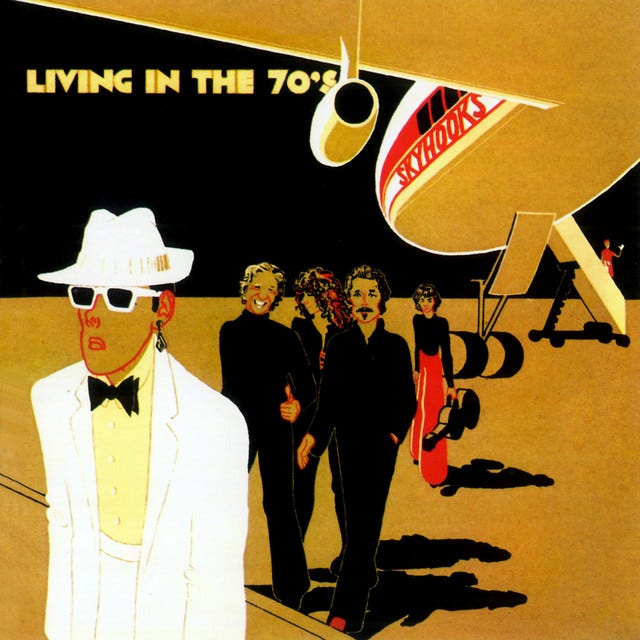
Every episode of Dig Me Out begins with the community. A listener drops a suggestion, the votes roll in, and the most compelling argument wins the floor. This time, listener Eric Peterson nominated Living in the 70s by Skyhooks — then voted against it when the poll opened. Classic. Four albums entered ring: Detective’s self-titled 1977 debut, Hurriganes’ Roadrunner (1974), Thundermug’s Thundermug Strikes (1972), and this one got the most votes.
Want your album in the running? Submit a suggestion — 70s, 80s, 90s, or 00s, all eras are open. Then, become a subscriber and vote on upcoming episodes. Keep the podcast ad-free and make the next episode happen.
Australia’s Biggest Band You’ve Never Heard Of
Here is the deal on Living in the 70s: in Australia, in 1974, this wasn’t a cult record. It was a cultural earthquake.
Released in October 1974 on Michael Gudinski’s fledgling Mushroom Records, the album got off to a quiet start before detonating early in 1975 — sitting at #1 on the Australian album charts for 16 consecutive weeks and becoming the highest-selling album by an Australian artist in the country at that time. It has since shipped over 375,000 copies, a figure that sounds modest until you factor in Australia’s population: fewer people than California, spread across a continent. Proportionally, this was a monster.
The second single, “Horror Movie,” hit #1 on the National Singles Chart in March 1975 — and it wasn’t even about horror movies. More on that in a minute. In 2010, the album was listed at #9 in 100 Best Australian Albums, and the title track ranked #72 on Triple M’s 2018 Ozzfest 100: The Most Australian Songs of All Time. The 50th anniversary reissue in 2025 only cemented its status as foundational Australian rock. And yet — virtually invisible outside its home country for fifty years.
The Band
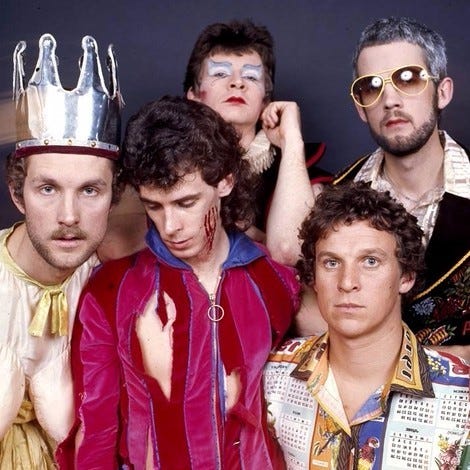
Skyhooks had only been together for about a year when they made this record. The lineup: Greg McCainsh on bass and backing vocals, Bob “Bingo” Starkey on guitar and backing vocals, Red Simons on guitar, mandolin, and backing vocals, Freddy Strauks on drums and percussion, and Graham “Shirley” Strachan — pronounced, inexplicably, “Strawn” — on lead vocals.
Strachan was the engine. A larrikin in the truest Australian sense — wit-sharp, theatrically fearless, and possessed of a vocal tone that didn’t sound quite like any other male rock singer of the era. His post-Skyhooks careersprawled into children’s television (Shirl’s Neighborhood, 1979–83) and home renovation hosting (Our House) before he died in a self-piloted helicopter crash in August 2001. Guitarist Red Simons went in a different direction — spending decades as the resident gonger on beloved Australian variety institution Hey Hey It’s Saturday, publicly humiliating amateur performers for 28 years. These were not conventional rock band trajectories.
The album was produced by Ross Wilson, a songwriter and Australian scene fixture whose credits ranged from Daddy Cool to Mighty Kong. He gave the record a clean, punchy sound that still holds up — which makes the commercial radio ban all the more absurd.
The Sound That Blindsides You
Walk into Living in the 70s expecting pub rock and you will be disoriented within thirty seconds. This is not a guitar-forward record. It’s bass-driven, rhythmically varied, and built around Strachan’s voice rather than a lead guitar hero. The production is lean — some tones are surprisingly small and nuanced — but the energy is relentless.
What the album actually sounds like is a blender set to “eclectic.” “Whatever Happened to the Revolution” opens with a boogie swagger that anticipates the sleazier corners of late 80s hard rock — specifically the kind of Black Oak Arkansas-indebted groove that bands like Dangerous Toys would revisit a decade and a half later. “Carlton (Lygon Street Limbo)” tucks a brief Caribbean rhythm into a Melbourne street narrative. “Smut” plays like two different personalities sharing one microphone — darker, stranger, more theatrical than anything else on the record. “Reckless” drifts into cosmic cowboy territory that wouldn’t feel out of place in the Texan outback. And then there’s the title track: jaunty, almost power-pop, melody-first in a way that keeps catching you off guard.
The unifying thread is theatricality. These songs are set pieces. Characters and places, delivered by a vocalist with genuine dramatic range — one who could come across, on first listen, as a woman, or as an Australian cousin to Alice Cooper, or as a lead in a production that Rocky Horror hadn’t quite invented yet. The band performed in full face makeup and costumes, a visual provocation in 1974 Australia that landed harder than it reads today.
“Horror Movie” and the Art of the Disguised Gut Punch
The most enduring track on the record is “Horror Movie,” and it’s also the cleverest. Written by bassist Greg McCainsh, the song presents itself as a campy, glam-infused rocker — the kind of hook that lodges in your skull immediately. Then you catch the lyric: It’s a horror movie right there on my TV / Horror movie, it’s the 6:30 news.
The song is about the nightly news. The relentless parade of murders, fires, and violence packaged and delivered to Australian living rooms every evening. Social commentary dressed up as a dancefloor banger, debuted live on Countdown the very day Australian television went to color. In 1975, that juxtaposition hit differently. Six songs on the album were banned from commercial Australian radio for content deemed too risqué — songs like “You Just Like Me Because I’m Good in Bed,” “Smut,” and “Motorcycle Bitch.” The first song played on Triple J when the station relaunched to target younger listeners? “You Just Like Me Because I’m Good in Bed.” Quite the programming choice.
At some point in 1974–75, at the height of their commercial dominance, Skyhooks headlined a show. Two of the opening acts were AC/DC — then a barely-formed Melbourne band with one single to their name — and Split Ends, the New Zealand art-rock outfit that would eventually dissolve and re-emerge as Crowded House. Three radically different bands, three radically different futures, one bill. And Skyhooks was the headliner. That’s a footnote worth sitting with: the band that time forgot was, for a moment, more important than two bands that wouldn’t be forgotten.
The American rock narrative of the 70s is dominated by a small group of bands — Zeppelin, Sabbath, Aerosmith — whose shadow is so long it has, for fifty years, made the rest of the decade nearly invisible. What Living in the 70s represents is an entire parallel universe: bass-driven, theatrical, lyrically provocative rock that flourished completely outside that shadow and then, largely, never made it over the equator.
How many records like this are still waiting to be dug out?
Hear the Full Conversation
The episode covering Living in the 70s is live now. J, Tim, and Chip dig into every track — what holds up, what doesn’t, which songs deserve a spot on your playlist, and what this album says about the forgotten geography of 70s rock. Listen to the full episode.
Songs in this episode
Intro - Living in the ‘70s
15:39 - Balwyn Calling
24:40 - Whatever Happened to the Revolution
26:18 - Carlton (Lygon Street Limbo)
29:04 - Kashmir (cover by The Party Boys)
32:24 - Horror Movie
Outro - Smut


