



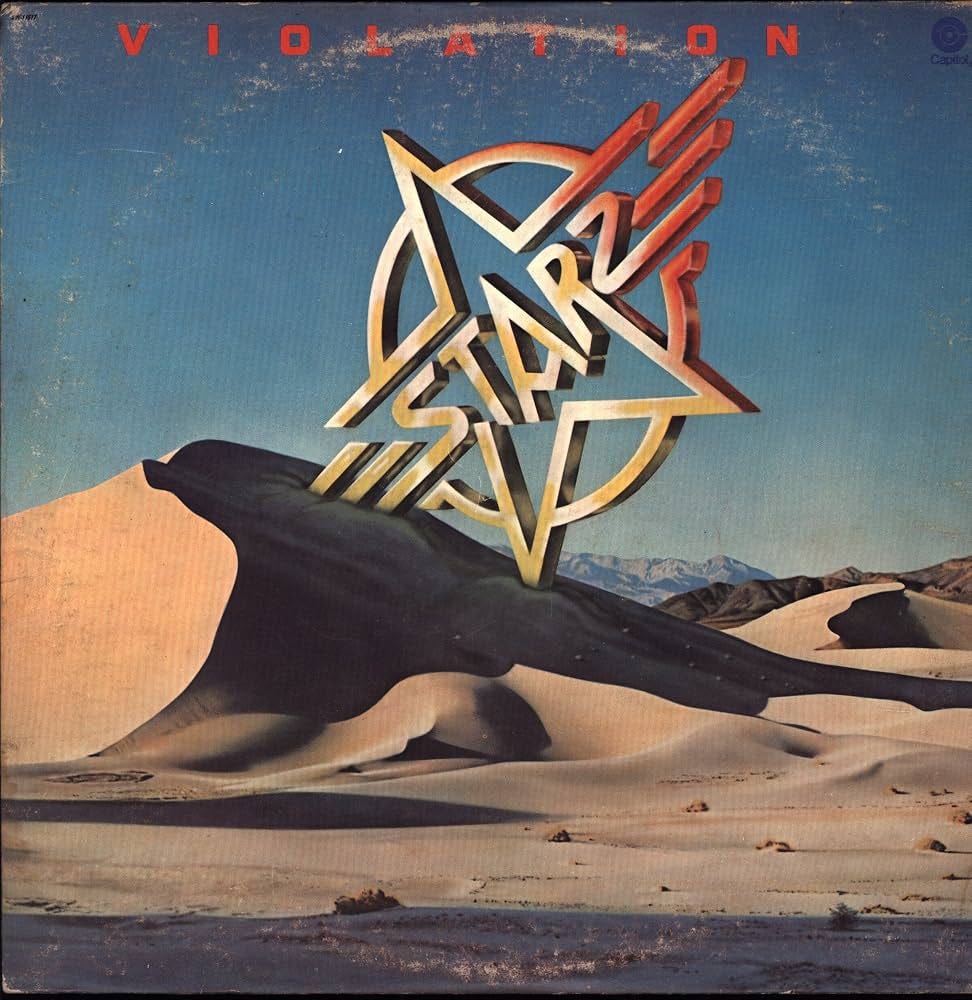
Our September community poll landed on Starz’ 1977 second album, Violation. It is a Capitol Records hard-rock record produced by Jack Douglas, packed with melody, musical left turns, and just enough KISS-world mythology to make you wonder why it never became a household name. Want to bring YOUR favorite lost album to the table? Suggest it for a future episode or community poll.
How Did This Miss?
How did a band with KISS connections, a Capitol deal, and a Top 40 single disappear?
That is the question sitting at the center of Violation. Starz had Bill Aucoin, the manager best known for building KISS into an arena-sized phenomenon, in their corner. They recorded with Jack Douglas, who had already helped define the early sound of Aerosmith. Guitarist Richie Ranno would later play on Gene Simmons’ 1978 solo album. On paper, that sounds like a straight line to something much bigger.
Instead, Starz became one of those bands musicians remember, crate-diggers defend, and casual rock fans somehow never encountered. Their second album reached No. 89 on the Billboard 200, while “Cherry Baby” climbed to No. 33 on the Billboard Hot 100, their biggest single. That is not nothing. But it is also a long way from the level of cultural permanence enjoyed by KISS, Cheap Trick, or the Raspberries.
The story gets stranger because the ingredients are all here. Violation was cut at New York’s Record Plant and A&R Recording, with engineer Jay Messina, then released by Capitol Recordsin 1977. It is polished without becoming sterile, heavy without leaning fully into metal, and pop-minded without abandoning the odd instincts that separate a durable rock record from a stack of forgotten radio singles.
What we hear is a band caught in the productive friction between accessibility and ambition. Starz could write a chorus that felt built for FM radio. They just could not always resist making it stranger.
The Hooks Have Teeth
“Cherry Baby” makes a very persuasive opening argument.
The song has the kind of chorus that feels instantly familiar, as if it had always been tucked between “Surrender” and “Come On Feel the Noize” on a late-night rock-radio playlist. Its peak at No. 33 makes sense. The hook is immediate, bright, and almost bubblegum in its simplicity, yet the rest of the arrangement is tougher and more restless than the chorus initially suggests.
That tension runs through the best parts of Violation. “Rock Six Times,” “Sing It, Shout It,” and the title track follow the same basic mission: make hard rock that is catchy enough to sing after one pass, then complicate the route there. “Sing It, Shout It,” written with Sean Delaney and Jon Parrot, is especially revealing. The chorus carries a KISS-sized command, but the verses take higher, more theatrical melodic turns than that comparison would imply.
If you love the pop instincts of Cheap Trick, the crunch of KISS, and the melodic audacity of Styx, this is the zone where Starz earns its reputation. The songs are not simply built around a riff and a slogan. They contain overlapping guitar lines, unexpected vocal peaks, and arrangements that keep shifting once you think you have them mapped out.
That may also be part of the commercial problem. KISS often made the obvious choice feel inevitable. Starz frequently makes the more interesting choice, and interesting is not always the same as instantly legible. Violation asks you to stay with it past the first hook.
Heavy Without the Wall
The heaviness on Violation comes from the rhythm section, not from a blanket of distortion.
That matters. The album’s guitars are often clean to lightly overdriven, leaving space for Richie Ranno and Brendan Harkin to stack melodic parts rather than simply bulldoze the mix. The bass is loud, active, and occasionally fuzzed into something genuinely nasty. It gives “S.T.E.A.D.Y.” and “Subway Terror” their weight without sacrificing the clarity of the playing.
It is a very 1977 kind of production choice, and Jack Douglas knew how to make it work. Listen to early Aerosmith or the classic AC/DC records: the guitars are not always saturated, but the band feels huge because you can hear the strings, the pick attack, the bass movement, and the drummer pushing behind the beat. Violation lives in that same open-air mix.
“S.T.E.A.D.Y.” is one of the record’s best examples of Starz refusing to settle. It begins in a slower, heavier mode, then pivots toward an unexpectedly buoyant chorus. The song pulls downward with the riff and then keeps trying to lift itself free. “Subway Terror” is rougher and more direct, but it has its own weird, skewed momentum. Both tracks show a band more interested in movement than in simply repeating a successful formula.
That is why the album can sound more sophisticated than some of the groups it is routinely compared with. The music may share DNA with KISS, Angel, and power-pop contemporaries, but the internal logic is more complicated. Starz wants the hook. They also want the detour.
The Back Half Problem
Violation is strongest when it is either fully sweet or fully strange.
The opening run is formidable: “Cherry Baby,” “Rock Six Times,” “Sing It, Shout It,” and “Violation” make a convincing case for Starz as overlooked late-1970s melodic hard rock. The original nine-song LP is only 36 minutes long, so there is little room for filler. Yet the second side occasionally settles into a more generic boogie-rock lane, especially on “All Night Long” and “Cool One.”
Those songs are not disasters. They simply do not generate the same friction. They feel closer to familiar early- to mid-1970s rock language, where a good groove and an easy chorus can carry the day. Starz is more compelling when its writing gets less comfortable, when the band lets the singer climb, the bass growl, or the guitars lean into their off-kilter melodic chemistry.
That makes the album’s closing track, “Is That a Street Light or the Moon?,” such a fascinating problem. It is theatrical, high-voiced, and almost Broadway-adjacent in spots. It does not sound like the predictable pre-power-ballad move a band of this era might have made. Instead, it feels like Starz trying on a different identity in public.
Does it fit? Not neatly. Is it memorable? Absolutely.
This is the contradiction that makes Violation worth returning to. We can imagine a tighter, more commercially ruthless record with nine “Cherry Baby”-level choruses. We can also imagine a bolder album that goes all-in on “S.T.E.A.D.Y.” and the closing track’s dramatic weirdness. Starz gives us both impulses, sometimes in the same song.
The Band That Could Not Decide
Starz had the sound. What they lacked was a single, unmistakable identity.
That may sound harsh, but it explains a lot. KISS had the makeup, the mythology, and an instantly recognizable visual language. Cheap Trick had the oddball cool of Rick Nielsen, the beautiful-people-versus-misfits tension, and the songs to make all of it stick. Starz had a sharp logo, a major-label platform, a manager who understood presentation, and a set of musicians capable of delivering serious melodic hard rock.
But what exactly were they selling?
A future-dystopia concept involving forbidden rock and teenage rebellion? A glossy power-pop band with hard-rock guitars? A proto-glam influence? A smart, musician-friendly band working just outside the center of the mainstream? The answer is all of the above, which is artistically more interesting than a neat brand strategy but commercially confusing.
That is not just hindsight. The album’s reception has always seemed divided between listeners who hear the melodic craft and listeners who hear cheese. AllMusic describes Starz’s approach as sleek, commercial hard rock that pointed toward what would later be called pop-metal. That feels right, but it also underlines the timing issue. Violation arrived before the 1980s market fully rewarded this exact blend of big vocals, polished production, and hard-rock punch.
The future musicians who praised Starz were probably responding to those little glints of possibility. Not necessarily a wholesale blueprint, but a set of signals: the melodic reach, the punchy bass, the willingness to put something weird inside a catchy rock song.

Our Verdict
Violation is the kind of record that makes the Dig Me Out case for itself.
The record has flaws. It can lose focus on the back half. Its identity is fragmented. “Cherry Baby” may set expectations for a more consistent rush of sugar than the rest of the record delivers. But the best songs have real staying power, and the playing rewards the kind of attention that these albums rarely got in their original moment.
The external case is stronger than you might expect. “Cherry Baby” was a genuine Top 40 hit, the album charted, and the group’s KISS-adjacent history is well documented. Yet the stronger argument is in the listening: this is a smart, strange, melodic hard-rock record from a band that should be much easier to place in rock history than it is.
Was Violation an overlooked classic, a great half-record, or an album that works better as a tightly sequenced EP? Is “Cherry Baby” the accessible entry point or a misleading promise? Does “Is That a Street Light or the Moon?” close the album brilliantly, or does it wander in from another record entirely?
Listen to the full episode for our final verdict, then drop your own take in the comments. Which Starz song gets its hooks into you, and which one leaves you cold?
Episode Highlights
00:44: The September poll, how Violation beat Wishbone Ash, 1994, and Rose Tattoo
02:26: The KISS connection, Bill Aucoin, Richie Ranno, and Gene Simmons
07:23: Starz’s origin story, Capitol Records, Jack Douglas, and “Cherry Baby”
11:37: Why musicians championed Starz even when the public largely did not
16:44: “Sing It, Shout It,” “S.T.E.A.D.Y.,” and the sophisticated melodic twists
22:14: Michael Lee Smith, Rex Smith, and the album’s theatrical vocal range
30:07: “Subway Terror,” “Violation,” and the harder-edged side of the record
32:41: “Is That a Street Light or the Moon?,” the strange closing track
38:40: Why Violation may have been buried by timing, promotion, and unclear identity
44:30: What does not work, from “Cool One” to the album’s inconsistent second half
56:22: Final verdicts, worthy album versus better EP


