



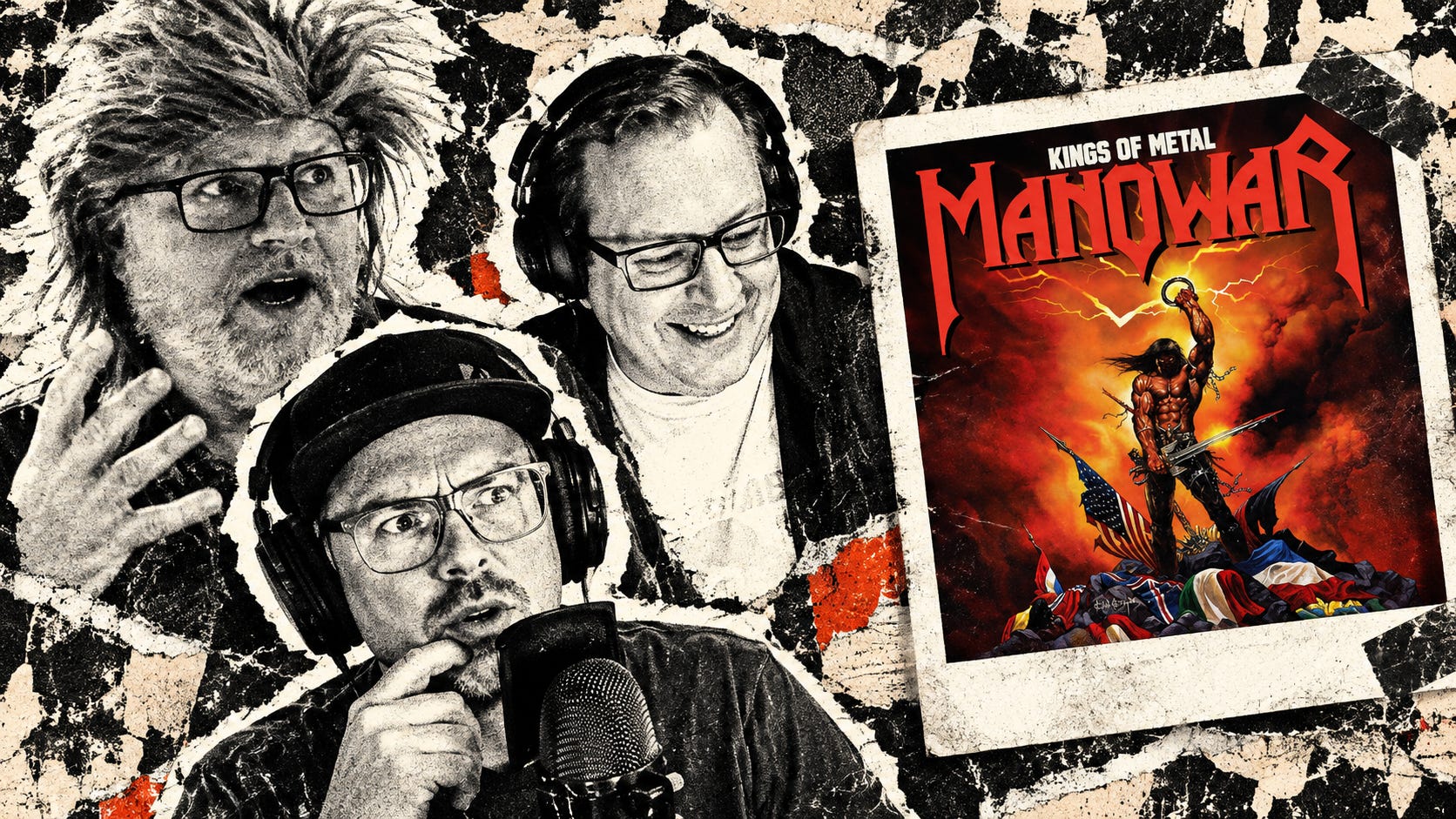
Gavin Reid brought Manowar’s Kings of Metal to the table because, when the eternal “what counts as metal?” argument flares up, few records answer with more volume, leather, choirs, and absolute conviction. Released November 18, 1988 on Atlantic Records, it is the sound of an American band building a fantasy kingdom large enough to contain power metal, traditional heavy metal, and a bass solo based on Rimsky-Korsakov. Want to bring YOUR favorite lost album to the table? Suggest it for a future episode.
What if metal’s loudest band is also its most theatrical?
There is no easing into Kings of Metal.
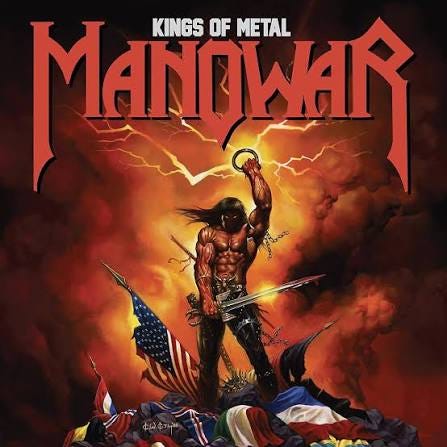
The opening seconds of “Wheels of Fire” arrive at full gallop, far faster and sharper than the cartoonish cover art might lead you to expect. Then Manowar makes its real move: it refuses to stay in one place. A charging opener gives way to the chant-ready title track, then the grand balladry of “Heart of Steel.” Before long, we are hearing choirs, ceremonial piano, dramatic narration, a full-throttle interpretation of “Flight of the Bumblebee,” and enough battle imagery to fill a paperback fantasy shelf.
That range is the record’s real surprise. We came in expecting something closer to a blunt-force, fist-pumping version of classic metal. What we found was a band trying to make every song feel like a scene in an imagined production, somewhere between arena metal, sword-and-sorcery paperback art, and musical theater with amplifiers stacked behind it.
That approach can be ridiculous. It is often supposed to be. The key is whether you agree to the terms.
Manowar asks us to suspend disbelief, step through the castle gate, and accept that every chorus should sound like a declaration from a mountaintop. Once we do, the album becomes strangely inviting. Its bombast does not repel so much as pull us toward the campfire, hand us a sword, and tell us there is a battle at dawn.
The American band that sounded European
Manowar formed in Auburn, New York, yet Kings of Metal often feels imported from another continent and another century. Joey DeMaio, Eric Adams, Ross “the Boss” Friedman, and Scott Columbus sound less interested in documenting late-1980s America than constructing their own version of European myth and battlefield folklore. The album was recorded at Universal Recording in Chicago, with the Canoldir Male Choir recorded in Birmingham, England.
That contradiction is part of the record’s charm. This is not Iron Maiden, with its detailed historical narratives and carefully researched time travel. Manowar’s world is broader, blurrier, and more proudly invented. Crowns, rings, armies, ale, steel, kings, conquest, and doomed warriors all appear, but they do not always lock into one consistent story.
Instead, the songs build atmosphere. “The Crown and the Ring (Lament of the Kings)” is stately and mournful, as if the band has suddenly wandered into a cathedral. “Kingdom Come” carries an almost AOR-sized melodic sweep beneath its metal armor. “Blood of the Kings” reaches for seven-minute epic territory, where the band seems determined to make every last gesture land with maximum gravity.
This is power metal before the genre had settled into its later habits. You can hear the lineage toward bands such as Blind Guardian, Týr, and the broader fantasy-metal world, but Manowar still sounds uniquely American in its need to declare itself the biggest, loudest, and most definitive version of everything.
The hooks are stronger than the armor
The title track makes the whole case in under four minutes.
“Kings of Metal” is an anthem built around a call-and-response hook so obvious that it barely needs instructions. The song’s joke, if it is a joke, is that Manowar spends its self-coronation anthem insisting that it alone represents “true metal,” while musically landing somewhere closer to a stripped-down Motörhead or AC/DC stomp than a complicated power-metal epic.
That is exactly why it works. The riff is direct, the chant is immediate, and the band’s unblinking seriousness turns the whole thing into a communal ritual. You can imagine a room full of fans shouting it back before the song has reached its second chorus.
But the album has more going on than its slogans suggest. “Heart of Steel” is a towering metal ballad whose choir and large-scale arrangement make it feel much closer to a dramatic showstopper than a standard slow song. “Hail and Kill” has the kind of enormous, battle-ready chorus that explains why this material lives on in Manowar’s concert mythology.
Then there is “Sting of the Bumblebee,” Joey DeMaio’s bass-driven adaptation of Nikolai Rimsky-Korsakov’s “Flight of the Bumblebee.” It is flashy, goofy, technically impressive, and not entirely necessary. But that combination may be the most Manowar thing on the record.
The record’s biggest enemy is its sequence
Kings of Metal has the ingredients of a focused fantasy-metal statement. Its sequencing keeps getting in the way.
The first four songs alone jump from speed metal to chant anthem to power ballad to virtuoso instrumental. The variety is admirable, but it also makes it difficult to settle into an arc. Rather than gathering momentum, the album repeatedly changes costumes before the last scene has landed.
The strangest placement is “The Warriors Prayer,” a spoken fantasy monologue with sound effects that arrives as the ninth track. It has all the qualities of an opening invocation or closing epilogue. Instead, it appears just before the final epic, which makes it feel as though the record has suddenly remembered it needs a plot.
A more deliberate version might open with a shortened “The Warriors Prayer,” charge into “Kings of Metal” or “Hail and Kill,” and let the record gradually become more ceremonial. Even Manowar’s 2014 re-recording, Kings of Metal MMXIV, revised the running order and left “Pleasure Slave” behind.
The variation does make every song distinct. Still, a record this theatrical needs pacing. If you are going to build a kingdom, the rooms should connect.
Where the fantasy breaks down
Manowar’s total commitment is the album’s superpower. It is also the source of its most dated moments.
“Pleasure Slave” is the clear problem. Originally left off the single-LP vinyl edition but included on most CD editions, it is not just uncomfortable because of its lyrics. It also drags the album away from its grand fantasy frame into a strain of 1980s metal sexuality that feels lazy, ugly, and dramatically smaller than the rest of the record.
There are other moments where the band’s obsession with dominance becomes more exhausting than empowering. Manowar does not merely want to play metal. It wants to be the kings of it, louder than every rival, tougher than every rival, more authentic than every rival. That absolutism is part of the fun, until it is not.
Yet there is something oddly compelling about a band that never breaks character. Manowar does not wink. It does not hedge. It does not step outside the costume to reassure us that everybody is in on the joke. The band commits so completely that its silliness becomes a kind of sincerity.
That is why the comparison to fantasy fiction matters. This is escapism on a different scale. Some metal confronts reality, anger, alienation, or personal damage. Kings of Metal walks away from reality and builds a parallel universe with flags, armies, choirs, and a bass solo in the middle of it.
Our verdict: How much fantasy do you want?
Kings of Metal remains a deeply divisive record, even inside our own conversation.
There is no debate that the playing is formidable, the vocals are huge, and the production gives the material enough scale to support its grandest claims. The album’s appeal comes from its ability to make classic metal feel theatrical, melodic, and surprisingly accessible, even when the imagery promises something far more intimidating.
But the flaws are not minor. The sequencing scatters the momentum. “Pleasure Slave” deserves its reputation as the track to skip. “The Warriors Prayer” feels stranded in the wrong part of the record. And the gap between Manowar’s self-proclaimed “true metal” status and the actual music can raise an eyebrow, especially when the title track’s simple rock-and-roll stomp carries the band’s loudest declaration.
So where do you land?
Does the album’s theatricality make it more fun, or less credible?
Would a better sequence turn this into a true front-to-back classic?
Is “Kings of Metal” a perfect anthem, or Manowar’s funniest contradiction?
Which song carries the real heart of this record: “Heart of Steel,” “Hail and Kill,” or “Blood of the Kings”?
Listen to the full episode for our final ratings, then drop a comment and tell us whether Manowar earned the throne or merely built the loudest castle. The community vote was unanimous: 100 percent landed on “worthy album.”
Episode Highlights
00:48: Gavin Reid joins us with a fantasy-metal pick and a formidable mullet
02:02: Why Kings of Metal became the album to test the “what is metal?” debate
05:38: The 1988 Atlantic Records release, lineup, and why Manowar felt like a magazine band
12:56: The original vinyl versus CD track lists, including the infamous “Pleasure Slave”
14:00: “Wheels of Fire,” theatrical vocals, and the unexpected accessibility of Manowar
19:58: “Heart of Steel,” choirs, Soviet-scale grandeur, and power metal’s emotional pull
26:07: “Kings of Metal,” hooks, call-and-response, and the band’s true-metal claim
30:55: Why the album’s sequence undermines its own fantasy-world logic
36:06: “Pleasure Slave,” lyrical misfires, and the songs we would remove
45:38: The revised Kings of Metal MMXIV track list and what it fixes
49:50: Our Album, EP, or Decent Single verdicts
53:46: The community’s unanimous verdict and Manowar’s fantasy-fueled fan culture


