



Our latest 70s metal ballot took a hard left turn into lore, with the community pulling us toward a proto metal curiosity hiding in Billy Joel’s past: the lone self titled album by Attila, his short lived duo with drummer Jon Small. Voted in over 1970s picks from Blue Öyster Cult and Rick Springfield, this record asks a simple question: what happens when a future piano man tries to out heavy Deep Purple and Black Sabbath? Want to bring YOUR favorite lost album to the table? Suggest it for a future episode.
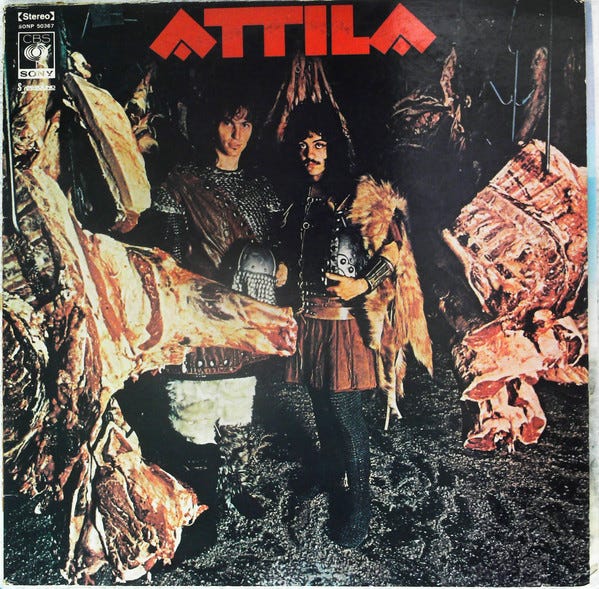
Heavy metal in the meat locker
The Attila story starts in the New York club circuit of the late 1960s, where Billy Joel and Jon Small cut their teeth in Long Island band The Hassles before deciding to strip things down, turn the amps up, and chase the emerging heavy rock wave. By 1969 they had walked away from their psych rock outfit, signed with Epic Records, and cut a duo album that replaced guitar and bass with an overdriven Hammond organ fed straight into Marshall stacks.
The self titled Attila album landed in July 1970, right as Sabbath, Zep, and Purple were defining what “heavy” meant to rock audiences. On paper it looked like a novelty, with a now notorious meat locker cover showing Joel and Small posing among hanging sides of beef, equal parts barbarian cosplay and bargain bin oddity. Inside, though, is a sincere attempt to match the volume and aggression of British heavy rock with nothing but organ, drums, and a 21 year old singer pulling every Robert Plant inspired scream his lungs will allow.
That context matters because it explains both the ambition and the backlash. Stephen Thomas Erlewine famously called Attila “undoubtedly the worst album released in the history of rock and roll,” while other writers have heard it as a chaotic joke that Joel himself never quite got. We came in knowing the reputation, but once we sat with the record, the story felt less like a punchline and more like a strange, almost alternate timeline for one of rock’s most conservative songwriters.
Organ instead of guitars
The first thing that hits you on Attila is not the songs, it is the sound. Joel is handling lead lines, riffs, bass, and chords on that single Hammond, all run into Marshall amplification that gives the entire record a fuzzed out, almost guitar like grind. On opener “Wonder Woman” and “California Flash,” the organ tone sits somewhere between Deep Purple’s Mark I era and a grittier club band, with the left hand pumping out bass figures while the right hand dives into distorted leads that often pass as rhythm guitar on first listen. You can hear how much this solves some of the late 60s recording limitations, because that saturated organ occupies plenty of sonic space without the brittleness that plagued early heavy guitar recordings.
That approach reaches its most Sabbath like moments on “Tear This Castle Down,” where the riffs and bass lines feel like they were written for Tony Iommi and Geezer Butler, only to be re routed through keys instead of strings. The band leans into that heaviness by arranging long, multi part pieces like “Amplifier Fire (Part I: Godzilla / Part II: March Of The Huns),” which rides an almost proto doom stomp before morphing into jammy, martial sections that show off Joel’s speed and Small’s stamina. When the record moves into “Holy Moses” and the closing instrumental “Brain Invasion,” the organ becomes outright shreddy, with runs that reminded us of later guitar hero records, except every note is coming from manuals and pedals rather than a fretboard.
Vocally, what stands out is how much power there is relative to other proto metal curios from the same era. We have covered plenty of early 70s heavy bands whose singers struggle to compete with their own rhythm sections, but here the voice cuts through with a full bodied, wailing delivery that feels more aligned with classic British hard rock than the cult obscurity bin. If you go back to Cold Spring Harbor a year later, or even forward to Piano Man, you can hear flashes of the same melodic instincts in lines that pop up for a bar or two in Attila’s otherwise riff driven songs.
Ahead of its time, short on songs
For all the sonic fun, Attila is not a secret masterpiece hiding in plain sight, and our conversation kept circling back to the same sticking point. There are almost no actual songs here, at least not in the way we usually talk about hooks and choruses. The record feels performance first, stitching together riffs, rhythmic hits, and extended instrumental passages into eight tracks that often blur into one another if you are not actively counting track changes. “California Flash” might be the clearest example of the tension; the chorus tries to lift with a simple ascending melody, but the lyrics are goofy enough that it veers into cringe and undercuts the musical punch.
That writing gap becomes more striking when you lay this album next to Cold Spring Harbor, which arrived only about fourteen months later with songs like “She’s Got a Way” and “Everybody Loves You Now.” One year you have extended Hammond jams about medieval sieges, the next you have compact, emotionally articulate piano ballads and proto singer songwriter material that would eventually lead to The Stranger. It creates this cognitive dissonance where you almost have to assume Attila was partly an attempt to ride a trend, a local band asking “what if we just did our own Deep Purple and Sabbath hybrid to get out of Long Island.”
If you approach Attila expecting fully formed songs, you will probably find yourself lost somewhere in the suite “Amplifier Fire” or spacing out during “Rollin’ Home,” realizing you cannot remember a chorus or lyric you want to return to. That is where the record works better if you think of it as a concept or jam project that never quite committed to being instrumental, rather than a heavy rock LP aimed at the singles and radio market. We found ourselves agreeing that the best way to appreciate this band is as an EP length experience focused on a handful of standout tracks, with the rest functioning as curiosities and context rather than essentials.
Billy Joel, alternate timeline
The human drama around Attila is almost as compelling as the music, and it gives the record a strange, bittersweet weight. Joel and Small not only left their previous band together, they also wound up in a personal triangle when Billy began a relationship with Jon’s wife, an affair that effectively ended their musical partnership. In interviews, Joel has talked about how badly the Attila era wrecked him, including a failed suicide attempt involving household cleaners and a subsequent period of depression as he watched his early band and record fall apart. That sense of failure hangs over the lore, right down to the story that he once tried to buy and destroy copies of the album from record stores because he hated it so deeply.
When you remember that he was only around twenty one when Attila came out, the ambition and the emotional volatility make more sense. This is a young player, heavily influenced by the Beatles and British Invasion pop, who somehow ended up fronting a two man heavy rock experiment that cleared most of its audiences out of the room. It is not hard to imagine an alternate universe where Attila tightens up, adds a guitarist, and turns Joel into a full time organ slinger in some American answer to Uriah Heep or Whitesnake, rather than the arena piano balladeer we know.
There is also a fascinating afterlife to Jon Small’s career. Instead of continuing as a drummer, he moved into video production and eventually worked on Billy Joel’s live concert films, a surprising reconciliation given the personal history that broke the band in the first place. Meanwhile, the Attila album has been reissued and repackaged in bootleg form over the decades, sometimes even marketed explicitly as a Billy Joel title in territories like Italy and New Zealand, complete with mismatched cover art that has nothing to do with the original meat locker concept. For a record its own creator wishes would disappear, it has an uncanny habit of resurfacing whenever someone wants to tell the story of “Billy Joel’s metal band.”
Proto metal, retro ears
Listening in 2026, one of the strangest pleasures of Attila is how modern it can feel if you strip away the reputation and origin story. If you played “Wonder Woman,” “California Flash,” or “Revenge Is Sweet” for a young garage rock or stoner rock fan today and told them it was a new band from Detroit, there is a decent chance they would hear it as a retro cool heavy psych record rather than a historical oddity. The Hammond tone, the raw drum sound, and the loose arrangements sit right next to the aesthetics that bands in the Third Man Records orbit have been mining for years, from The Dead Weather to The Raconteurs.
That retro compatibility is why we kept drifting into fantasy bookings during the episode. The idea of a band like Fu Manchu slowing “Wonder Woman” down into a giant fuzz riff, or Jack White pressing a lovingly remastered Attila reissue for Record Store Day, feels weirdly plausible once you sit with these tracks. Part of the charm is that nobody, to our knowledge, has actually covered these songs, which means the right band could rescue them from novelty status and reframe them as foundational deep cuts in the lineage of heavy organ rock.
At the same time, you cannot completely detach Attila from the Billy Joel name. The knowledge that this is “the Piano Man guy” shapes how critics and fans react, whether that means harsher reviews from rock historians or raised eyebrows from casual listeners who only know “Uptown Girl.” We found that the most rewarding way to listen is to consciously bracket the future star and imagine this as a one off by an unknown duo, then go back and catch all the little melodic and harmonic fingerprints that would later show up in his mainstream work.
Verdict
By the end of the episode, we all landed in roughly the same place: Attila is a fascinating, often thrilling artifact that works best in short doses. There is an EP buried here, anchored by “Wonder Woman,” “California Flash,” “Revenge Is Sweet,” and “Tear This Castle Down,” that we would happily spin again and share with friends who love heavy organ and proto metal oddities. Beyond that core, the record starts to feel like a document of a young band overextending itself, stretching ideas into suites and solos that do not have the melodic or lyrical weight to justify their length.
What makes it worth hearing is not the songwriting so much as the combination of context and execution. This is a 1970 heavy rock album with no guitars, a proto metal document that hints at Sabbath and Deep Purple while sounding like neither, and an early showcase for a keyboard player whose future career would revolve around carefully crafted, radio friendly piano songs. If you are a Billy Joel fan, a 70s metal obsessive, or just someone who loves weird corners of rock history, Attila is one of those records that can rewire how you think about career arcs and genre boundaries.
We left the conversation with more questions than answers. How different would the rock canon look if this band had made a second, more focused record instead of imploding? What forgotten heavy albums from future adult contemporary stars are still hiding out there? And what would it take for a modern band to adopt Attila’s organ driven template and push it forward instead of treating it as a punchline? For now, Attila remains a cult curiosity that lives on YouTube and archive rips rather than streaming, and the only way to get our full verdict is to queue up the episode, ride through the meat locker with us, and drop your own take in the comments.
Episode Highlights
01:18: Poll rundown: Blue Öyster Cult, Rick Springfield, Attila, Circuit Rider, and who nominated what.
02:36: Billy Joel deep dive, from The Hassles to Attila to early bootleg compilations.
10:13: Reading the infamous “worst album in rock history” review and reactions.
17:21: Breaking down the Hammond through Marshall sound and the Sabbath sized weight of “Tear This Castle Down.”
24:14: Why the first three tracks feel like a legit heavy rock deep cut EP.
32:02: The post Attila crash, suicide attempt stories, and the Cold Spring Harbor pivot.
53:38: Imagining Attila reissues, stoner rock covers, and a “before they were famous” series on other artists.


