



What happens when a major-label metal band is too melodic for the underground and too early for the hair-metal boom?
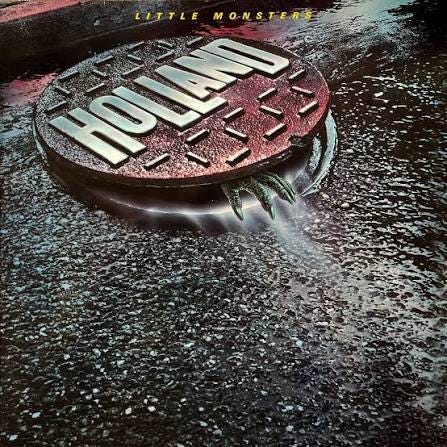
In 1985, the center of gravity for American hard rock was pulling hard toward Los Angeles. The visual language was getting louder, the choruses were getting bigger, and labels were figuring out how to sell a band in a single MTV clip. But Holland came from Chicago, and Little Monsterssounds like it.
The album arrived on Atlantic Records, a genuine major-label bet on singer Tom Holland and guitarist Michael Angelo Batio, years before Batio became synonymous with full-speed technical guitar spectacle and the famously multi-necked instruments of Nitro. That contrast is the first surprise. Little Monsters has plenty of shred, but it is not built to make the guitarist the entire event.
Instead, this is a compact, 34-minute album of tight songs, chunky guitars, sharp lead work, and a vocal presence that can carry melody without sanding down the record’s hard-rock edges. The songs rarely stretch past four minutes. No grand power ballad arrives to halt the momentum. Holland gets in, lands the hook or riff, gives Batio room to burn, then gets out before the whole thing turns into a clinic.
That economy makes the album feel less like a leftover from the Sunset Strip and more like an alternate branch of mid-’80s rock. You can hear the pressure of metal in the guitars, but beneath it is an instinct for power pop, Midwestern melody, and songs that want to do more than provide a runway for solos.
The secret weapon is the songwriting
The best parts of Little Monsters do not sound like anyone was chasing the standard 1985 metal formula.
The opening track, “Lovin’ on Time,” immediately points toward something more interesting. Strip away the distorted guitar and the flashy leads, and the core has a melodic discipline closer to Cheap Trick than to the era’s more interchangeable hard-rock acts. That does not make Holland a power-pop band in leather jackets. It means the band understood that a memorable riff only gets you so far without a verse and chorus that can stand on their own.
“Middle of a Dream” is where that balancing act becomes especially clear. Its acoustic-picked opening creates a spacious, almost 12-string feel before the arrangement pivots into heavier chords. Rather than treating soft and heavy as opposite poles, the song lets them work together. The verses breathe. The chorus tightens the screws. It is a small move, but it separates Holland from bands that treated dynamics as simply slowing down for the ballad.
“Gotta Run” works because it occupies the neglected middle ground. It is not a full-speed rocker, and it is not a lighter-waving power ballad. It is moody, mid-tempo, and built on vocal melody, layered guitars, and an arrangement that trusts the band to create tension without simply turning every dial upward.
Then there is “Keep It to Yourself,” another example of Holland’s underlying pop sense. The verse melody is strong enough to suggest what this band could have become with another album or two, especially as the late-’80s hard-rock market began demanding larger, cleaner, more immediate choruses.
This is where the record earns its place in the Dig Me Out universe. It is not a perfect lost classic. It is a record with an identifiable personality, one that keeps surfacing when Holland leans into songwriting rather than genre posture.
If you have a record that never got its rightful second listen, put it in front of the community. The poll is how these overlooked albums get pulled back into the conversation.
Batio shreds, but the songs survive
Michael Angelo Batio is everywhere on this album, yet he rarely overwhelms it.
That is not a small accomplishment. Batio’s later reputation is built on jaw-dropping technique, speed, ambidextrous playing, and visual excess. On Little Monsters, his guitar work is clearly the work of a player with serious technical firepower, but the solos are usually deployed like solos should be: brief bursts of escalation inside songs that already have a reason to exist.
The comparison that kept returning for us was Vinnie Vincent Invasion. Not because Holland sounds exactly like Vinnie Vincent’s band, but because both projects can feel like pop-minded songwriting covered in a metallic finish, with virtuoso guitar playing pushed well forward in the mix. The key difference is restraint. Holland gives Batio room, but the songs do not get swallowed by the demonstration.
“High Life” gives him one of the album’s more obvious opportunities to cut loose, built around a descending hard-rock riff that recalls the kind of muscular metal heard from bands such as Malice. “Basics of the Bullet” brings a shuffle feel and shouted backing vocals into the mix, placing Batio’s sharper lines against a more rhythmic, bar-band-ready foundation.
There is a revealing live clip of “High Life” in the band’s afterlife online: the song itself runs with album-like efficiency, then the spotlight shifts into a much longer guitar showcase. That split may explain the record’s identity. In the studio, the band and producer Max Carl appear to have kept the excess contained. Onstage, Batio could take the leash off.
It was the right instinct for the album. If Little Monsters had become a full-time shred exercise, its strongest melodies would have disappeared under the fretboard fireworks.
One movie scene kept it alive
Holland’s most-streamed song may be familiar to people who never knew the band’s name.
“Wake Up the Neighborhood” became attached to the 1985 dance-comedy film Girls Just Want to Have Fun, featuring Helen Hunt, Sarah Jessica Parker, and Shannen Doherty. In the film, the song scores a classic ’80s disruption: young characters bring a loud rock band’s energy into a more formal setting, while adults look on in stunned disapproval.
That placement explains why the track has a streaming footprint disproportionate to Holland’s broader cultural visibility. It was a soundtrack moment, a memory trigger, and a song many listeners absorbed without tracing it back to Little Monsters.
It is also a useful illustration of the record’s divide. “Wake Up the Neighborhood” is immediate, driving, and built for a movie scene. It has the kind of generic party-rock utility a soundtrack supervisor wants. But it does not reveal the full story of what makes Holland distinctive. It is more representative of the album’s standard hard-rock side than the more curious melodic material on “Lovin’ on Time,” “Middle of a Dream,” “Gotta Run,” or “Keep It to Yourself.”
The track works. It is fun. But if that is the only Holland song you know, you have missed the part of the record that suggests a band with a more individual path available to it.
Chicago was not the Strip
The question is not why Holland lacked talent. The question is why the timing never gave that talent a second chance.
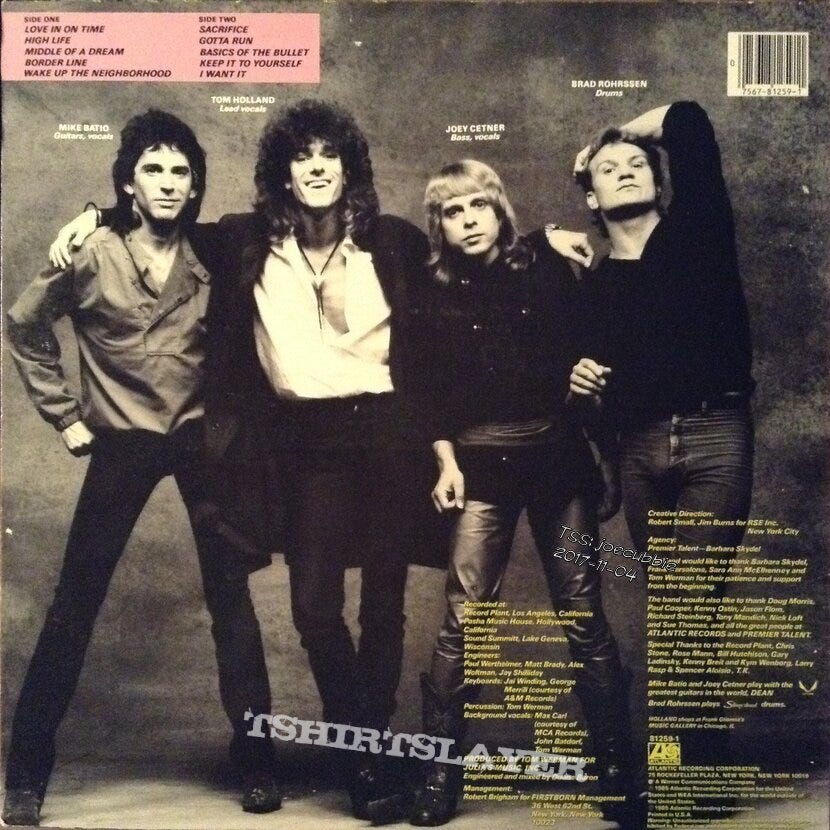
By the middle of the decade, hard rock was increasingly a regional and visual business. Los Angeles had the clubs, labels, managers, industry attention, and constant proximity that could turn a local band into a national story. Chicago had a different set of strengths: musicianship, rock history, and a power-pop sensibility that sits naturally beside the harder material on Little Monsters.
That Midwestern identity may be precisely what makes the album interesting now. Holland did not fully resemble the emerging glam-metal template, but it also was not part of the heavier underground movements building elsewhere. The band sounds like it was caught in the transition, a few years too early for the huge, radio-focused hooks that would soon dominate the market.
It is tempting to imagine the next record. A 1987 or 1988 Holland album, with the songwriting strengths sharpened and the choruses pushed further forward, might have found a larger audience. Enuff Z’Nuff, another Chicago-area act, would eventually find traction by making melodic hooks and Beatlesque instincts impossible to ignore. Holland had pieces of that same equation, even if Little Monsters never quite locks every one of them into place.
The band’s short life makes the album feel unfinished in a compelling way. It is not simply an artifact of what happened. It is an artifact of what might have happened if the scene, the label, and the songwriting had aligned at the right moment.
The verdict is in the edit
There is a great EP trapped inside this good album.
Little Monsters is easy to enjoy. It is well played, cleanly produced, and full of evidence that Holland had real capabilities. Tom Holland can sing. Michael Angelo Batio can certainly play. The rhythm section keeps the material moving. The album never becomes a slog.
But the gap between the strongest songs and the more formula-driven tracks is hard to ignore. When Holland leans into melody, texture, and the band’s Midwestern personality, the album sounds distinct. When it leans toward conventional hard-rock mechanics, the songs can begin to blur into material that could have come from a dozen other mid-’80s bands.
“Lovin’ on Time,” “Middle of a Dream,” “Borderline,” “Sacrifice,” “Gotta Run,” and “Keep It to Yourself” form a compelling alternate version of Little Monsters. That version is leaner, stranger, more melodic, and more likely to make you wonder why Holland did not get a longer run.
Was the album too early for the hooks it needed? Did Atlantic fail to find the right lane for a Chicago hard-rock band in a Los Angeles moment? Or did the band simply need one more record to turn its best ideas into a complete statement?
Listen to the full episode for our final rating, then tell us where you land. Is Little Monsters a lost album, a better EP, or a record that deserved a second swing at the late-’80s hard-rock boom?
Episode Highlights
00:44: The community poll, how Holland emerged from a tie with L.A. Guns
01:40: The short, elusive history of Holland and the Chicago connection
02:22: Michael Angelo Batio before Nitro, technical guitar with restraint
02:37: “Wake Up the Neighborhood,” Girls Just Want to Have Fun, and Holland’s unexpected soundtrack legacy
03:09: “High Life,” “Sacrifice,” and the record’s shifting hard-rock influences
03:45: “I Want It,” the closer that could have been a bigger single
04:04: Where the record loses focus, and why the choruses do not always land
04:50: The final assessment, a better EP hiding inside a full-length album
05:13: Chicago versus Los Angeles, and the career Holland never got to build


