



In 1976, Boston smuggled a basement-built guitar symphony onto the FM dial and turned it into one of the best‑selling debut albums of all time, while most of the rock world was either going slick, going disco, or quietly burning out. Around it, Kiss, Thin Lizzy, Aerosmith, Judas Priest, and a wave of European deep cuts tried to decide what hard rock should sound like in the second half of the 70s. This week we go back to the bicentennial year, the moment when punk first bared its teeth and arena rock perfected its roar, and ask what 1976 really meant for heavy music. Want to suggest an album for a future episode or community poll? Submit it here.
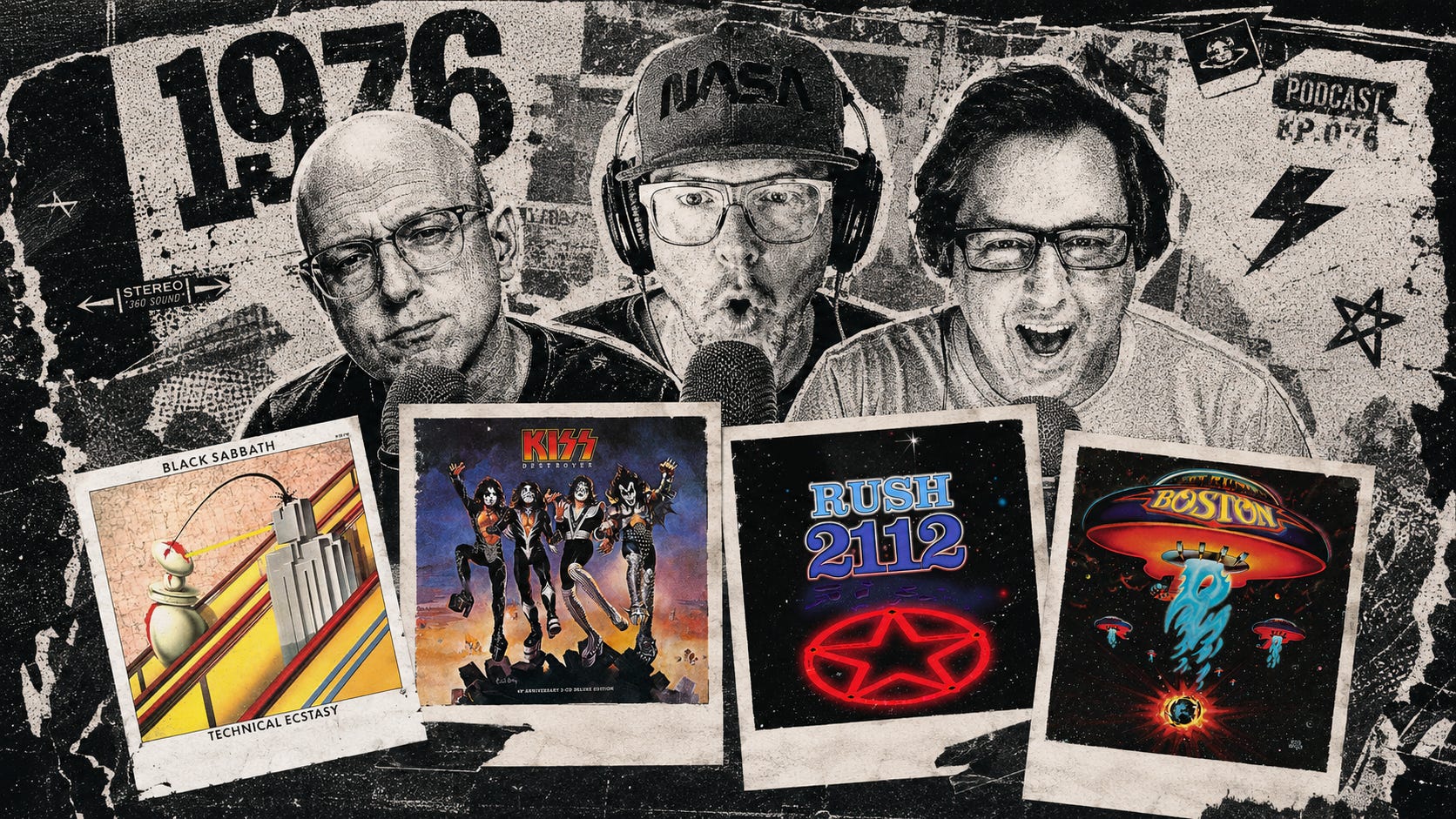
The year guitar rock grew up
1976 was supposed to belong to disco, MOR pop, and singer‑songwriters. The Billboard year‑end list is loaded with “A Fifth of Beethoven,” “Disco Lady,” “Don’t Go Breaking My Heart,” and “50 Ways to Leave Your Lover,” while the biggest “rock” presence is Queen with “Bohemian Rhapsody” and Aerosmith with a revived “Dream On.” The charts are soft‑focus and string‑heavy, yet underneath that glossy surface a very different story is playing out in album land: hard rock bands making two records a year, European groups getting heavier and stranger, and a Boston engineer named Tom Scholz quietly building spaceship guitars in his basement.
Boston’s debut is the hinge that explains why 1976 feels like a pivot. Recorded largely at Scholz’s home studio, then released by Epic Records in August, Boston fused classical‑leaning guitar lines, stacked harmonies, and radio‑ready hooks into eight songs that still dominate classic rock playlists. “More Than a Feeling,” “Peace of Mind,” and “Foreplay/Long Time” are precision‑engineered, yet they breathe like a bar band that has been woodshedding for years. When we talk in the episode about albums that are “jammy but laser‑focused,” this is the record we mean: long instrumental sections that would get sliced away a decade later, presented here as the whole point.
At the same time, you can hear how saturated the landscape already is. By 1976, Grand Funk Railroad are on their tenth and eleventh albums, Golden Earring hit their eleventh, Nazareth release albums seven and eight, and the James Gang bow out with their ninth. The classic rock machine is well into its veteran phase. That tension, between bands digging deeper into careers and new sounds trying to crash the party, is what makes 1976 so fun to revisit.
Two albums in one year
One thing that keeps blowing our minds about 1976 is the output. Thin Lizzy release Jailbreak in March, then end up back in the studio for Johnny the Fox when Phil Lynott’s hepatitis sidelines touring. The second album is almost an accident, written and recorded when the band cannot go on the road, and made under the cloud of Brian Robertson being fired, rehired, and fired again during the sessions. Yet out of that chaos you still get swaggering hard rock that extends the Jailbreak palette rather than recycling it.
Kiss push themselves just as hard. In March they release Destroyer with producer Bob Ezrin, all strings, sound effects, and the ballad “Beth.” By November they have Rock and Roll Over on the shelves, recorded with Eddie Kramer in a stripped‑down, live‑in‑the‑room style that feels like a reaction to their own bombast. In the span of eight months they go from Broadway‑sized concept rock to raw, four‑on‑the‑floor crunch and still have enough juice left to nearly get Ace Frehley killed when he is shocked on stage in Lakeland, Florida, a near‑electrocution that later inspires “Shock Me.”
Behind them, Nazareth squeeze in Close Enough for Rock ’n’ Roll and Play ’n’ the Game. Wishbone Ash deliver both Locked In and New England. Uriah Heep put out High and Mighty in May and then close the year with Firefly. Even if some of these records feel like transitional entries today, it is wild to remember that in a pre‑MTV world, bands are telling the story of their evolution through two LPs a year, not an album cycle stretched over half a decade.
That pace explains a lot of what we hear when we listen back. Some albums are tight and focused because the band is on fire. Others sound tired, the riffs running out, the cocaine catching up. Either way, 1976 gives you more snapshots per band than almost any other year.
Seeds of metal: Priest, Scorpions, Rainbow, and Rush
While Boston and the arena crowd are perfecting melodic rock, something heavier is quietly taking shape. Judas Priest release Sad Wings of Destiny, their second album, and you can hear the template for much of 80s metal starting to click. The twin guitars, the operatic vocal lines, the sense that heaviness can be elegant and structured rather than just a fuzz pedal slammed into the red, all of that starts here.
Scorpions are already on album four with Virgin Killer, sharpening the European metal edge that will later carry them into arenas. Rainbow move from side project to full statement with Rising and the eight‑minute “Stargazer,” a song that feels like Led Zeppelin’s “Kashmir” rewritten as sword‑and‑sorcery opera. You can practically hear power metal being born bar by bar.
Even Rush are in pivot mode. 2112 arrives in March, a heavy‑prog suite that takes the technicality of British prog and bolts it onto a harder rhythmic engine. If early 70s prog is all about Yes and Gentle Giant, 1976 Rush is already pointing toward a different lineage: intricate, conceptual, but with enough muscle in the riffs that metal bands will claim them as ancestors.
The strange part is that the original prototypes are struggling just as their ideas spread. Black Sabbath release Technical Ecstasy in October, a creatively restless album that experiments with slicker production, melodic detours, and even a Bill Ward lead vocal while Sabbath’s influence on other bands starts to lag behind their own name recognition. Ozzy is one album away from leaving, the band is recording in Miami with all the chaos that implies, and you can feel the fatigue in the grooves. 1976 is the weird moment when Sabbath are both the blueprint and already a bit lost, while younger bands interpret their sound in ways they themselves are not.
Punks at the gate: Ramones, Sex Pistols, and Blondie
Outside the hard rock bubble, 1976 is also the year the punk fuse really gets lit. In April, Ramones drop their debut on Sire Records, a 14‑song, 29‑minute reset button that makes a lot of the mid‑70s rock establishment sound ancient overnight. By October, the Sex Pistols have signed with EMI and released “Anarchy in the U.K.,” and The Damned have issued “New Rose,” one of the first British punk singles.
On the edges of that scene, Blondie release their debut, a record that folds girl‑group pop, garage rock, and nascent new wave into something that critics file under “punk” simply because they share a scene with Ramones and Television. In the episode, we talk about Blondie as one of those bands who never really stay in one lane, which makes them hard to slot into the “metal and hard rock” context, but essential to understanding how 1976 sounds in New York clubs compared to American radio.
From the other side of the Atlantic, a band like Gasolin’ complicates the picture even more. In Denmark they are massive, selling out arenas and working with Roy Thomas Baker on big, distorted rock records, but because they sing in Danish they barely leave a trace in the US. When they try an English‑language push with What a Lemon, it becomes one more 1976 curiosity rather than a new pillar of the canon. The borders of what “counts” as classic rock are already being drawn in language and distribution, not just sound.
Deep cuts and private‑press ghosts
Beyond the headline acts, one of the joys of doing this episode is the research rabbit hole. We go hunting for the 1976 equivalent of future Bandcamp bands and find a different ecosystem. There is no global indie network yet, but there are private‑press records and regional scenes where bands press a few hundred copies and disappear.
A Midwest band like Truth and Janey makes a gritty hard rock record, but their story lives in collector circles rather than magazines. Pittsburgh’s Diamond Reo (not the later country act) and a group like Marcus with Pillow Stars exist at the knife edge where leafing through crates or falling into YouTube holes becomes the only way to find them.
Then there is Solid Ground’s Made in Rock, a Swedish private‑press monster where only 200 copies were pressed and 170 destroyed. For decades it is one of those records that sells for several thousand dollars because the original pressing is effectively mythical. Sonically, it sounds more like the future stoner and doom bands than the glossy 1976 mainstream, which is part of why it hits so hard today. In 1976 no one is calling it proto‑stoner rock; it is just another obscure European heavy album. Now it feels like an early blueprint for an entire later scene.
We also talk about how different European blues‑rock feels compared to American equivalents. Where US bands drift toward slicker, guitar‑hero‑centric records, Scandinavian groups like Solid Ground or Gasolin’ embrace thicker distortion, stranger arrangements, and an almost Sabbath‑via‑Budgie heaviness that does not map neatly onto what was on US radio. That contrast becomes one of the hidden stories of 1976.
Boston, presence, and the burnout of giants
Looping back to the mainline classics, 1976 is also one of the oddest Led Zeppelin years. Presence arrives in March, a leaner, more anxious record that still contains epics like “Achilles Last Stand.” Later in October, the concert film and live album The Song Remains the Same lands, documenting a 1973 version of the band that already feels like a different era. Zeppelin are simultaneously present‑tense and archival, and by 1976 younger bands are less directly copying them than you might expect.
We hear only a handful of obvious Zeppelin echoes in 1976 records: Rainbow’s “Stargazer” borrowing the rolling grandeur of “Kashmir,” parts of UFO’s “I’m a Loser” evoking the acoustic build of “Ramble On,” and a Montrose track where the post‑Sammy Hagar singer shades closer to Robert Plant than feels coincidental. For the most part, 1976 rock bands are pointed at their contemporaries, not their parents. Angel and Starz feel like Kiss satellites. Arena‑ready acts like Heart are moving toward radio single polish, away from their folky roots.
Against that backdrop, Boston’s debut almost feels like science fiction. Scholz is using custom‑built gear, carefully controlled overdubs, and classical‑inspired dynamics to make a record that is both heavier than much of the radio rock around it and far cleaner. The fact that it is tracked largely in a small Massachusetts basement and then partially finished in a pro studio gives it this hybrid DNA: basement‑band obsessiveness with big‑studio sheen. That sound becomes a template for power‑pop‑leaning hard rock for years.
We want to hear from you:
If you had to pick one 1976 hard rock or metal album to keep, what is it and why?
Do you hear Boston as the birth of a cleaner, more engineered heavy rock, or as the last moment before radio rock gets too slick?
Which private‑press or non‑US 1976 records have you discovered that deserve to be in this conversation?
Do you remember when punk first made the classic rock bands you loved feel “old,” whether in the 70s, 80s, or 90s?
Listen to the full episode for the deep cuts, disagreements, and side quests we could not fit here, then drop your own 1976 pick in the comments so we can keep building this alternate history together.
Episode highlights
02:30: Billboard Top 10 of 1976, the disco and soft rock snapshot that hides what is happening on albums.
06:45: Two albums a year, the sprinting schedules of Kiss, Thin Lizzy, Uriah Heep, and more.
12:10: Thin Lizzy’s hepatitis detour, how a canceled tour accidentally gives us Johnny the Fox.
17:30: Counting our own shelves, how many 1976 albums we actually own and still spin.
24:10: Kiss vs Kiss, the theatrical Destroyer against the raw Rock and Roll Over in the same year.
29:20: Gasolin’, Solid Ground, and the strange, heavier sound of 70s Scandinavian rock.
33:30: Sabbath at a crossroads, Technical Ecstasy and the feeling of a prototype band losing the plot.
37:40: Zeppelin echoes, where we actually hear the “Kashmir” and “Ramble On” DNA in lesser‑known 1976 tracks.
41:50: Boston as a production milestone, why the debut still sounds impossibly clean and big.


