



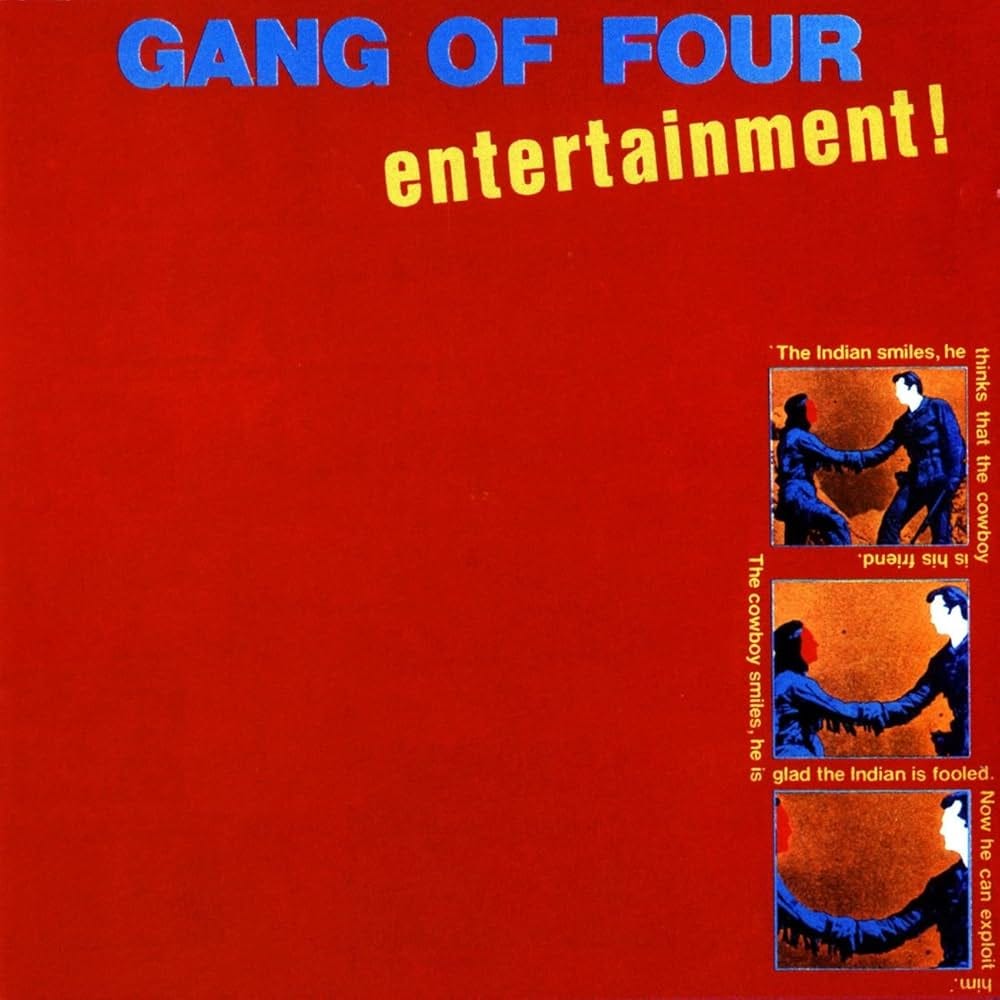
Before post‑punk had a neat genre tag and its own Spotify lane, it was more of a problem than a sound: what do you do after punk has already lit the match and burned down the building, but you still want guitars to feel dangerous? In 1979, four art‑school weirdos from Leeds answered with Entertainment!, a record that sounds like it was carved out of sheet metal and wired straight into the anxiety of late‑70s Britain.
And the reason we’re talking about it now isn’t because some label cooked up a deluxe box set. It’s because a bunch of listeners threw it into a cage match. In one corner: The Damned’s Machine Gun Etiquette. In another: Lone Star’s Firing on All Six. Over there: Throbbing Gristle’s D.O.A.. And then, quietly sharpening its knives in the back, Gang of Four’s Entertainment!—a 1979 outlier that ended up squeaking past The Damned in a runoff vote that felt more like 51–49 than a decisive knockout.
If you’ve got a 70s, 80s, 90s, or 2000s rock record you’d throw into that kind of knife‑fight—a weird outlier, a buried classic, the one you’re mad nobody talks about—submit it for a future poll and see if your pick survives the gauntlet.
The sound of the floor dropping out
Drop the needle on Entertainment! and the first thing that hits you isn’t melody, it’s geometry. The guitars don’t strum; they jab. They show up in short, percussive bursts, like somebody turned the rhythm guitar slot into a blunt instrument. You’re waiting for big chords to ring out and instead you get these knife‑edge shapes that hang in mid‑air and never resolve the way a classic rock brain expects.
So what keeps it from collapsing into pure noise? The bass. The bass is the secret hero here. It doesn’t just thud along on root notes—it moves. There’s funk in there, and R&B, and a bit of dub lurch, like someone sped up a James Brown or Parliament groove and stripped away the gloss. If you soloed some of these lines, you could probably drop them into a dance or soul track and nobody would flinch.
The drums glue it all together with this weird human‑machine feel. Remember, this is 1979—drum machines are starting to sneak into pop, sequencers are creeping in—but Gang of Four get to that stilted, almost robotic grid using nothing but people in a room. It feels mechanical and slightly cold, but you can still hear the sticks, the air, the tiny imperfections. The future they’re pointing at is automated, but the hands playing it aren’t there yet, which gives the whole record this uncanny, in‑between vibe.
Rhythm as manifesto
Most rock bands treat rhythm like plumbing: you need it, but you don’t talk about it. Here, rhythm is the whole architecture. Guitars, bass, vocals—almost everything behaves like percussion. The riffs are clipped, the phrases are short, and even when the band locks into a groove, it feels like they’re testing how tightly they can coil it before it snaps.
That leads to one of the coolest (and most disorienting) tricks on Entertainment!: the subtractive chorus. We’re wired to expect the chorus to be the moment where everything explodes—more guitars, more backing vocals, more everything. Gang of Four often do the opposite. “Damaged Goods” spends the verses building this twitchy, nervous energy, and when the chorus finally arrives, the arrangement drops down to basically drums and voice. It’s like the floor disappears right when you expect fireworks.
Why does that matter? Because in a scene where “punk” was already getting standardized—faster, louder, snottier—they’re quietly saying, “We’re not playing that game.” Punk doesn’t have to mean turning the volume knob further right than the band next to you. It can mean ripping up the invisible rules about how songs are supposed to work in the first place.
Theory in the pit: lyrics and delivery
If the music is all sharp angles and rhythmic traps, the lyrics are the essay written in the margins. This is late‑70s Britain; unemployment is up, Thatcherism is looming, and everyone’s being sold a story about modern life getting better and better. Gang of Four’s answer is basically: “Better for whom?”
Take “Natural’s Not In.” On the surface, it’s a jagged little tune with that same stripped‑down aesthetic. Underneath, it’s a takedown of how “advancement” can hollow out the actual experience of being alive. The key line—“this heaven gives me migraine”—lands like the punchline to a very bleak joke: you’ve been promised paradise, but it just makes your head hurt. You can hear the frustration of living in an allegedly golden age that still feels gray and constricting.
The band keeps circling back to the body as a site of business. There’s a line that essentially casts the body as “good business,” which is a brutal way of saying we carve ourselves up, day after day, and hand those hours to capitalism. Eight hours at work, every day, traded to the machine so we can afford to keep existing. It’s not subtle, but honestly, it’s not trying to be.
What really sets the lyrics apart, though, is how they’re delivered. A lot of these songs use two vocal lines at once: one speaking, one singing. On “Anthrax,” you get this almost spoken‑word rant running alongside a more traditional vocal, and every so often they sync up on a phrase like “Love will get you like anthrax,” and it hits twice as hard. It feels like you’re hearing someone’s inner monologue and their public voice collide in real time.
And then there are the little nerdy Easter eggs: references to Lot’s wife, Great Expectations, and more obscure ideological threads tucked into the verses. It’s the same trick Manic Street Preachers would pull years later—writing songs that double as reading lists if you’re the kind of listener who pauses to Google a line. If you like disappearing down rabbit holes, this record absolutely enables that behavior.
Totally 1979, somehow not stuck there
Here’s the weird thing: Entertainment! is obviously a product of its time, but it doesn’t feel trapped in 1979. You can hear the era in the ingredients—punk’s urgency, disco’s groove, reggae and dub’s sense of space, funk’s bass language—but the band never settles into any of those as a comfy lane.
Contrast it with what rock radio was doing. While Fleetwood Mac and The Eagles were rolling out big, plush, FM‑ready productions with layers of overdubs and studio shine, Gang of Four basically sound like they plugged in, checked levels, and hit record. The guitars are dry and almost confrontationally unadorned—no lush reverb caves, not a lot of pedalboard ornamentation. You can practically see the cables on the floor.
The funk and R&B influence isn’t “here’s our funk song” obvious either. It’s more like the record is wearing those styles under its clothes. Those basslines and rhythmic shapes keep things moving and give you something to latch onto, even when the guitars and vocals are trying their hardest to knock you off balance.
That’s part of why so many people discover Entertainment! backwards. They hear the 2000s bands first—the dance‑punk wave, the angular‑guitar indie stuff—and then stumble across Gang of Four and realize, “Oh, this is the blueprint.”
The template everyone else stole from
If you want to understand how ahead of the curve Entertainment! was, you don’t even have to stay in the 70s. Skip forward a couple of decades to when The Rapture, Bloc Party, Franz Ferdinand and company were getting tagged with “dance‑punk” or “post‑punk revival,” and you can basically draw a straight line back to this album.
That whole recipe—tight, syncopated drums; basslines doing as much heavy lifting as the vocals; guitars that slash on the off‑beat instead of ringing out heroically—lives here in rougher, more abrasive form. Those later bands had the luxury of sanding down the edges, adding bigger choruses, and slotting themselves into festivals and TV dramas. Gang of Four were busy, you know, inventing the thing.
The influence radiates beyond the obvious too. You can hear flashes of this approach in the way Local H’s “Bound for the Floor” handles its verses—those simple, stabbing guitar figures that feel more Gang of Four than grunge, even if the song doesn’t sound like a tribute. Parts of The Cult’s more taut, post‑punk‑leaning moments seem to drink from the same well, especially in how they build verse tension before letting the chorus go widescreen.
Individual players took notes as well. Flea has talked about how this band rewired the way he thought about bass, and it’s no coincidence that Andy Gill ended up producing the Red Hot Chili Peppers’ debut, dragging some of that jagged, skeletal funk into their orbit. Dave Allen’s later band Low Pop Suicide and the long list of musicians who rotated through Gang of Four over the years—people tied to Belly, L7, Slint and more—helped spread that influence across alternative rock, post‑hardcore, and beyond.
Even hip‑hop got in on it. “Ether” gets sampled by Run the Jewels decades later, proof that those rigid yet funky grooves still hit hard enough to anchor a modern beat. “Damaged Goods,” meanwhile, has become the closest thing the band has to a standard—covered, referenced, and even nearly turned into an album title by bigger acts.
When innovation wears you out
Here’s the honest part: as much as Entertainment! is a landmark, it’s not exactly an easy Sunday‑morning listen. Several spins in, one thing that keeps coming up is how long 40 minutes can feel when every song is challenging you on multiple fronts.
Because the record leans so hard on tension—rhythmic, harmonic, structural—it doesn’t give your ears a lot of release valves. There aren’t many big, sing‑along choruses to coast on, no lush ballads where everything softens and breathes. For some listeners, that’s thrilling; for others, it can start to feel like homework by the back third of the album.
It’s easy to imagine a slightly tighter version that trims a track or two and keeps the focus on the absolute killers: “Ether,” “Not Great Men,” “Damaged Goods,” “At Home He’s a Tourist,” “5.45,” maybe “Glass” depending on your tolerance for the more abrasive end of their palette. The flip side is that these “less essential” tracks also show you the limits of the band at this stage—they’re not great at slow, moody pieces yet, and when they stray too far from their rhythmic sweet spot, you start thinking more about what they can’t do than what they can.
But that’s kind of the nature of a record like this. It’s not designed as a greatest‑hits package; it’s a document of a band figuring out how far they can push rock’s skeleton before it breaks. Sometimes that means a few experiments land awkwardly. It also means the highs feel genuinely new, not just very good versions of something you’ve already heard a hundred times.
After the blast radius
If Entertainment! hooks you, there’s a whole rest of the story waiting: albums like Solid Gold and Songs of the Free, where the band leans harder into funk and more polished production, pulling in things like backing vocalists and slicker arrangements without totally losing the bite. The lineup shifts, people cycle in and out, and Andy Gill slowly morphs from just “the guitarist in Gang of Four” into a kind of patron saint of jagged, groove‑driven rock production.
For some listeners, the best single starting point is a well‑chosen compilation that pulls key tracks from Entertainment! and the more accessible later records, showing how the band moved from skeletal agit‑funk to something closer to alt‑rock with teeth. For others, it’s all about absorbing the debut whole at least once—letting the full 40 minutes wash over you so you can feel where so many later bands quietly stole their ideas.
Either way, Entertainment! is one of those albums that changes how you hear other records. Once you’ve spent time with it, you start spotting its fingerprints everywhere: in a riff here, a bassline there, a weirdly empty chorus that suddenly makes more sense.
So if you’ve got a record you think plays a similar role—rewrites the rules instead of just following them—send it in. Maybe it’s a too‑heavy 90s album that scared radio programmers, or a 2000s rock disc that got lost in the blog deluge, or another punk/post‑punk mutant like Entertainment! that never quite fit anywhere. Throw it into the next poll and see if you can force everybody else to sit with “your” difficult, brilliant 40 minutes and ask, “How were we not talking about this already?”
What kind of album are you personally itching to nominate next: a jagged art‑punk curveball, or a melodic, hooky record that still got criminally overlooked?
Episode Highlights
0:00 – Intro – How a community poll pitted Gang of Four against The Damned, Lone Star, and Throbbing Gristle, and why Entertainment! edged out the win
5:12 – Setting the stage – Late‑70s Leeds, art school punks, and how Gang of Four stitched punk, funk, reggae, and dub into something new
13:30 – “Ether” – Opening track breakdown: rhythmic knife‑edge guitars, politicized lyrics, and the groove that anchors the chaos
20:45 – Rhythm as revolution – Why the band treats guitars and vocals like percussion, and how their subtractive choruses flip rock song structure on its head
27:10 – “Natural’s Not In” & “Not Great Men” – Capitalism, bodies as “good business,” biblical and literary references, and the link to Manic Street Preachers‑style lyric nerdery
34:30 – “Damaged Goods” – The band’s de facto anthem: from angular verses to that stripped‑back chorus, and how it became a template for generations of bands
42:05 – “At Home He’s a Tourist” & “5.45” – Melodica lines, TV‑age dread, and the way the record feels both 1979 and weirdly timeless
50:20 – “Anthrax” – Dual vocals, anti‑love‑song energy, and how the band turns noise, rant, and groove into something iconic
58:40 – Influence and aftershocks – From Flea and Red Hot Chili Peppers to The Rapture, Bloc Party, Franz Ferdinand, Local H, and Run the Jewels sampling “Ether”
1:06:15 – Does it still work front to back? – The guys debate the 40‑minute runtime, favorite cuts, what they’d trim, and whether Entertainment! is best as full album or curated gateway
1:13:50 – Final verdicts – Where Entertainment! lands in the Gang of Four catalog, why it’s still required listening, and who this record is really for


