



Keith Miller, a Dig Me Out patron, suggested the Black Roses (1988) Original Motion Picture Soundtrack and paid $100 for the CD to do it. The soundtrack won the poll at 30.4%, beating Venom’s Welcome to Hell, Death Angel’s Frolic Through the Park, and Marry My Hope’s Museum. After watching the film, it was discovered that an actor named Keith Miller appears in the credits. Keith has some explaining to do. Want to suggest an album for a future episode? Submit your pick here.
The Satanic Band Nobody Was Supposed to Recognize
In 1988, a low-budget Canadian horror film called Black Roses went straight to VHS without so much as a theatrical run. The premise: a demonic heavy metal band arrives in a small town, corrupts the youth, and generally causes satanic mayhem. The satanic band in question was called Black Roses. The lead singer was named Damien. A character in the credits was listed simply as “Flunky.”
It is, by any measure, a terrible movie. One of the fathers gets pulled into a wall-mounted speaker by a giant rubber bug creature. The teacher hero kills a monster with a tennis racket. Vincent Pastore, best known as Big Pussy from The Sopranos, plays one of the concerned dads. There is fake blood so bright red it looks like latex paint. The film ends with a news broadcast announcing Black Roses is about to open a three-night stand at Madison Square Garden, implying the demonic conquest continues, presumably into Europe.
None of this is relevant to why you should care about the soundtrack.
The soundtrack is worth caring about for a completely different reason: the fictional band Black Roses was played by members of the real band King Kobra, specifically the lineup featuring Marcie Free on vocals, Mick Sweda on guitar, Carmine Appice on drums, and Chuck Wright on bass. King Kobra was being dropped by their label at the time. A friend of Carmine’s had a connection to the film production company. And so, by the kind of casual chain of favors that defined the late-80s LA music scene, one of the better-assembled melodic rock lineups of the decade ended up recording songs for a straight-to-VHS horror movie about devil worship.
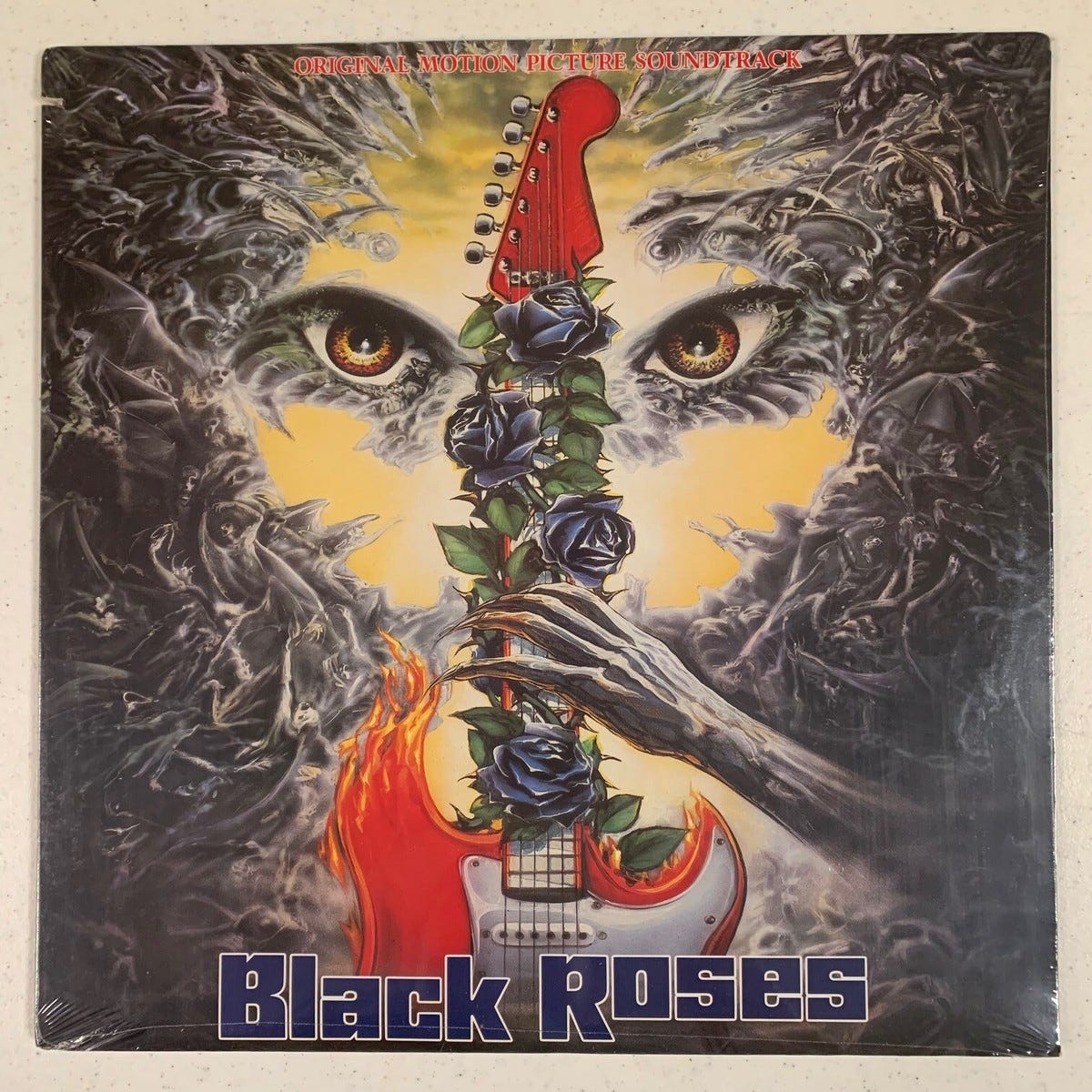
Metal Blade Records bought full-page ads. The album cover is legitimately striking. A lot of people remember seeing it in Hit Parader and Circus. Almost nobody bought the record.
The King Kobra Reunion Nobody Announced
To understand what makes this soundtrack more than a curiosity, you need to understand the lineup politics embedded in the tracklist.
The four songs credited to Black Roses: “Dance on Fire,” “Soldiers of the Night,” “Rock Invasion,” and “Paradise (We’re On Our Way)” are essentially an unreleased King Kobra record. This is the Marcie Free/Mick Sweda/Carmine Appice/Chuck Wright version of the band, recording under a pseudonym for a horror movie while their label situation dissolved around them. The performances are not B-movie filler.
Marcie Free (who recorded these tracks in 1987 under the name Mark Free, before her transition in 1993; she passed away in 2025) delivers some of her finest 1980s vocal work here, particularly on “Soldiers of the Night,” where her range draws comparisons to Kevin DuBrow and Blackie Lawless in the same breath. Mick Sweda’s guitar work is more expansive than his later Bulletboys material. Carmine Appice, whose drumming can sometimes blend into the era’s generic hard rock sound on standard King Kobra recordings, is distinctly audible throughout.
“Rock Invasion” is the track that most clearly demonstrates what this lineup was capable of. It opens as a conventional anthemic hard rock number, the kind of song that could have appeared on any respectable 1988 metal record. Then the middle section arrives: a minor-key breakdown with trippy guitar effects that genuinely does not belong in the same song, in the best possible way. It is the most musically unexpected moment on the record, and it arrives buried in track four of a straight-to-VHS movie soundtrack.
“Dance on Fire” has the cadence and construction of a legitimate Headbangers Ball single. The chorus shares DNA with Bon Jovi’s “In and Out of Love,” and in any other context, on any other release, it could have been exactly that.
There is also a second version of King Kobra on this record. “Take It Off,” credited to King Kobra (with the later, different spelling signaling the lineup change), features Johnny Edwards on vocals, the singer who replaced Marcie Free after the label dropped the original lineup. Edwards later became the lead singer of Foreigner. “Take It Off” is a slicker, more polished track, closer in spirit to a Gene Simmons-era Kiss song than the Black Roses material. It is fine. It is not the same band, and the contrast is audible.
Bang Tango’s Secret First Recording
One of the more surprising footnotes on this record sits at track three: “I’m No Stranger” by Bang Tango.
Bang Tango became a name in 1989 when Psycho Cafe arrived and introduced the world to their sleazy funk-metal hybrid. But “I’m No Stranger” predates that debut by a year. This is their first commercial recording, released before a single album, before most people had heard their name. It appears on a straight-to-VHS horror movie soundtrack because Metal Blade Records was using the project as a partial showcase for emerging LA bands alongside the fictional band from the film.
Even the liner notes give away the newness: Joe Leste’s name is spelled differently in the credits, a small error that signals Bang Tango had not yet solidified their own identity in print, let alone in the marketplace.
“I’m No Stranger” holds up. It is recognizably the same band that would make Psycho Cafe, with the same street-level energy and Joe Leste’s distinctive delivery. As a time capsule of what Bang Tango sounded like before they had a record deal, it is genuinely interesting. As a commercial release, it had zero impact. The movie was on Tubi before Tubi was a concept.
The Lizzy Borden Standout and the Soundtrack’s Identity Problem
“Me Against the World” by Lizzy Borden is the best song on this record. It is not particularly close.
The track is more stripped-back than the band’s usual theatrical material, closer in spirit to an AC/DC-amped chorus than the elaborate compositions that define their studio albums. It is also the song used twice in the film: once during the opening sequence, when rubber-masked ghouls stomp around a club stage, and again when Vincent Pastore’s character listens to an album that spawns the creature that kills him. “Me Against the World” had already been a single with a video before the movie existed. Its presence here is almost incidental to its actual quality.
But the fact that it is so clearly the best track on the record also illuminates the soundtrack’s central structural problem. The Black Roses album exists in an uncomfortable middle space between two things a soundtrack can be. On one end: a cohesive artist record, where every track serves the same creative vision (the Fastway/Trick or Treat model, where the soundtrack is effectively a Fastway album that happens to have a film attached). On the other end: a showcase compilation, where a range of bands get positioned against each other in a way that works as a listening experience even without the film (the Bill and Ted approach, with Extreme, Tora Tora, Winger, Shark Island, Kiss, Slaughter, Steve Vai, and Richie Kotzen creating a coherent document of the era).
Black Roses is neither. It has four songs from the fictional movie band, a structural choice that commits to the artist-record model, but then pivots to showcase mode with Bang Tango, Tempest, Hallow’s Eve, and the two King Kobra/David Michael Phillips tracks. The result is a record that is more cohesive than it has any right to be across the middle eight songs, then derails with “Paradise (We’re On Our Way),” a power ballad that sounds like Winger writing a song for a Transformers soundtrack, and “D.I.E.” by Hallow’s Eve, which is sludgy and thrashy and sounds like it came from a completely different decade.
Tempest’s “Streetlife Warrior” is a minor footnote: a band that released exactly one self-distributed cassette EP before disappearing entirely, landing one song on this soundtrack as what appears to have been their only commercial release.
The Pink Floyd Footnote
Carmine Appice is the only member of the King Kobra lineup who actually appears in the film. While the movie was shooting in Canada, he visited a local record store because an album he had played on was just being released: A Momentary Lapse of Reasonby Pink Floyd. Nick Mason had a hand injury; Pink Floyd called Carmine to play on “Dogs of War.” Standing in a Canadian record store while playing the demonic drummer in a zero-budget horror film, Carmine Appice heard himself on a Pink Floyd album for the first time.
This is, in miniature, the story the whole record tells: legitimate talent operating in contexts that had nothing to do with the mainstream industry, doing work that would not be properly contextualized for decades.
The Scarcity Paradox
The Black Roses soundtrack is not available on any streaming platform. There is no authorized digital release. Finding it on YouTube means finding a bootleg upload. The CD on Discogs ranges from $50 to over $300. Patron Keith Miller paid $100 for his copy.
The movie, by contrast, is free on Tubi with no account required, and also available on Shudder, Peacock, and AMC+.
This inversion is close to perfect. The thing of no cultural value is freely available everywhere. The thing of genuine musical interest requires either a significant cash outlay or a bootleg upload. It is a precise diagram of how the late-80s music industry treated its second-tier roster: promoted the packaging, abandoned the content, and let the actual recordings vanish.
The album cover, that striking image that appeared in full-page ads across every metal magazine in 1988, still exists everywhere you look. The music it was selling is effectively inaccessible unless you know exactly where to look.
What Did the Hosts Make of It?
The Black Roses soundtrack rewards the kind of listener who finds the archaeology more interesting than the hit. There is no hit here. There was never going to be a hit here, because there was no infrastructure to make one happen. What there is instead: a document of Marcie Free at or near her vocal peak, Mick Sweda doing his most interesting work, Carmine Appice playing with genuine commitment, Bang Tango before they were Bang Tango, and Lizzy Borden delivering one of their finest individual performances.
Does that add up to an album? Does it earn a full listen, or is it more honestly an EP’s worth of material spread across ten tracks? Does the identity crisis at the heart of the tracklist (part fictional-band concept record, part B-movie showcase, part late-label-deal salvage operation) actually diminish what the strongest songs accomplish?
The three hosts landed on the same verdict. Whether you agree or disagree says something about how you weigh the good against the awkward, and whether a record needs to know what it is to be worth your time. The full conversation, and the final call, is in the episode. Drop your own verdict in the comments below.
Episode Highlights
Intro (0:00): Poll reveal. Black Roses wins a four-way race at 30.4%, beating Venom, Death Angel, and Marry My Hope. Patron Keith Miller spent $100 on the CD to make this happen.
6:23: The movie. Jay watched it on Tubi: satanic band, small-town teacher, monster from a speaker, tennis racket murder, Vincent Pastore, an open ending where Black Roses heads to Madison Square Garden.
14:07: Is it fun-bad or just bad? Jay: “Worst movie I’ve ever seen.” Taken completely seriously, no camp wink at the camera, zero budget.
17:45: The Keith Miller subplot. An actor named Keith Miller appears in the film’s credits. Running gag: he is possessed, much older than we realize, a satanic demon.
20:07: Rock Invasion. Carmine Appice’s drumming is most audible here; a conventional anthemic verse gives way to a minor-key trippy middle section nobody expected.
22:27: Two versions of King Kobra on one record. The Black Roses band is the Marcie Free/Mick Sweda/Carmine Appice lineup; “Take It Off” is King Kobra with Johnny Edwards, who later sang for Foreigner.
26:34: Paradise (We’re On Our Way). Power ballad that divides the hosts: sounds like Winger or Stan Bush’s “The Touch,” overly positive, no edge.
30:10: Bang Tango’s first commercial recording. “I’m No Stranger” predates Psycho Cafe by a year. Joe Leste’s name is spelled differently in the liner notes.
32:13: Me Against the World. The best song on the record by a clear margin. Used twice in the film. Already had a video before the movie existed.
36:03: Take It Off (King Kobra). Johnny Edwards, later of Foreigner. Jay: “Could have been a Gene Simmons song.”
41:40: Trick or Treat comparison. The 1986 Fastway soundtrack as a contrast: bigger budget, theatrical release, now retroactively a Fastway album. Future episode pairing suggested.
44:38: Carmine and Pink Floyd. While filming in Canada, Carmine walked into a record store and heard himself on A Momentary Lapse of Reason for the first time. Nick Mason had a hand injury; Floyd called Carmine for “Dogs of War.”
47:07: Bill and Ted comparison. Black Roses falls between a cohesive all-artist album and a showcase compilation, satisfying neither. Hosts rattle off both Bill and Ted soundtracks from memory.
53:20: Dance on Fire. Chip: “I kept singing Bon Jovi’s ‘In and Out of Love’: same cadence.” Could have had a Headbangers Ball video.
Outro: Verdicts delivered. Keith Miller shoutout.


