



What happens when mall rock meets grunge? When the band that wrote “Barracuda” gets stuck chasing Mutt Lange hits? Heart’s 90s journey is a masterclass in survival—messy, confusing, and somehow redemptive .
Their shift split the band’s entire identity down the middle. Ann and Nancy Wilson spent the 1970s as hard-rock pioneers, writing fierce album tracks like “Barracuda” and “Magic Man” that held their own next to Led Zeppelin. Then 1985 hit. Suddenly, Heart was everywhere—power ballads, big hair, synthesizers layered over every guitar riff like sonic frosting.
And it worked. Massively.
Heart (1985) went five-times platinum. Bad Animals (1987) hit number two and sold three million copies. Songs written by Mutt Lange, Diane Warren, and Bernie Taupin—not the Wilson sisters—dominated radio. “Alone.” “These Dreams.” “What About Love.” The hits kept coming, each one more polished and producer-driven than the last.
But here’s the thing about chasing trends: eventually, the trend changes direction.
March 1990: Brigade Lands Like a Relic
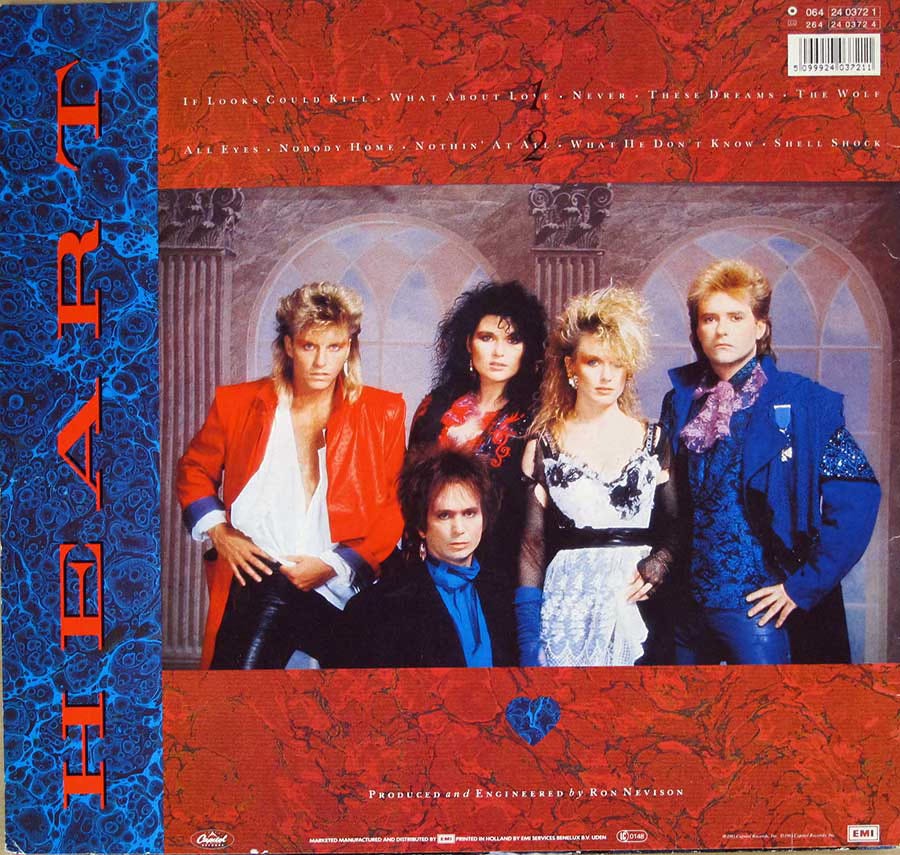
Brigade arrived on March 26, 1990, and on paper, it should have continued Heart’s winning streak. The lead single, “All I Wanna Do Is Make Love to You,” hit number two on the Billboard Hot 100. The album itself peaked at number three. Capitol Records had invested heavily in another round of outside songwriters—Mutt Lange, Sammy Hagar, Diane Warren—all the usual suspects from the power-ballad industrial complex.
But something felt off.
The album sounded expensive. Glossy. Mechanically perfect. Drums that pounded with the relentless precision of a drum machine. Synth pads smoothing out every guitar edge. Keyboard horns softening riffs that once had teeth. This was mall rock at its apex, the kind of thing that played over the speakers at Chess King while you picked out Z. Cavariccis.
“Wild Child,” the album opener, teases a return to hard rock with its opening riff—something meaty enough to get your attention. Then the verse kicks in, and it deflates into another verse-chorus formula designed for maximum radio friendliness. Track two? “All I Wanna Do Is Make Love to You,” a Mutt Lange confection so syrupy that Ann Wilson later called its message “hideous”. Track three? Another ballad.
This was the sound of a band that had stopped trusting its own instincts.
The Wilsons barely wrote on Brigade. When they did contribute—songs like “Call of the Wild” and “Under the Sky”—those tracks were buried on side B, relegated to album-filler status while hired guns delivered the singles. It’s a familiar pattern: veteran rockers handing creative control to hitmakers because the label demands it and the checks keep clearing.
But Brigade wasn’t recorded in 1989—it was conceived in 1988, written and produced during the tail end of the ‘80s power-ballad boom. By the time it hit stores in March 1990, the cultural ground was already shifting. Grunge wasn’t yet everywhere, but it was rumbling beneath Seattle’s surface. And Heart? Heart sounded like the past, even if they were still selling records.
November 1993: Desire Walks On Into the Void
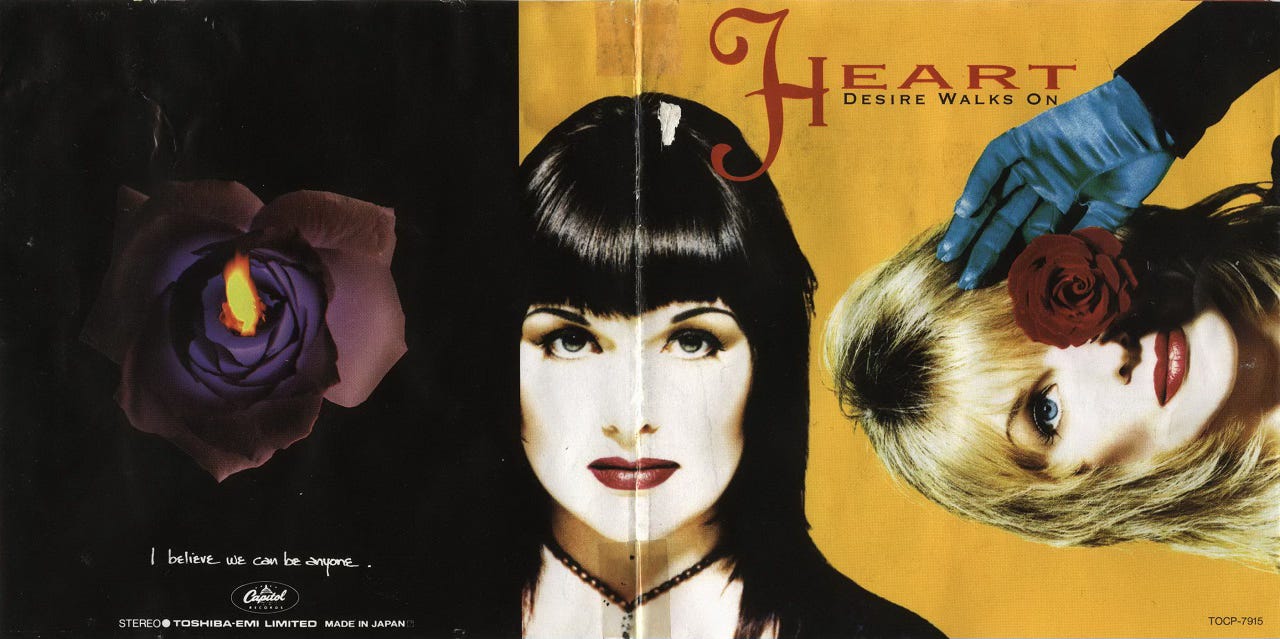
If Brigade was Heart trying to maintain the ’80s formula, Desire Walks On was the sound of a band caught between two worlds—and belonging to neither.
Released on November 16, 1993, the album landed squarely in grunge’s dominance. Nirvana had blown open the mainstream two years earlier. Pearl Jam, Soundgarden, and Alice in Chains were selling millions. Seattle was the center of the rock universe, and Heart—Seattle’s original rock pioneers—should have owned that moment.
Instead, they sounded lost.
To their credit, Ann and Nancy tried to pivot. They returned to writing most of the material themselves, collaborating with longtime friend Sue Ennis and reclaiming creative control after years of outsourcing their songwriting. They brought in producer John Purdell, who’d worked on Ozzy Osbourne’s No More Tears and would go on to produce Dream Theater’s Awake. They even got Layne Staley to sing on a Bob Dylan cover, “Ring Them Bells,” which should have been a Seattle grunge stamp of approval.
But the production was still wrong.
The album still leaned on synth bass, digital drums, and that same overly polished sheen that had defined Brigade. Songs like “Voodoo Doll” felt trapped in 1989. Even “Rage,” which had moments of Jerry Cantrell-style guitar grit, couldn’t quite commit to being heavy. It’s as if Heart wanted to sound darker and dirtier but couldn’t shake the muscle memory of a decade spent smoothing out every rough edge.
“Black on Black II”—a cover of a Dalbello track originally recorded for the 9½ Weeks soundtrack in 1986—hit number four on the Mainstream Rock chart. But it’s telling that one of the album’s most successful songs was a seven-year-old retread, not new material.
The album peaked at number 48 on the Billboard 200 and eventually went gold, selling 500,000 copies. Respectable numbers for most bands. For Heart, coming off multi-platinum records just three years earlier? A freefall.
The Songs They Wrote vs. The Songs They Sang
Here’s what makes Heart’s ’90s output so frustrating: the Wilson sisters could write.
In the ‘70s, they wrote “Crazy on You,” “Magic Man,” and “Barracuda”—songs with verses as iconic as their choruses, built on attitude, groove, and emotional weight. Those tracks didn’t just have hooks; they had architecture. They went somewhere.
But when you listen to the ’80s and early-‘90s material, the songwriting philosophy flips. The verses became placeholders—functional, forgettable setups for the big, belted chorus. It’s the sound of songs engineered for radio rotation, where the only thing that matters is whether someone remembers the hook after one listen.
Ann Wilson could still sing those songs into submission. Her voice remained a force of nature, capable of selling even the cheesiest Diane Warren lyric with conviction. But you can hear the difference. The ’70s material came from somewhere personal. The ’80s hits came from a boardroom.
The tragic irony? By the time Desire Walks On came around, the Wilsons were writing again—trying to reconnect with the band they used to be. But they’d spent so long working with outside producers and commercial songwriters that they’d lost confidence in their own creative instincts. The damage was done.
Seattle’s Grunge Brotherhood
When Nirvana, Soundgarden, and Alice in Chains exploded in the early ’90s, Heart should have been positioned as the godfathers—or, more accurately, the godmothers—of Seattle rock.
And in some ways, they were.
Chris Cornell inducted Heart into the Rock and Roll Hall of Fame, calling them an inspiration. Jerry Cantrell asked Nancy Wilson how to play “Barracuda”. Mike Inez from Alice in Chains played bass on Heart’s 2004 album Jupiter’s Darling. The grunge generation revered the Wilsons, not in spite of their ’70s hard-rock origins, but because of them.
In 1991, Ann and Nancy bought and renovated Bad Animals Studio in Seattle. The studio became a hub for the grunge scene—Soundgarden recorded Superunknown there, Alice in Chains tracked their self-titled album, and Pearl Jam used the space for sessions. The Wilsons thought the Seattle scene would hate them for being “MTV darlings with the big hair and corsets.” Instead, they were embraced.
“They were like, ‘Oh, wow, you guys, you did some cool stuff,’” Nancy recalled. “So they were like an instant brotherhood for us, and it was such a relief.”
But here’s the problem: Heart sounded nothing like grunge in 1993. They had the credibility, the connections, and the hometown advantage. What they didn’t have was the sound.
If Desire Walks On had leaned into live instrumentation, raw production, and the grit of bands half their age, it might have been a different story. Instead, it split the difference—too polished to be grunge, too tentative to reclaim their ‘70s edge. The album sold respectably, but it didn’t define anything. It didn’t change the conversation.
What They Lost—And What They Saved
Heart didn’t thrive in the ‘90s. They didn’t even really survive it in the traditional sense. They adapted—barely—by retreating, regrouping, and eventually finding their way back on their own terms.
After Desire Walks On, the band went on an 11-year hiatus from studio albums. When they returned in 2004 with Jupiter’s Darling, the sound had changed. Real instruments. Acoustic guitars. A harmonica that wasn’t digital. It sounded like a band again, not a studio confection. Mike McCready and Jerry Cantrell played on the record, cementing Heart’s connection to the Seattle legacy they’d helped create decades earlier.
By the time Heart hit the road again in the 2010s, they’d figured out what mattered. Their current setlists lean heavily on ‘70s material—“Barracuda,” “Magic Man,” “Crazy on You”—and they’ve added Led Zeppelin covers that showcase Ann Wilson’s vocal power. “All I Wanna Do Is Make Love to You”? Last played in 2009, and even then, only twice in 50 shows. It’s been excised from the canon, a relic of a time the band would rather forget.
The Wilsons didn’t just survive the ‘90s—they outlasted them. But the cost was high. A decade of creative compromise. Two albums that don’t hold up. And the nagging question: what if they’d trusted themselves sooner?
Adapted (But Just Barely)
Heart didn’t die in the ‘90s, which means they technically survived. But survival isn’t the same as triumph.
They adapted by stepping back, taking time off, and eventually reclaiming their identity. But the ’90s themselves? Heart spent that decade as a cautionary tale—proof that even the most talented artists can lose their way when they stop writing their own story.
The good news? Artists respect them. Chapel Roan covered “Barracuda” live and brought Nancy Wilson onstage. Younger generations discovering Heart on streaming services hear the ’70s albums first, not the power-ballad era. The cultural memory is intact.
But if you want to understand Heart’s legacy, don’t start with Brigade. Start with Dreamboat Annie. Start with the band that wrote “Crazy on You” and meant every word. The band that opened for Queen and held their own. The band that proved women could front a hard-rock band without apology.
That’s the Heart worth remembering.
And in the end, that’s the Heart they became again.
Songs in this Episode
Intro - Barracuda
21:49 - Heartless
41:31 - Wild Child
51:16 - Will You Be There (In The Morning)
Outro - Magic Man
Foreigner | Surviving the 90s

By the time grunge tore through the Sunset Strip like a wrecking ball, many classic rock acts found themselves stranded, uncertain where their place in the new world order might be. Foreigner—the arena rock behemoths who racked up platinum albums like they were stocking up on batteries for a Y2K scare—faced that very reckoning.
Styx | Surviving the 90s

The 1990s were a cold, unrelenting decade for the golden gods of 70s and 80s rock. When grunge arrived like a wrecking ball, it smashed the grandeur of arena rock into dust and ushered in an era of flannel, introspection, and lo-fi sensibilities. Bands like Styx, who once soundtracked teenage dreams with power ballads, synth-fueled anthems, and concept …
Billy Squier | Surviving the 90s

Remember that moment in the early ‘80s when Billy Squier was everywhere? You turned on the radio, there he was. Flipped on MTV, there he was again, slinging his guitar like a man born for the stage. His songs weren’t just hits; they were huge. Anthems like


