


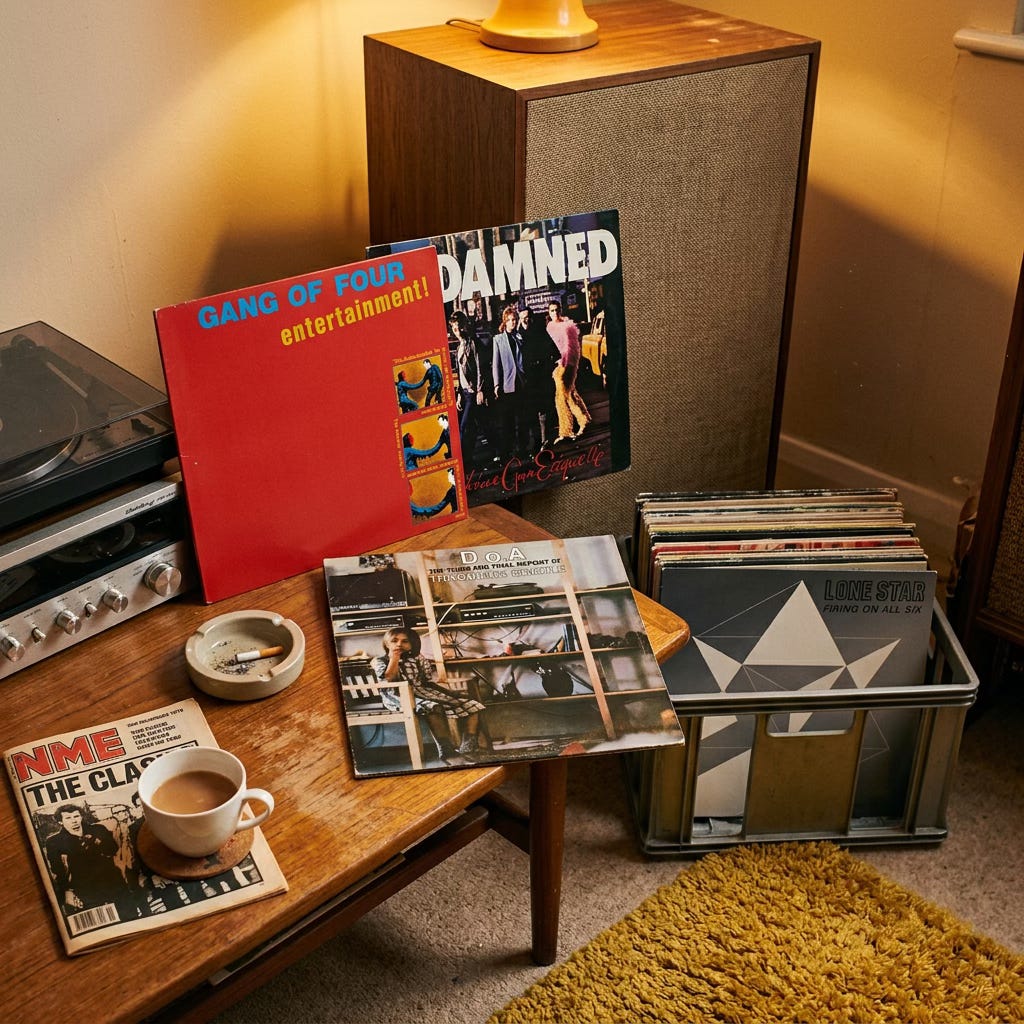
The late 70s had like four different timelines running at once—punk burning down the house, art kids rebuilding it, hard rock trying to go bigger, and weirdos quietly inventing industrial in the corner.
Machine Gun Etiquette is punk evolving in real time: safety pins still in, but now there’s 60s psychedelia, horror‑movie energy, and big hooks pushing beyond the three‑chord sprint. Entertainment! is a few blocks over—art‑school punk where the cover looks like a warning label and the rhythm section yanks you around while the lyrics side‑eye capitalism.
Firing on All Six lives on the hard‑rock side street: denim, dual guitars, soaring vocals, and that hazy space between classic rock radio and the metal that’s about to crash in. And D.o.A is the shadowy lab, where Throbbing Gristle are tearing rock apart with tape machines and electronics, accidentally sketching out the blueprint for industrial and noise.
So which late‑70s timeline do we step into together—the sweaty punk club, the art‑school dancefloor, the overlooked hard‑rock back road, or the experimental bunker? Your vote decides which of these worlds we blow up into a full episode.
The Damned – Machine Gun Etiquette (1979)
Suggested by Eric Peterson
“Everybody knows London is calling and never mind the bollocks. Here’s the Sex Pistols right behind those records is machine gun etiquette by the Damned as one of the great 70s UK punk albums
Edging away from the full throttle garage punk of Damned Damned Damned … 1979 machine gun etiquette finds the first UK punk band release a single on the first UK punk band to release an album having broken up reformed and kicking off a new moment of evolution for their sound. This was around the time that Lemmy was in the band and it’s a record and not to be missed.”
Gang of Four – Entertainment! (1979)
Suggested by Darren Leach
If Machine Gun Etiquette is punk mutating in real time, Entertainment! is punk learning to dance while reading Marx. Released in 1979, Gang of Four’s debut is a seminal post‑punk album that chops up punk, funk, reggae, and dub, then welds it into something angular, danceable, and confrontational.
Lyrically, it’s all about capitalism, war, and alienation, but it never feels like homework—more like having your worldview reprogrammed over a jagged rhythm section and scraped-raw guitar lines. If you’ve ever thought, “How did we get from The Clash to Fugazi, Rage, and beyond?” this is one of the missing links.
Lone Star – Firing on All Six (1977)
Suggested by Richard Waterman
Time for the “wait, how have I never heard this?” pick. Firing on All Six is the second album from Welsh hard rock band Lone Star, released in 1977, and it leans into a heavier, more progressive-leaning sound than their debut. With new vocalist John Sloman in place, the record pushes dual guitars to the front—big riffs, dramatic turns, and that late‑70s “is this classic rock, proto‑metal, or early prog?” blur that so many bands never quite nailed.
It charted modestly in the UK but never fully crossed generations, making it a perfect candidate for a “how did this not become a staple?” deep dive. If you love the intersection of early Queen, Thin Lizzy, and UFO, this could scratch a very specific itch.
Throbbing Gristle – D.O.A.: The Third and Final Report of Throbbing Gristle (1978)
Suggested by Ian McIvor
And then there’s the curveball. D.O.A. isn’t rock in the traditional sense so much as the sound of rock’s corpse being rearranged in a basement lab. Released in 1978, this Throbbing Gristle album is a foundational industrial record: abrasive electronics, tape experiments, unsettling atmospheres, and an almost total rejection of conventional song structure.
It’s the kind of album that makes later industrial, noise, and experimental bands possible, even if most people never actually hear it—more cited than spun, more felt in influence than remembered in tracklists. If you want an episode that leans into “what even is music anymore?” territory, this is the chaos button.
How the Poll Works
Pick one album from the four above.
Drop a comment:
What’s your history with the record?
First-time listen or long-time favorite?
Why does it deserve a podcast episode?
We’ll tally the votes, declare a winner, and then go full deep-dive on the top pick in an upcoming episode—history, context, sonics, and why it still matters (or doesn’t) today.
And if your personal 70s hill to die on isn’t on this list? Tell us that too. Drop your dream pick for a future poll in the hopper.