


The 1970s are supposed to be settled history by now: the great classic-rock monuments, the platinum albums, the bands whose logos have outlived record stores, radio formats, and probably several empires.
But this ballot tells a different story.
There’s Wishbone Ash’s Argus, a 1972 record whose twin-guitar harmonies quietly helped lay groundwork for the metal bands that would dominate the next decade. There’s Rose Tattoo’s self-titled 1978 debut, all sweat, slide guitar, and Australian pub-rock danger—the kind of raw, lived-in hard rock that would echo loudly in Guns N’ Roses. There’s Starz’s Violation, a band with KISS-world connections, Jack Douglas behind the board, and every reason to be bigger than they were. And then there’s 1994:’s self-titled album, a melodic hard-rock record from 1978 that feels almost unnervingly like it arrived from the mid-’80s ahead of schedule.
That is the real pleasure of digging into the decade: not replaying the consensus, but finding the forks in the road. These are four records from four different versions of the ’70s—the prog-to-metal bridge, the barroom hard-rock lifers, the almost-made-it arena contenders, and the band that seemed to hear the future before the rest of the industry caught up.
One of them will become the next full Dig Me Out episode: the story behind the band, the record’s place in the larger rock map, our review, host ratings, and the community verdict.
The September 70s ballot
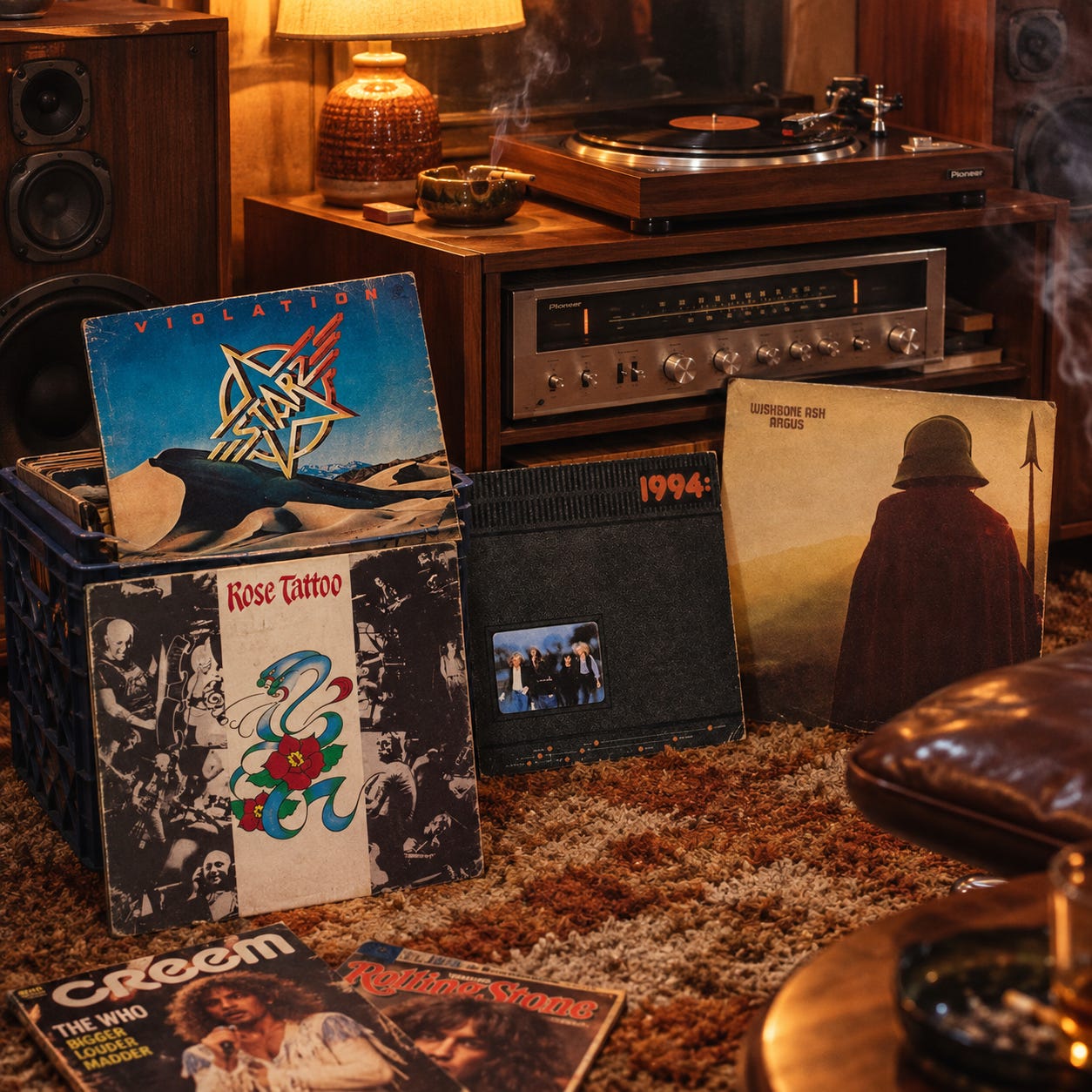
Rose Tattoo — Rose Tattoo (1978)
Suggested by Gavin Reid
Before there was Guns N’ Roses, there was Rose Tattoo: hard-living, no-frills Australian rock ’n’ roll with a fistful of slide guitar and zero interest in polishing the dirt off its boots.
Gavin calls them a cornerstone of Australian rock and points straight to “Nice Boys,” the song that helped put the “Rose” in Guns N’ Roses. If you want to hear a band whose influence runs from the pub-rock circuit to Sunset Strip, this is the record with the bootprints.
1994: — 1994: (1978)
Suggested by Keith P. Miller
A band named 1994: releasing a record in 1978 that sounds like it showed up five or six years early? That is already the kind of timeline glitch Dig Me Out was made to investigate.
Keith hears big hooks, polished songwriting, arena-ready choruses, and a melodic hard-rock/AOR sound that would have made far more commercial sense in the mid-’80s. At the center is Karen Lawrence: powerful, soulful, and apparently overdue for a serious reappraisal. Start with “Once Again,” then ask yourself how this one didn’t become a staple.
Starz — Violation (1977)
Suggested by jdziak
This one has the kind of résumé that should have made it impossible to miss.
Bill Aucoin—KISS’s manager—was behind Starz. They toured with KISS. Guitarist Richie Ranno played on Gene Simmons’ solo record. Jack Douglas produced Violation. And yet, as the nomination puts it, they still got totally buried.
So: was Violation a lost hard-rock contender that got swallowed by the sheer volume of late-’70s rock releases? Or is it a perfect example of why connections, touring slots, and big-name production still can’t guarantee a lasting place in the story? Let’s put it on the table.
Wishbone Ash — Argus (1972)
Suggested by Chip
Prog? Folk rock? Hard rock? Argus lives in the fertile collision zone where those labels stop being useful and the guitars take over.
Chip’s nomination gets right to the point: Wishbone Ash’s twin-guitar approach would become a major part of the language for bands like Judas Priest and Iron Maiden. Steve Harris has specifically pointed fans toward Argus to understand Maiden’s early harmony-guitar sound. There is even the wonderfully strange side note that its cover may have helped inspire Darth Vader’s design.
If this is one of the records that helped teach heavy metal how two guitars could speak at once, it deserves our attention.
That's a strong list. Argus is a landmark album. I'd argue it's not obscure enough. Karen Lawrence is amazing. 1994's 2nd record "Please Stand by" is my favorite. Jack Douglass produced both.
Violation is the choice. Starz best record. It's "a dystopian, near-future concept album: a society where teenage rebellion, sex, and rock ’n’ roll are criminalized and punished." Also a Jack Douglass production.
That 1994 is pretty decent, but Starz is a classic of the genre, despite not having huge sales.