


Melbourne glam rebels. Finnish rock gods. Canadian hard rock heavyweights. A Led Zeppelin-backed mystery band. Your vote decides who gets the spotlight.
Here’s the thing about the mid-70s.
While America was busy with stadium rock and the UK was deep in prog excess, something was happening in the margins. Something heavier, weirder, and way more honest. A batch of bands — from Melbourne to Helsinki, from London, Ontario to Los Angeles — were making records that deserved a bigger audience than they ever got.
These are four of them.
Same era. Very different worlds. All of them carrying that raw, unfiltered 70s energy that you just can’t manufacture. Each one has a legitimate claim to your vote. Each one has a story worth knowing.
So let’s dig them out.
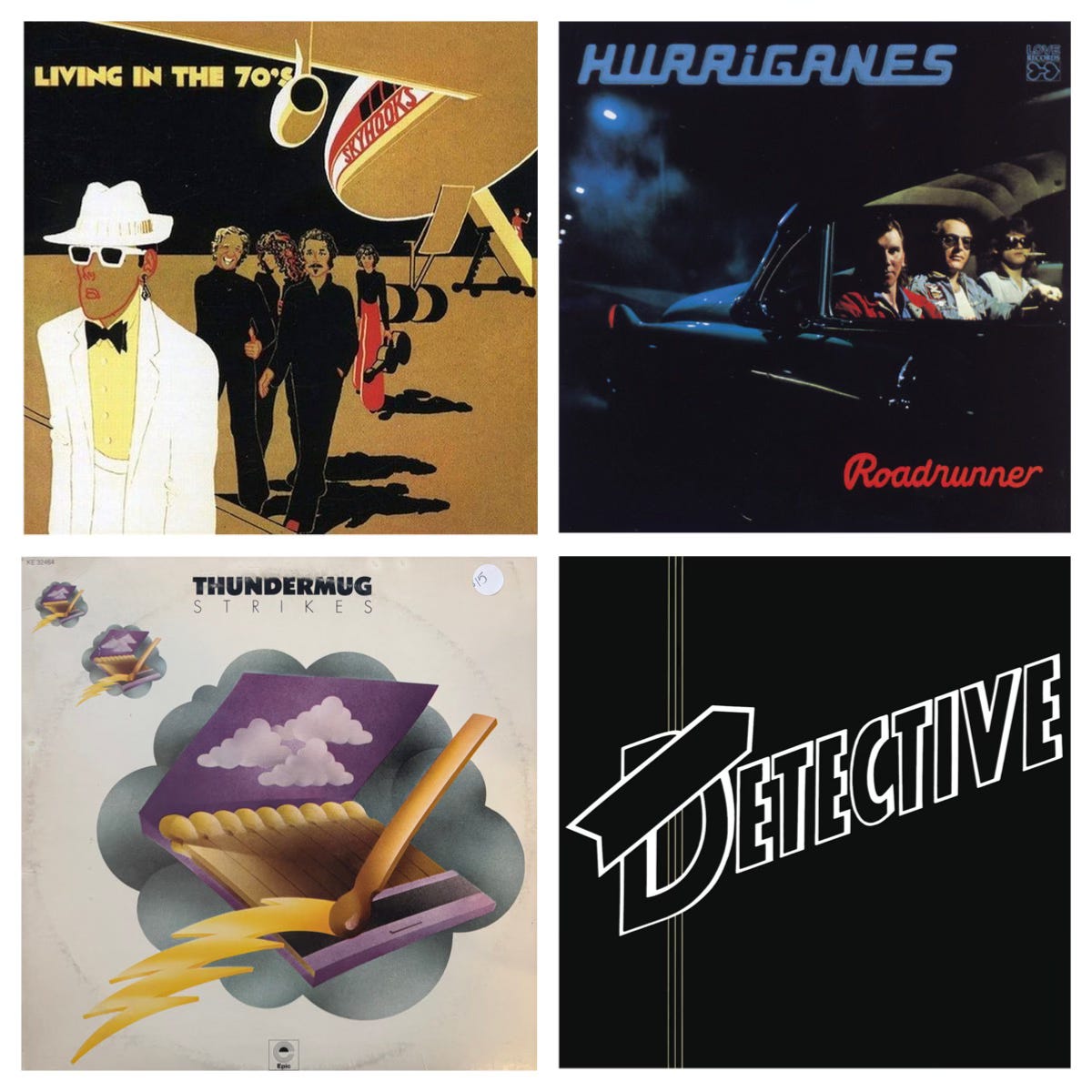
🇦🇺 Skyhooks — Living in the 70’s (1974)
Imagine releasing your debut album — and having six of the ten tracks immediately banned from commercial radio.
That’s exactly what happened to Melbourne’s Skyhooks in 1974. The Federation of Australian Commercial Broadcasters took one look at songs like “You Just Like Me ‘Cos I’m Good in Bed” and “Motorcycle Bitch” and said: absolutely not.
The band’s manager, Michael Gudinski, was delighted.
The album hit #1 in Australia and stayed there for 16 weeks. It became the best-selling album by an Australian artist up to that time. And in a defiant twist, the ABC’s brand new youth station 2JJ — which would eventually become the national Triple J network — chose “You Just Like Me ‘Cos I’m Good in Bed” as the very first song they ever broadcast in January 1975.
Produced by Ross Wilson of Daddy Cool fame, Living in the 70’s is glam rock with an Australian accent — eyeliner and irony, loud costumes and suburban poetry. Lead singer Graham “Shirley” Strachan belts it out like he’s got something to prove and nowhere left to be polite about it. The songs are about sex, drugs, boredom, and growing up in Melbourne’s inner suburbs when the kids of the sixties were finally done listening to their parents.
It’s a national treasure that most of the world has never heard.
🇫🇮 Hurriganes — Roadrunner (1974)
You want to talk about a band that redefined a country’s musical identity?
Hurriganes didn’t just make a great album. They basically invented Finnish rock.
Roadrunner — named after the Bo Diddley song and featuring that classic Chuck Berry “Johnny B. Goode” intro DNA courtesy of guitarist Albert Järvinen — hit #1 in Finland in 1974 and became the best-selling Finnish album by a Finnish band for over a decade. It’s Finland’s seventh-best-selling album of all time.
The lineup was a trio: Remu Aaltonen on vocals and drums, Cisse Häkkinen on bass, and Järvinen on guitar. Lean, loud, and locked in. The album was recorded in Stockholm at Marcus Music Studios, and the cover — band members sitting in the backseat of a Cadillac in Helsinki — has been voted Finland’s greatest album cover multiple times.
The song they almost didn’t include, “Get On,” has since been repeatedly named the finest single rock & roll song ever released in Finland. They added it as a throwaway because the album ran short. That’s the kind of accidental greatness that defines this record.
Power boogie roots ‘n’ roll at its absolute finest.
🇨🇦 Thundermug — Thundermug Strikes (1972)
Once billed as “the heaviest band in the world.”
That’s a bold claim. But drop the needle on Thundermug Strikes and you’ll start to understand it.
These London, Ontario kids — Joe DeAngelis on vocals, Bill Durst on guitar, Ed Pranskus on drums, and Jim Corbett on bass — started in their garage in 1970 covering the Beatles and Stones. By 1972, they were recording at Toronto Sound Studios with engineer Terry Brown, who would later go on to produce Rush and Klaatu. That pedigree shows.
Their cover of the Kinks’ “You Really Got Me” was the first single. Radio programmers started playing “Africa” instead — one of the only rock songs you’ll ever hear with a kazoo solo — and it cracked the national Canadian top 30.
The album was released domestically on Axe Records, then picked up by Epic Records in the US, where selections from their first two albums were compiled under the Thundermug Strikes title. Critic Richie Unterberger called it a “reasonable job of representing the sound of this Canadian hard rock band.” Which, to be fair, undersells how ferociously these songs hit.
Thundermug never got the mainstream spotlight. What they left behind is a raw, heavy, and genuinely unique slice of early 70s rock that deserves way more ears.
🇬🇧🇺🇸 Detective — Detective (1977)
Here’s a band with one of the most remarkable backstories in all of 70s rock.
Jimmy Page signed them. Led Zeppelin’s own Swan Song Records was their label home. And the producer credited on four of the album’s ten tracks is listed as “Jimmy Robinson” — a name so suspicious that rock historians have spent decades speculating it’s actually a Page pseudonym. (For the record: it isn’t. Probably.)
The lineup reads like a 70s rock fever dream: Michael Des Barres on vocals (fresh from Silverhead, Deep Purple’s Purple Records act), Michael Monarch on guitar (the original Steppenwolf guitarist, the guy on “Born to Be Wild”), Tony Kaye on keyboards (the original Yes keyboardist), and drummer Jon Hyde.
Des Barres howls like a wounded warrior across tracks like “Got Enough Love” and the dense, riff-heavy opener “Recognition.” The guitar tone is described by Louder Sound as “the archetypal sloppy leviathan,” and drummer Jon Hyde is called “as gonzo as Bonzo.” That’s a hell of a comparison — and on tracks like “Grim Reaper” and “Wild Hot Summer Nights,” it doesn’t feel like an exaggeration.
Neither Detective album charted well. But Jimmy Page loved them, they toured as support for Kiss, and they’ve maintained a devoted cult following ever since. If you love Physical Graffiti-era Zeppelin and want something less omnipresent, Detective slaps.
🗳️ Cast Your Vote
Four albums. Four countries. One very specific kind of heavy that only the early-to-mid 70s could produce.
If we don’t dig out these albums, who will? 🎸
Want to suggest a heavy 70s or 80s album for a future poll? Drop it in the hopper. The best suggestions come from you.
This is a tough one. Thundermug brings the thunderous guitars, but Skyhooks seems to be a legendary band in Australia. Detective is good too - exudes some elements of Bad Company and Rush. I haven’t been able to find Hurriganes to listen.