


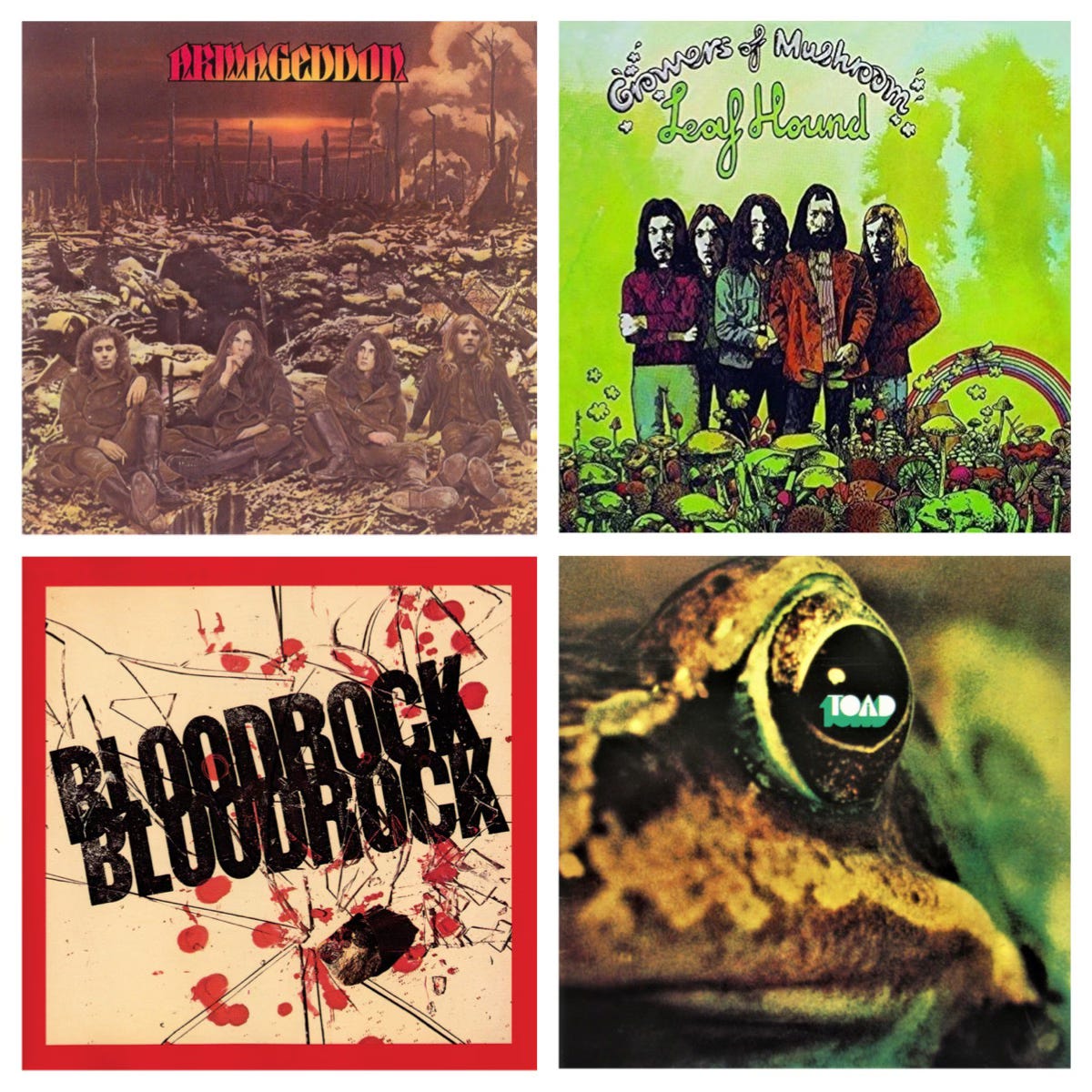
Our listeners nominated these four. You pick the winner. The pod digs deep.
While Black Sabbath was inventing doom, these bands were doing something weirder: building the bridge between blues-rock and something darker, heavier, and way more riff-obsessed than radio wanted.
We’re taking the winner to the podcast for the full treatment.
Armageddon – Armageddon (1975)
The supergroup nobody remembers but absolutely should.
Keith Relf from The Yardbirds. Martin Pugh from Steamhammer. Bobby Caldwell, who’d played with Captain Beyond. One album. Five songs. Guitars so loud they practically climb out of your speakers.
The mix is deliberately, defiantly heavy. “Buzzard” kicks off like a punk-speed apocalypse. “Silver Tightrope” pivots to shimmer-and-ache balladry. By “Basking In The White Of The Midnight Sun,” you’ve heard more textural variety than most bands manage in entire discographies.
The tragedy: No tour. No promotion. Relf returned to England, fell ill, and was electrocuted while playing at home in 1975. That album became a footnote.
But if they’d gotten the breaks? You’d know this band.
Leaf Hound – Growers of Mushroom (1971)
One day. One 11-hour session. Still considered the holy grail of stoner proto-metal.
Recorded at Spot Studios in Mayfair, London. Raw, confident, grimy. Pete French and Mick Halls literally composed “With a Minute to Go” on the spot when they ran out of material. The album gets cited as pioneering heavy metal, hard rock, psychedelic rock, and stoner rock—basically, when everyone disagrees about what you did, you probably did something important.
“Work My Body” is an eight-minute odyssey. The title track is two minutes of mushroom-induced horror. It walks the line between muddy blues-rock and something heavier. Influences everyone from Kyuss to Wolfmother.
But outside underground circles? Most people have never heard of them.
Bloodrock – Bloodrock (1970)
Fort Worth, Texas. February 1970. A stew of psychedelia, riff-heavy machismo, and proto-prog that never escaped the South.
Grand Funk Railroad’s manager signed them. Capitol Records. Jim Rutledge’s drums hit like a sledgehammer. “Gotta Find a Way” opens with six-and-a-half minutes of pure heaviness. Lee Pickens’ lead guitar is slick and sludgy. “Melvin Laid an Egg” closes as a seven-minute sludge monolith—feels like it stepped straight out of an early Black Sabbath session.
They opened for Jimi Hendrix. Built cult status.
Peaked at #160 on Billboard 200.
That’s it.
Toad – Toad (1971)
Swiss hard rock engineered by Martin Birch (Deep Purple, Iron Maiden).
Seven songs. No fillers. Vic Vergeat’s guitar is greasy, loose, reminiscent of Hendrix but completely its own thing. Werner Fröhlich’s bass is massive, melodic, constantly moving. “Cottonwood Hill” opens as an eight-minute journey that’s both progressive and blues-drunk. “Life Goes On” stretches past eleven minutes and justifies every second.
Their single “Stay” made headway on Swiss charts—the only hard rock band to accomplish that at the time. Vergeat played guitar with his teeth. Shows got compared to Hendrix’s wild energy.
But Benjamin Jaeger left once the album finished.
It became a collector’s object. A holy grail for diehards who understood that regional success doesn’t equal recognition.
Pluto (1971): From Record Bin Oddity to Cult Classic

Heads up, metalheads: you’re not lost—this is a special edition of the podcast, and we’re time-traveling back to the primordial soup of 70s rock! This week, you all went deep, voting Pluto’s self-titled 1971 album to victory in our October poll, edging out Trapeze, Julian’s Treatment, and Dr. Z in a heated runoff. Who says the most legendary records are…
Captain Beyond - Captain Beyond | 70s Rock Podcast

Ever heard of a band where two members couldn’t even put their names on their own album? Welcome to the weird world of Captain Beyond, one of rock’s most fascinating legal nightmares and musical triumphs.