


Think about 1988 for a second.
Metallica just made their first music video. “One” was on MTV, and for millions of kids who’d never heard a single riff from Kill ‘Em All, it was the beginning of everything. A whole generation of metal fans got their door kicked open by that song — by that video — by a band that some of us had already been following for years through tape trading and word of mouth and the kind of loyalty that feels personal before it goes public.
That’s one story. But there are others happening in the same decade that didn’t end the same way.
Five years earlier, a guitarist from Motörhead and a bassist from UFO made a debut record together that should have launched something huge — and then quietly didn’t. Somewhere in Texas, four guys from Arlington were putting out glam metal albums under the Pantera name that their future selves would spend decades pretending didn’t exist. And in the Pacific Northwest, a band called Metal Church was making records so heavy, so precise, so genuinely dangerous — records that bridged punk and thrash and traditional metal with real intelligence — that critics noticed, fans noticed, and then somehow the moment passed anyway.
This is what the 80s actually were.
We’ve collected four nominations from listeners — four albums that each represent a different kind of story worth telling. Your vote decides which one we dig into next. No algorithm. No editorial agenda. Just the community deciding what gets rescued, revisited, or finally reckoned with.
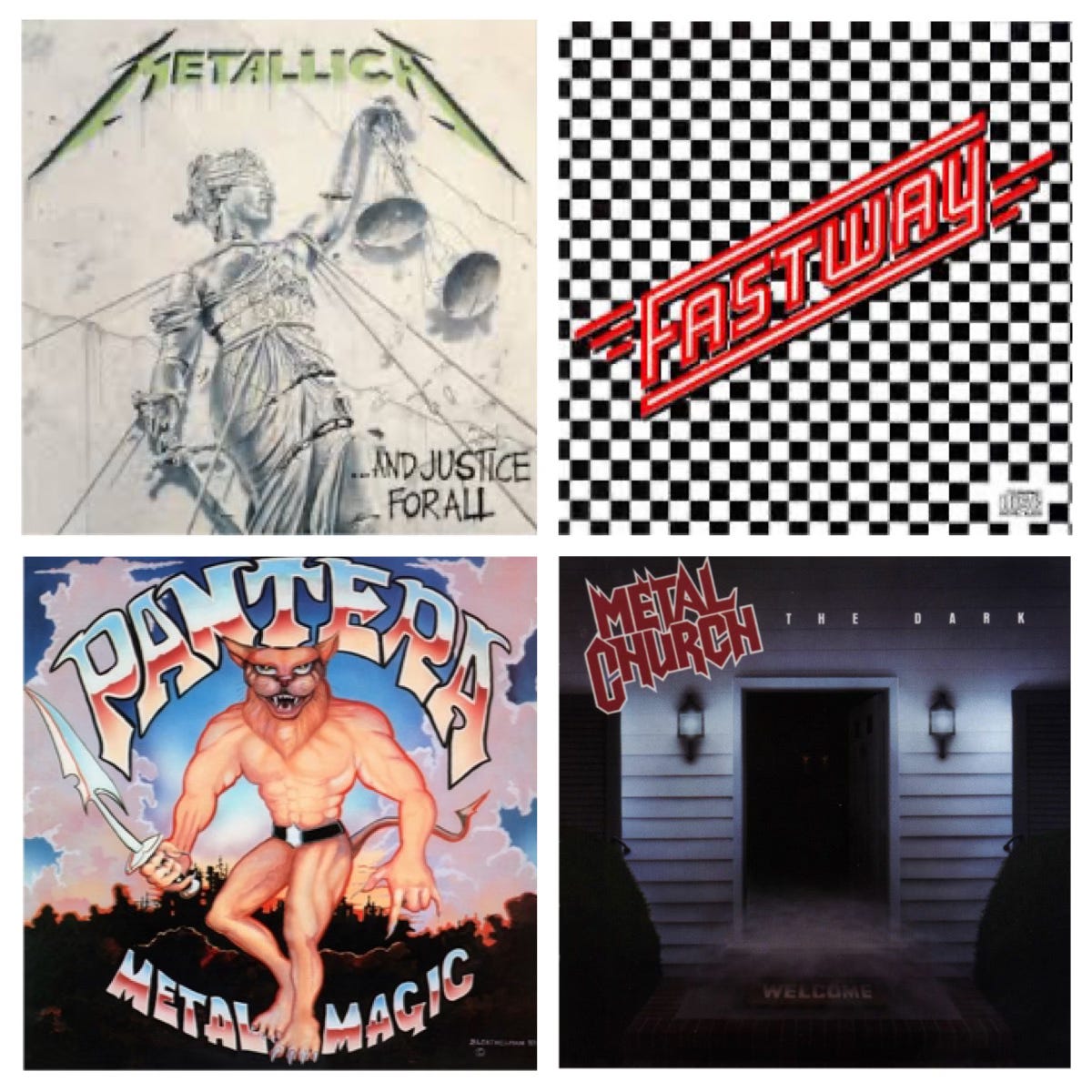
The Nominees
⚡ Metallica — ...And Justice for All (1988)
Nominated by Keith P. Miller
1988 was the year Metallica finally made a music video — and for a lot of fans, that was the moment everything changed.
Some of us had already been there for years, wearing out cassette copies of Kill ‘Em All and Master of Puppets, guarding the secret like it was ours alone. Then “One” hit MTV and suddenly Metallica belonged to everyone.
That’s not a complaint. That’s just what it felt like.
...And Justice for All brought the world “Harvester of Sorrow,” “Blackened,” and of course “One” — but it also brought one of the most infamous production decisions in metal history. We’re talking about a bass mix so absent, so deliberately erased, that Jason Newsted’s entire performance essentially vanished. People are still annoyed about it. Respectfully, they should be.
More importantly, this album is a crossroads. It’s the last time Metallica sounded genuinely heavy before the 90s pulled them toward stadium-sized simplicity. Was that the right call? Was this the beginning of the end — or just the end of the beginning? That’s a conversation worth having.
🇬🇧 Fastway — Fastway (1983)
Nominated by Richard Waterman
Take “Fast” Eddie Clarke — guitarist for Motörhead. Add Pete Way — bassist for UFO. Put them in a room together in 1983 with something to prove.
What you get is a British hard rock debut that hits with more force than its current reputation deserves. Raw, bluesy, heavy — the kind of album that should have launched a dynasty but somehow didn’t.
That’s the mystery. That’s why it’s here.
Fastway existed at the exact moment where British heavy metal and American hard rock were having an argument about who owned the genre. This record falls squarely in the middle of that tension, and it never got the credit it deserved for it. If you’ve never heard it, you’re about to understand why some of us have been quietly championing this band for decades.
🤠 Pantera — Metal Magic (1983)
Nominated by Gavin Reid
Yes, that Pantera.
Before Cowboys from Hell redefined what heavy metal could sound like. Before Dimebag Darrell became one of the most revered guitarists of his generation. There was a version of Pantera from Arlington, Texas, playing glam-influenced 80s metal with a singer named Terry Glaze, and four albums that the band has done absolutely everything in their power to make you forget exist.
None of them are on streaming. All of them are out of print. Metal Magic — their second record — has the word metal right there in the title, a cover that looks like it was designed in under an hour, and a vocalist who sounds like he wandered in from a regional wrestling broadcast. It is, to put it charitably, a historical document.
But here’s the thing. Pantera is one of the most influential metal bands of the last 40 years — the kind of band that sits in the same conversation as Metallica before them and Slipknot after. And yet four of their albums are completely buried. How does that happen? Why does that happen? And what does it tell us about how bands reinvent themselves — and how much of the past they’re allowed to erase?
That’s worth an episode.
⚡ Metal Church — The Dark (1986)
Nominated by Patrick Testa
The debut was a wrecking ball. Pure, barely-controlled aggression — a record that expanded the boundaries of heavy metal by smashing through a few of them entirely.
So what do you do for the follow-up?
Apparently, you tighten everything up and make something even more unsettling. The Dark is more produced, more precise, and somehow more dangerous than the record that came before it. It occupies that exact bridge between traditional heavy metal and the thrash movement that was exploding in the mid-80s, and it does it with a confidence that very few bands managed at the time. “Start the Fire” and “Ton of Bricks” have earned their place in Metal Church’s permanent setlist. They hit as hard today as they did in ‘86.
And then there’s David Wayne’s voice. Somewhere between Rob Halford’s stratospheric power and something darker — uglier, scarier, more feral. Like Judas Priest if they rehearsed in a condemned building. It’s sharp and gritty and commanding, and it belongs to a moment in metal history when vocalists were still figuring out just how far they could push the register before it broke. Wayne never broke. He just leaned in harder.
This is a record that deserves more than it got.
🗳️ Cast Your Vote
🎤 Got Your Own Nomination?
We’re always building the next round of nominations. If there’s an 80s metal album you’ve been waiting for someone to dig into — something overlooked, underrated, buried, or just unfairly forgotten — drop it in the hopper.
Tell us the album, the artist, and the one sentence that makes the case for why it belongs in the conversation.
The Dark Wins: Our 80s Metal Poll Results

When the dust settled, one record kept punching above everything else: Metal Church — The Dark (1986). It pulled in almost half the votes from the DMO Community, ahead of Pantera’s Metal Magic, Metallica’s ...And Justice for All, and Fastway’s debut.