


When you think 70s rock, your brain probably goes to one of two places: either arenas packed with screaming fans, or the smoke-filled clubs where the real music was happening. This tournament has both.
We’re pitting four albums against each other—each one a heavy hitter in different ways. One’s a spiritual journey that nearly ended a superstar’s reign. One’s a hard rock monument that absolutely should not work on paper but became eternal. One’s a prog-rock secret that prog obsessives whisper about like it’s scripture. And one’s a theatrical Scottish firecracker that basically invented glam rock’s rebellious edge.
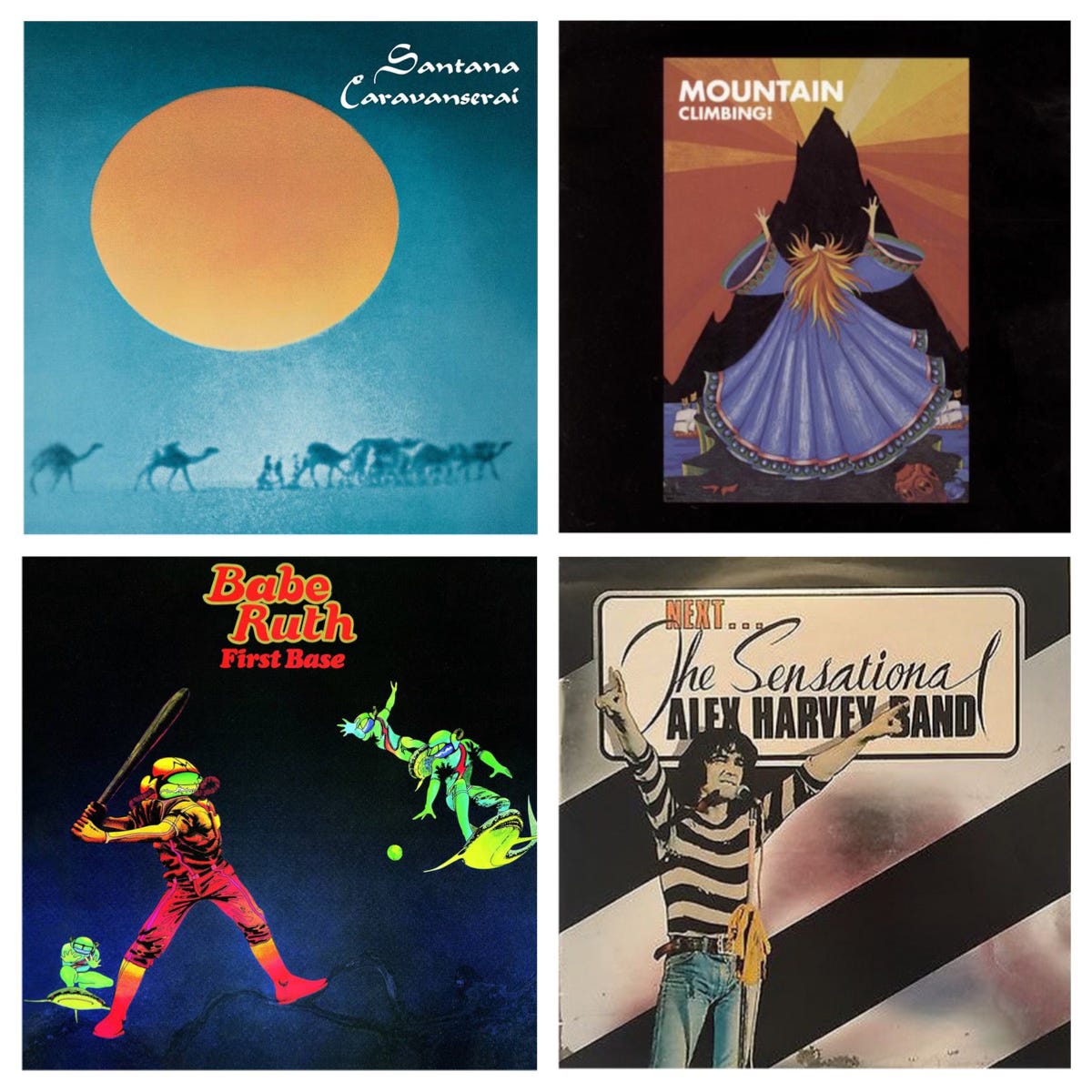
Here’s the bracket:
Santana – Caravanserai (1972)
Imagine you’ve just released three consecutive chart-topping albums. You’ve got “Oye Como Va” in everyone’s head. The whole world expects album four to be more of the same Latin-rock hook machine that made you a household name.
Then you don’t do that at all.
Caravanserai is what happens when Carlos Santana and Michael Shrieve got tired of writing radio singles and decided to chase Miles Davis, Weather Report, and Antonio Carlos Jobim instead. No hooks. No vocal lines to sing along to. Just pure instrumental exploration—spiritual, dense, almost hypnotic.
The album still hit #8 on the Billboard 200 (not bad, but a real drop from their earlier dominance), and commercial radio didn’t know what to do with it. Columbia Records president Clive Davis told Santana he was committing “career suicide.”
Is Caravanserai a brave artistic statement that proves Santana could evolve? Or did they leave their soul on the dance floor?
Mountain – Climbing! (1970)
Leslie West, Felix Pappalardi, and Mountain wanted one thing: to sound like Cream’s Disraeli Gears, but meaner. What they made instead was the blueprint for every dirty, blues-soaked hard rock riff that came after.
Climbing! peaked at #17, went gold (and eventually platinum), and gave the world “Mississippi Queen”—a song so iconic it’s been played at every sporting event and classic rock station ever since. It hit #21 on the Hot 100, and it’s not just a hit; it’s a fixture.
But here’s what makes this album special: it’s not trying to be anything other than exactly what it is. Blues-driven, heavy, grimy, unapologetic. The album’s got “For Yasgur’s Farm” (a Woodstock tribute), “The Laird,” and pure hard rock swagger throughout. Leslie West’s guitar tone became the template for heavy blues-rock.
Is this just a one-hit-wonder album that happened to have multiple hits? Or is it the most honest heavy rock debut ever recorded?
Babe Ruth – First Base (1972)
Babe Ruth’s debut—that’s right, Babe Ruth—is a masterclass in the space between hard rock and progressive rock. Alan Shacklock’s guitars, Janita Haan’s vocals, the orchestral arrangements (yes, there are cellos), and the sheer audacity of their choices make this album feel like it shouldn’t work.
And yet it does. “Wells Fargo” became an FM radio hit. “The Mexican”—which interpolates Ennio Morricone’s western theme—has been sampled and covered by everyone from Liam Howlett (The Prodigy) to GZA. Roger Dean painted the cover (the same guy who did all those Yes albums).
The album went gold in Canada, peaked at #178 on the US Billboard 200, but got slept on in the UK—which tells you everything about how ahead of its time this was. The Reddit prog community calls it “genuinely underrated” and rates it 8/10. That’s not an accident.
Is First Base an underappreciated masterpiece that got lost in the margins of rock history? Or does it blend too many styles to be great at any one thing?
The Sensational Alex Harvey Band – Next (1973)
SAHB’s second album, Next, is pure theatrical aggression. Alex Harvey—a journeyman who’d been chasing stardom for two decades—finally found his moment when he teamed up with Zal Cleminson, Chris Glen, Hugh McKenna, and Ted McKenna. What they made was something that didn’t fit into any box: glam rock, hard rock, music hall, punk attitude, all at once.
“The Faith Healer” is a seven-minute epic that builds like nothing else in 1973. The album hit #37 in the UK, got a Silver certification, and was later selected for 1001 Albums You Must Hear Before You Die.
Robert Smith of The Cure said Alex Harvey was “the forerunner of the punk movement” in Britain. Nick Cave literally said his first band, the Boys Next Door, was “basically an Alex Harvey cover band.” They covered “Framed,” “The Faith Healer,” and more.
Is SAHB the bridge between glam and punk that everyone should know about but doesn’t? Or are they too theatrical, too much character, not enough meat?
Vote Now
Which album should get the spotlight? Which one deserves to be rescued from the margins of rock history—or, in Santana’s case, from the shadow of their bigger hits?
Cast your vote. Then tell us why in the comments. We want to know which heavy-70s album you think the people are sleeping on.
SAHB is a band you might enjoy. I recently finished a Discography crawl on them, plus there is a live mega boxset coming shortly from the UK's Cherry Red Records. Alex Harvey is comparable to Bon Scott when Bon wasn't lusting after the ladies, but sometimes moodier.
Caravanserai, Welcome and Borboletta make up the strongest trio of Santana albums, not I-III. Might not be as commercial as the original trilogy, but the jazzier style is undeniable.