


Think about it. An all-female band that could out-riff most of the boys on the Sunset Strip, out-punk the Seattle scene, and out-shock anyone who dared throw mud at them. They co-founded Rock for Choice with Nirvana. Butch Vig produced their masterpiece. Rolling Stone called their early work “one of Sub Pop’s finest hours.” Entertainment Weekly gave them an A+. They played the main stage at Lollapalooza and appeared in a John Waters film. And yet, when people rattle off the essential 90s alternative bands, L7 rarely makes the list.
That needs to change.
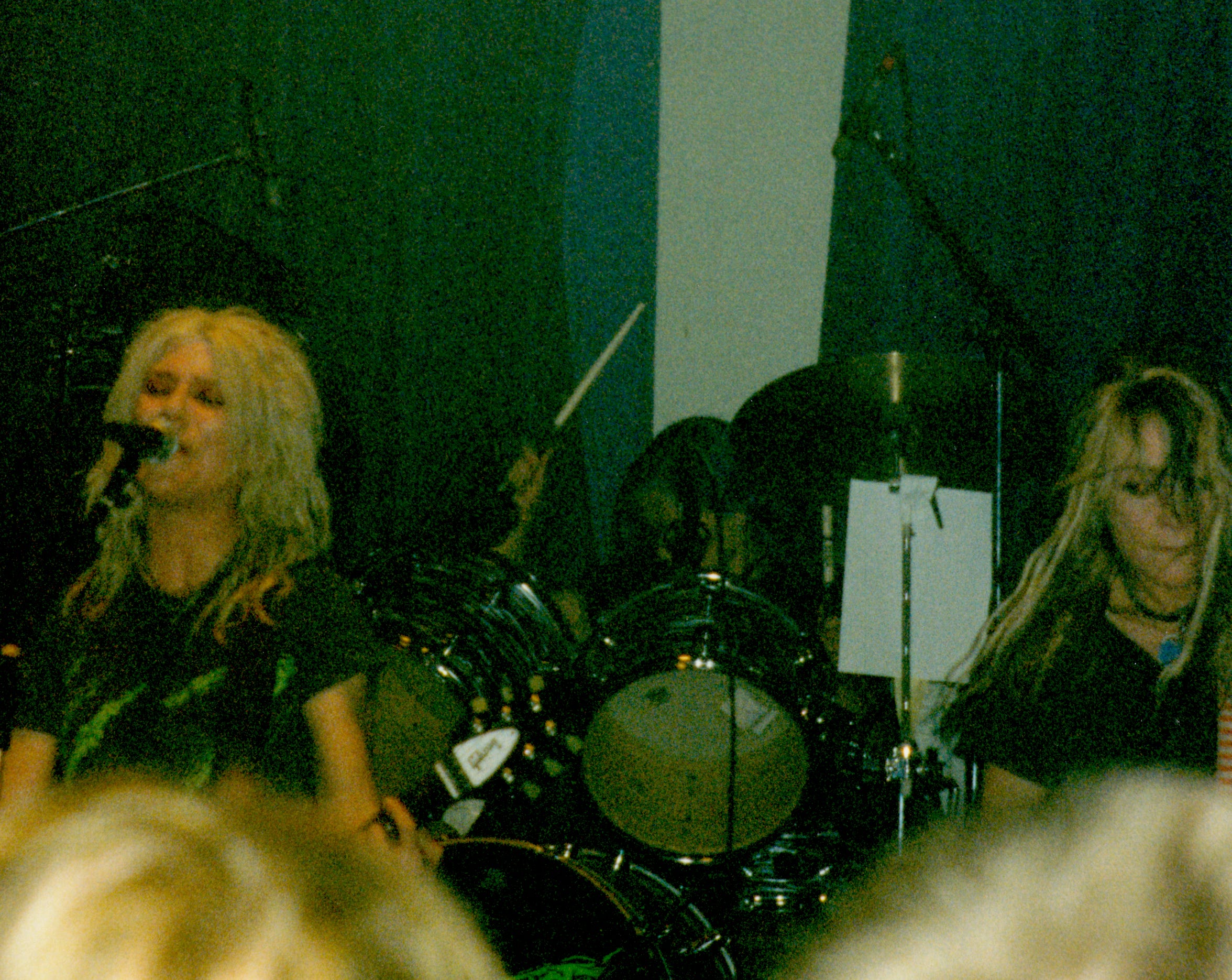

How L7 Formed in the Echo Park Punk Scene
L7 started in 1985 in Los Angeles, born out of the Echo Park art punk community. Donita Sparks(vocals, guitar) and Suzi Gardner (guitar, vocals) had both worked at the LA Weekly at different times. When Gardner handed Sparks a tape of songs she was working on, Sparks called it “one of the happiest days of my life.” Gardner already had underground cred: she’d sung backing vocals on Black Flag‘s “Slip It In” in 1984.
But LA in the mid-80s was not exactly welcoming. Sparks told Crack Magazine:
“I found LA to be a borderline misogynistic town, especially in the rock world. Guys who wanted to play hard rock didn’t want to be playing with chicks.”
Their first drummer, a man, was kicked out for “calling us cunts and bitches and not wanting to play a gay bar.” So how did they keep going? Jennifer Finch showed up.
Finch joined on bass in 1986, bringing connections and fearlessness. She’d played in Sugar Babydoll with Courtney Love, and she knew Brett Gurewitz of Epitaph Records. Sparks remembered her impact: “When Jennifer came in she had a lot of drive, she was fearless in talking to people and asking for things.” Venues that had turned them down suddenly opened up.
The name “L7” itself was a deliberate choice. It’s 1950s slang for “square,” and if you make an L and a 7 with your hands, they form a square. More importantly, it was gender-neutral. Sparks told SPIN: “We did not want a gender-specific name. I wanted people to listen to our music and go, ‘Who the fuck is this?’”
After cycling through drummers (including the debut album’s Roy Koutsky, who got “so drunk during practice he’d fall off his throne”), Chicago native Demetra “Dee” Plakas joined in late 1989. The classic lineup was locked. Chicago Tribune‘s Greg Kot later nailed why she mattered: “Their secret weapon remains drummer Dee Plakas.”
L7’s Sound: Where Punk Meets Sludge Metal
How do you describe L7’s sound? Imagine a Ramones song played through Black Sabbath‘s amplifiers, with Dick Dale surf guitar lurking underneath. It’s punk velocity meets metal weight, with hooks sharp enough to draw blood.
Sparks brought the punk: Ramones, Sex Pistols, the B-52’s. Gardner brought the sludge: Sabbath, Deep Purple, Hawkwind, Led Zeppelin. Together, their guitars created what Greg Kot described as “low-end guitar chug, a sound that suggests the idling engine of a Harley-Davidson.”
Were they grunge? Not exactly. Were they riot grrrl? Not that either. They preceded and inspired both movements, but fit comfortably into neither. Sparks was characteristically blunt in a 1993 SPIN cover story: “There was the girl band thing, there was the foxcore farce, there was the Seattle band farce, there was the grunge-rock thing. We’ve been around longer than all that stuff. Basically, we’re a rock band from Los Angeles.”
They called themselves “slob girls,” and the aesthetic was purposeful. Ratty hair, thrift-store punk fashion, heavy eyeliner or none at all, snarls instead of smiles. Finch performed barefoot. i-D Magazine called them “true style icons” and credited Sparks’ washed-out blue hair and Finch’s super red locks as originating the home-dyed crazy color look. As Sparks put it: “If we were gonna be looked at, we were gonna be thrashin.”
L7’s 90s Discography: Every Album Ranked and Reviewed
Smell the Magic (1990, Sub Pop Records)
L7’s major statement arrived on September 1, 1990, courtesy of Sub Pop Records and legendary producer Jack Endino, the man who recorded Nirvana‘s Bleach. Originally a six-track EP, it expanded to nine tracks on CD, with photography by Charles Peterson.
Here’s a detail that tells you everything about the era: the false start at the beginning of “Shove” (which opens the album) is actually a segment of a Mudhoney jam session that accidentally got caught on the recording reel. They kept it.
Rolling Stone gave it four stars, praising “Donita Sparks’ and Suzi Gardner’s twin lockstep guitars racing down the highway to hell” and calling it “one of Sub Pop’s finest hours.” The magazine later ranked it #37 on their list of the 50 Greatest Grunge Albums, noting it “was an electric shock in a sea of grey” and “one of the most widely cited as an inspiration by the next wave of punk and riot grrrl bands.” Robert Christgau gave it an A. Ugly Things ranked it #24 among the top 40 punk albums of all time.
Why does this matter for the bigger 90s story? Because Smell the Magic dropped before Nevermind, before Bikini Kill‘s first demos, before the word “grunge” meant anything to a record executive. L7 wasn’t riding a wave. They were the water.
Bricks Are Heavy (1992, Slash Records)
This is the one. Released April 14, 1992, on Slash Records, Bricks Are Heavy was produced by Butch Vig at Smart Studios and Sound City Studios. How did they land Vig? L7 had visited Nirvana in the studio during the Nevermind sessions. When that album exploded, their reaction was simple: “We want that guy.”
The album opens with “Wargasm,” featuring a sampled scream from Yoko Ono, who reportedly said she “had her fingers crossed for the group as it was time for their music to get popular.” Then comes the centerpiece: “Pretend We’re Dead.”
The song’s origin story is pure Donita Sparks. She was heartbroken over a guy and her first thought was “I just pretend that you’re dead.” Then it pivoted. She told SPIN: “What about ‘pretend we’re dead’? I liked that because that was a children’s game. And then it became kind of a commentary on Reagan/Bush-era apathy.” SPIN called the finished product “a perfectly immediate slice of ‘bubblegrunge,’ simultaneously channeling the noisiness of an active trash compactor with the effortless pop of opening a soda can.”
“Pretend We’re Dead” climbed to #8 on the US Billboard Modern Rock Tracks chart, spending 20 weeks in rotation. It also hit #21 in the UK and #5 in Finland. The album reached #1 on the US Heatseekers chart, #24 in the UK, and sold over 327,000 copies in the US.
The critics loved it. Entertainment Weekly‘s Gina Arnold gave it an A, describing “catchy tunes and mean vocals on top of ugly guitars and a quick-but-thick bottom of cast-iron grunge” and calling L7 “simultaneously fun and furious.” Kerrang!‘s Steffan Chirazi gave it a perfect 5/5. Robert Christgau gave it another A, noting it “never quite gathers Nirvana’s momentum, but it’s just as catchy and a touch nastier.” NME‘s Angela Lewis praised its “polished, virile white heat rock” and warned L7 shouldn’t be pigeonholed “in the vein of ‘Hole-Babes-Jane.’” AllMusic‘s Eduardo Rivadavia later called it L7’s “crowning achievement” and “an impossible act to follow.”
Not everyone agreed. Rolling Stone‘s Arion Berger felt Vig’s “neatly modulated dynamics” made the album “merely raucous where it might have been apocalyptic.” There’s something to that. But commercially and culturally, this was L7’s peak, and Rolling Stone ranked it #15 on their 50 Greatest Grunge Albums.
Sparks captured the awkwardness of underground success: “If you’re from the underground, you get almost embarrassed about your hit. All of a sudden, it starts to separate you from the scene that you came from.”
Hungry for Stink (1994, Slash/Reprise Records)
The follow-up arrived July 12, 1994, produced by GGGarth Richardson at Sound City. The album title? Derived from an ad the band saw in Bear Magazine, a gay publication “for and about big hairy men.” That’s the most L7 thing imaginable.
This is the grittiest, nastiest record in their catalog. Entertainment Weekly‘s Greg Sandow gave it an A+, writing that while earlier albums “were forceful and bratty,” Hungry for Stink “is far more sophisticated, with a musical surprise on nearly every track,” cementing L7 as “one of the top hard-rocking bands of any kind, gender be damned.” Chicago Tribune‘s Greg Kot declared “L7 affirms that it is a great band” with their “strongest batch of songs.”
It peaked at #117 on the Billboard 200 (their highest chart position) and #26 in the UK. The standout track “Fuel My Fire” would later be covered by The Prodigy on their massive 1997 album The Fat of the Land, introducing L7’s DNA to an entirely different audience.
Robert Christgau gave it an A- in the Village Voice, crediting L7 for avoiding grunge’s “dull despair” and keeping their music “rooted in the rock and roll everyday, where it belongs.”
The Beauty Process: Triple Platinum (1997, Slash/Reprise Records)
Here’s where the story gets complicated. Released February 25, 1997, and produced by Rob Cavallo and Joe Barresi, this album marked a deliberate artistic pivot. The title itself was a double joke: “The Beauty Process” referred to Sparks putting on her “fright makeup” before shows, while “Triple Platinum” was pure sarcasm about their commercial standing (they hadn’t even gone gold).
Jennifer Finch had departed to return to college. Bass duties were split between Greta Brinkman and Sparks herself. The band slowed down, got more adventurous, and dropped the need to prove anything. Sparks explained: “In the past, I think we wanted to prove that we were tough cookies. We wanted to show that we could rock harder than anyone. Now we’re more secure. So we have more freedom.”
Rolling Stone‘s Alec Foege loved it, writing that L7 had “matured into punk’s distaff Jagger and Richards” and delivered “more fresh stylistic variations on classic punk into 40 minutes than most bands come up with during a career. Clever, cocky and ultimately ageless.” But Entertainment Weeklyinitially gave it a B, then included it on their “flop albums of 1997” list due to poor sales. Reprise Records dropped the band.
Sparks has called this her personal favorite L7 album. She wasn’t wrong to believe in it. But the marketplace had moved on.
Slap-Happy (1999, Wax Tadpole/Bong Load Records)
Dropped by their major label? Fine. L7 formed their own label, Wax Tadpole Records, and made the record anyway. Now a trio (Sparks, Gardner, Plakas), they recorded on a shoestring budget with producer Brian Haught.
Sparks didn’t hide the motivation: “Almost a spit in the eye of our label, who had dropped us. It was like, ‘Fuck you, we’re going to make another record anyway, so fuck off!’”
The album features “Freeway,” a hip hop-influenced track with sampled Casio keyboards inspired by an LA Times article about a man who stopped his truck on a freeway and committed suicide. “Crackpot Baby” featured L7’s first-ever three-part vocal harmony. The critics were lukewarm. Exclaim! called it “a fairly solid record” but one “mainly going to appeal to fans.” The Austin Chronicle filed its review under the brutal heading: “The Nineties are over.”
But the promotional stunt? Chef’s kiss. L7 hired a plane to fly a banner reading “Bored? Tired? Try L7” over Lilith Fair at the Rose Bowl. The next day, they flew “Warped needs more beaver...love, L7” over the Warped Tour in New Jersey. That’s the kind of band they were.
Rock for Choice, Reading Festival, and the Moments That Define L7
Co-Founding Rock for Choice (1991)
In October 1991, L7 and LA Weekly senior editor Sue Cummings partnered with the Feminist Majority Foundation to create Rock for Choice, loosely modeled on Bob Geldof’s Live Aid. The inaugural concert at the Hollywood Palace on October 25, 1991, featured Nirvana, Hole, L7, and Sister Double Happiness. After the show, a conversation between L7 and Dave Grohl at the afterparty helped shape the series’ visual identity. Subsequent shows featured Red Hot Chili Peppers, Mudhoney, Rage Against the Machine, X, Pearl Jam, and Foo Fighters. Within two years, the New York Times reported 37 such concerts nationwide. The series ran through 2001.
The Reading Festival Tampon Incident (1992)
At the 1992 Reading Festival, L7 had been chosen to appear by Kurt Cobain himself. Then everything went wrong. The airline lost their gear. They recovered guitars but not pedals, borrowed equipment with no soundcheck, and fought feedback throughout their set. The crowd got ugly, pelting them with mud.
Sparks’ response became one of rock’s most infamous moments. She told Guitar World: “It really felt like an assault, so I pulled my tampon out, and I threw it at them.” She yelled: “Eat my used tampon, fuckers!” The tampon has been called “one of the most unsanitary pieces of rock memorabilia in history.” Sparks has remained unapologetic.
On the career impact, she was pragmatic: “We were thinking, ‘Oh, man, maybe we’ve got a shot at being bigger than we are.’ It didn’t happen. That’s the way the mud clump crumbles.”
Pop Culture Appearances
L7 appeared in John Waters’ 1994 dark comedy Serial Mom (starring Kathleen Turner) as a band called “Camel Lips.” Waters reportedly made them leggings with “faux camel toe pussies in the crotch.” Their video for “Pretend We’re Dead” aired on Beavis and Butt-Head, where in a later episode, the characters argued that “one chick from L7 could kick all their asses combined” (referring to Tiffany, Wilson Phillips, and Debbie Gibson). They played the main stage at Lollapalooza 1994 alongside The Smashing Pumpkins, Beastie Boys, A Tribe Called Quest, and The Breeders.
L7’s Influence on Grunge, Riot Grrrl, and Women in Rock
L7’s legacy is the kind that shows up in other people’s stories more than their own. Smell the Magicpredated and inspired the riot grrrl explosion. The Prodigy carried “Fuel My Fire” to millions. “Shitlist” soundtracked Natural Born Killers and became entrance music for professional wrestler Jon Moxley. “Pretend We’re Dead” lived on through Grand Theft Auto: San Andreas.
i-D Magazine framed their impact clearly: L7 “carved out a space in popular music that would eventually make way for other badass females, think Shirley Manson, Courtney Love and Gwen Stefani.” Kerrang! in 2019 named them one of the “Ten Bands No One Expected to be So Influential Today,” calling them “one of rock’s most volatile and respected acts. Predictable on paper, anything but on stage.”
In 2014, after Sparks started a Facebook page that quickly rallied their fanbase, L7 announced a full reunion with the classic lineup. Their first show back was Rock am Ring in Germany on June 6, 2015. The 2016 documentary L7: Pretend We’re Dead, directed by Sarah Price, drew on Sparks’ 100+ hours of home video and featured testimonials from Joan Jett, Shirley Manson, Krist Novoselic, Lydia Lunch, and Butch Vig. Jett later signed L7 to her Blackheart Records label for their 2019 comeback album Scatter the Rats.
As of 2026, L7 is still going. They celebrated their 40th anniversary in 2025 with a takeover of The Belasco Theater in downtown LA. This summer, they’re touring with Amyl and the Sniffers, including a date at Red Rocks. Forty-one years in, and they’re still thrashin.
Why L7 Is a Missing Piece of the 90s Puzzle
L7 was always stuck in the spaces between categories. Too punk for the metal kids. Too metal for the punk kids. Too feminist for the mainstream. Too rock and roll for the feminists. They didn’t soften their sound, didn’t apologize for their bodies, didn’t play nice with interviewers, and didn’t pretend to be anything other than what they were: four women who could level a room.
Sparks summed up the mission simply: “We get letters from young girls who say that we’re their inspiration for picking up an instrument, and that makes us really proud. We didn’t really have role models growing up.”
When Alternative Press looked back at L7’s peak, they described a band that was “positively bulletproof and larger than life. Not as come-hither nymphs or saucy rock star minxes bestowed with privilege but as a hard-rocking unit that could not be messed with.”
That’s the story. L7 didn’t need the world’s permission to be great. They just needed you to finally notice.
So here’s the question for the comments: if you could introduce someone to L7 with one album, which one are you picking? Smell the Magic for the raw gut punch, Bricks Are Heavy for the hooks, or Hungry for Stink for the sheer nastiness? Make your case.
Suggest an album for the podcast: Suggest an album
I’m very happy we got the Camel Lips reference in this fine piece.